Day Trips from Tokyo · Guide №090
Enoshima Day Trip from Tokyo: Island, Shrine & Seafood Guide
A complete Enoshima day trip from Tokyo: trains and the Freepass, the Sea Candle, Benten shrines, Iwaya Caves, whitebait bowls, Fuji views and how to pair it with Kamakura.

目次 — Contents
- Why Enoshima Is Worth the Trip
- Getting to Enoshima from Tokyo
- The Enoshima-Kamakura Freepass: Is It Worth It?
- Crossing the Bridge and Climbing the Island
- Enoshima Shrine: Three Halls, One Goddess
- Samuel Cocking Garden and the Sea Candle
- The Iwaya Caves
- What to Eat: Shirasu, Tako-senbei and More
- Pairing Enoshima with Kamakura in One Day
- Enoshima Day Trip Cost Breakdown (2026)
- Best Time to Visit Enoshima
- Mistakes to Avoid
- Beyond the Island: Aquarium, Beaches and the Monorail
- Practical Tips: Weather, Stairs and Timing the Light
- Frequently Asked Questions
- Photo Credits
This article contains advertising. Our booking links are routed through a partner that adds commission tracking automatically, so if you book through one we earn a commission from the provider, at no extra cost to you. It never affects what we recommend. Affiliate disclosure
An Enoshima day trip from Tokyo takes about 70 minutes each way and packs a sacred cave, a 60-metre observation tower, a clifftop shrine to the goddess Benten, and bowls of just-caught whitebait into a single, walkable island. From Shinjuku you ride the Odakyu line to Katase-Enoshima, cross a footbridge, and climb a green hill that drops away to the sea. On clear afternoons, Mount Fuji floats on the horizon at sunset.
I have done this trip in winter for the Fuji views and in midsummer when the beaches across the bridge are packed, and Enoshima rewards both. It is small enough to see in half a day, which is exactly why so many people pair it with neighbouring Kamakura. Below is everything you actually need: the right train and pass, what each ticket covers in 2026 yen, the order to walk the island, where to eat, and the mistakes that cost first-timers time and money. For the wider picture, see our roundup of where to go beyond the city.
Why Enoshima Is Worth the Trip
Enoshima (江ノ島) is a small forested island in Sagami Bay, just off the Shonan coast where Kanagawa Prefecture meets the Pacific. It is tied to the mainland by a 600-metre bridge, so you reach it on foot rather than by boat. The whole island is barely a kilometre across, but it rises steeply, and most of the sights sit on the wooded hill: three shrine halls, a botanical garden, an observation tower, a love bell, and a set of sea caves at the far southern tip.
The island has been a pilgrimage site for centuries. Local legend says the goddess Benten raised Enoshima from the seabed to subdue a five-headed dragon that was terrorising the coast, then charmed and married him. That dragon-and-goddess love story is why couples come here to ring bells and leave padlocks, and why the shrines are dedicated to Benten, the deity of music, water, wealth and good fortune. Add the seafood, the Fuji views and the salt-air walk, and you have one of the most satisfying short escapes from the city. It pairs beautifully with the temple town next door, which we cover in our Kamakura day trip guide.
Getting to Enoshima from Tokyo
Three separate rail lines reach the Enoshima area, each with its own station: the Odakyu line to Katase-Enoshima, the Enoden (Enoshima Electric Railway) to Enoshima Station, and the Shonan Monorail to Shonan-Enoshima. For most visitors coming straight from Tokyo, the Odakyu line is the simplest.
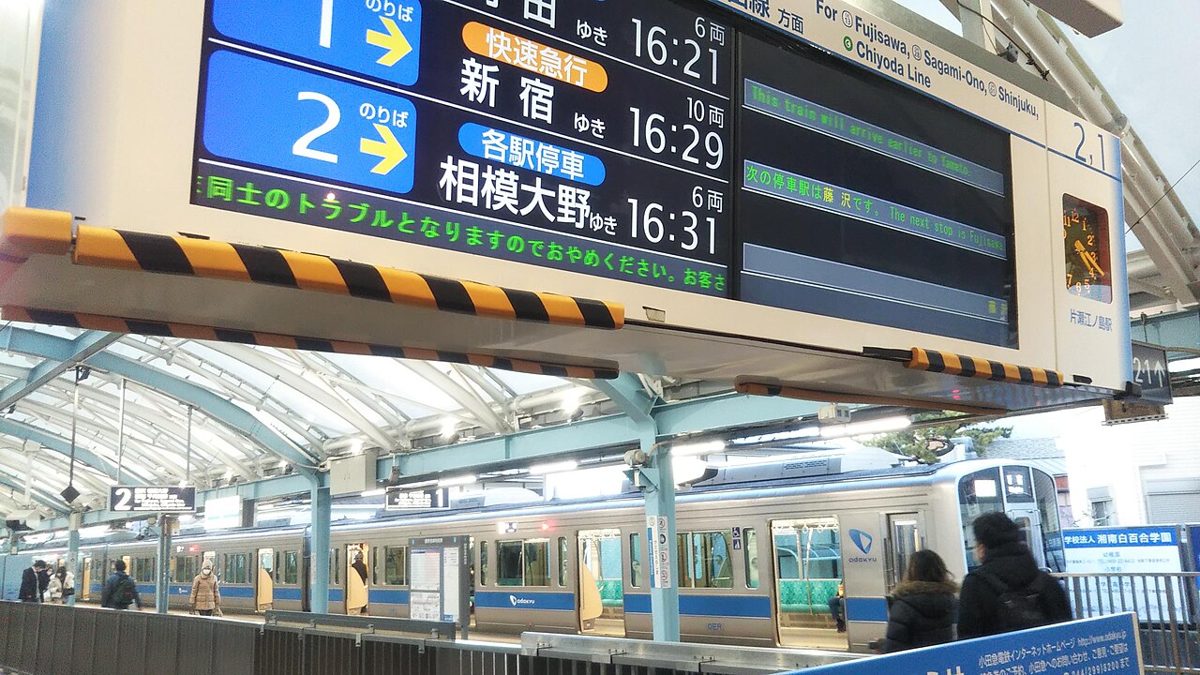
By Odakyu line from Shinjuku (the easy way)
From Shinjuku, take an Odakyu express or rapid express toward Fujisawa, then change to a local train for Katase-Enoshima, the terminus. The whole trip runs about 65–75 minutes and costs roughly ¥650 one way, with departures every 10–15 minutes. Katase-Enoshima Station is a sight in itself: it was rebuilt to look like Ryugu-jo, the mythical undersea dragon palace, all vermilion beams and a golden dragon over the entrance. It is a two-minute walk from the station to the bridge.
If you want to arrive in comfort, the Odakyu Romancecar limited express runs directly from Shinjuku to Katase-Enoshima in about 60 minutes for around ¥1,400 (a little less with an e-ticket). These run roughly every one to two hours, mostly on weekends and holidays, with reserved panoramic seats. It is a treat, not a necessity.
By JR, or arriving from Kamakura on the Enoden
With a JR Pass or from Tokyo Station, take the JR Tokaido line (or the Shonan-Shinjuku line from Shinjuku) to Fujisawa in about 45–50 minutes for ¥1,040, then transfer to the Enoden (10 minutes, ¥220) or the Odakyu local (7 minutes, ¥170). Alternatively, ride to Ofuna and take the Shonan Monorail, which swings along an elevated track for an unusual 15-minute ride.
The most scenic approach is the Enoden from Kamakura. This single-car retro tram rattles for 25 minutes (¥260) along the coast, threading between houses and past Kamakura High School, the famous level crossing that anime fans will recognise, before reaching Enoshima Station. If you are doing both towns in a day, the Enoden is the thread that links them, which is the main argument for the pass below. Plan your wider rail strategy with our guide to how Tokyo’s trains fit together.
The Enoshima-Kamakura Freepass: Is It Worth It?
Odakyu sells the Enoshima-Kamakura Freepass, a one-day ticket that bundles a round trip between your Odakyu departure station and Fujisawa with unlimited rides on the Enoden along its whole length (Fujisawa–Kamakura) and on the Odakyu segment between Fujisawa and Katase-Enoshima. From Shinjuku it costs ¥1,640 for adults and ¥430 for children in 2026; bought at Fujisawa it is ¥810. You can buy it from Odakyu ticket machines, the Sightseeing Service Center, or as a digital pass on your phone through EMot.
Here is the honest maths. A plain round trip Shinjuku–Katase-Enoshima is about ¥1,300, so for Enoshima alone the pass barely breaks even. It pays off the moment you add Kamakura, because the Enoden between Enoshima and Kamakura is ¥260 each way and you will likely hop on and off several times (Hase for the Great Buddha, Kamakura for the main shrine). Buy the pass if you are visiting both Enoshima and Kamakura; skip it if you are only seeing the island. Note the pass is transport only: it does not include the Escar escalators, the Sea Candle, the garden or the Iwaya Caves, though it does unlock small discounts at some attractions.
Crossing the Bridge and Climbing the Island
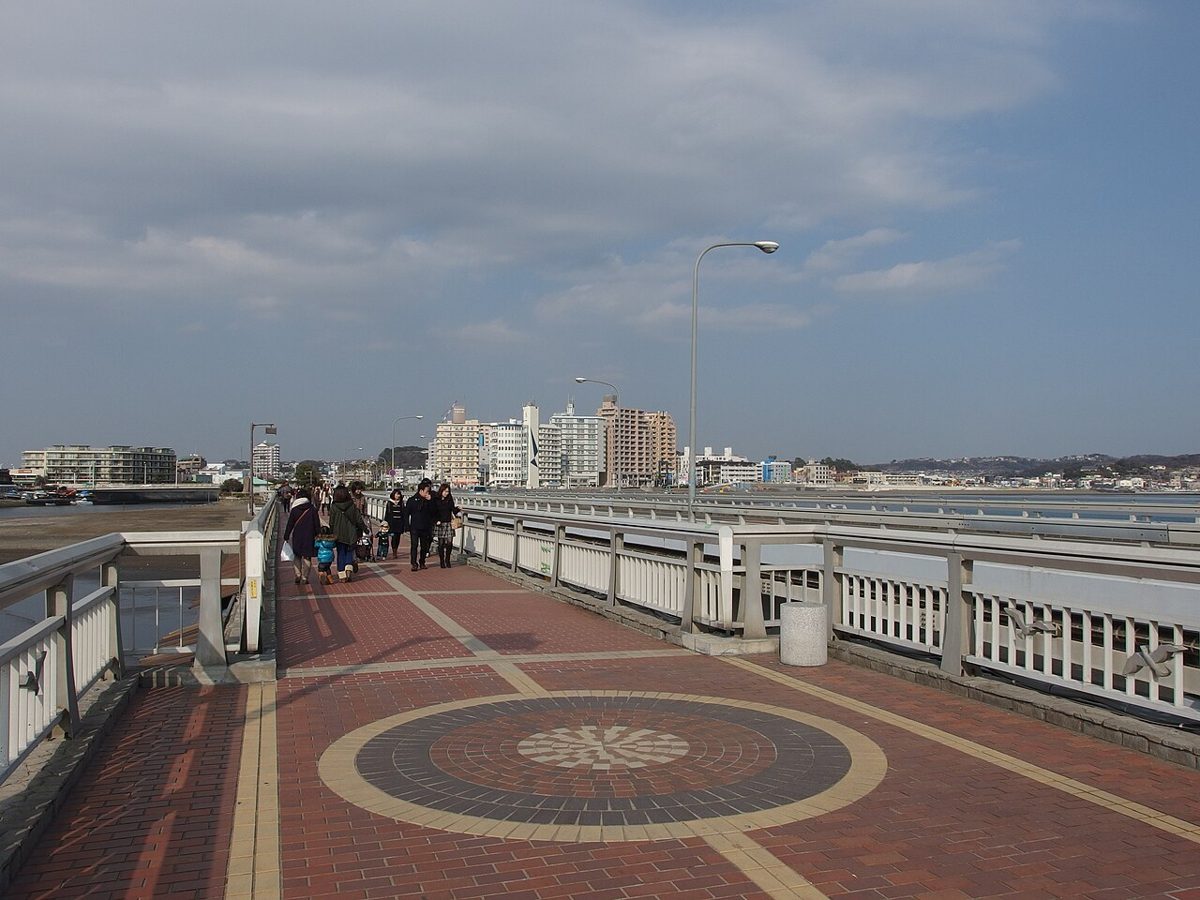
From either station you walk to the Benten-bashi / Enoshima-ohashi bridge and cross on foot — about 10 minutes with the sea on both sides and the green hump of the island ahead. At the far end you pass under a bronze torii gate and onto Benzaiten Nakamise-dori, a short, lively shopping street that climbs toward the first shrine. This is where the smell hits you: grilled squid, the snap of octopus crackers on hot presses, soft-serve in every flavour. Pace yourself; you will want room for a proper seafood bowl later.
The Enoshima Escar (paid escalators)
Enoshima is a hill, and the climb to the top is a real staircase workout. To skip it, most visitors buy a ticket for the Enoshima Escar, a chain of three outdoor escalators that lift you most of the way up. As of late 2025 the Escar costs ¥500 for adults and ¥250 for children (one direction only — escalators go up, so you walk down). It saves roughly 20 minutes of climbing and a lot of sweat in summer. If you are reasonably fit and not in a hurry, the stairs are perfectly doable and free.
The smartest move for most people is the Enoshima 1-Day Passport (the “Enopass”), which bundles the Escar, the Samuel Cocking Garden, the Sea Candle and the Iwaya Caves into a single ticket for about ¥1,100 (around ¥1,500 if you stay in the garden after 5pm for the evening illumination). Bought separately those add up to more, so if you plan to see the tower and the caves, the Enopass is the clear value pick. Buy it at the escalator ticket office or the tourist information desk near the bridge.
Enoshima Shrine: Three Halls, One Goddess
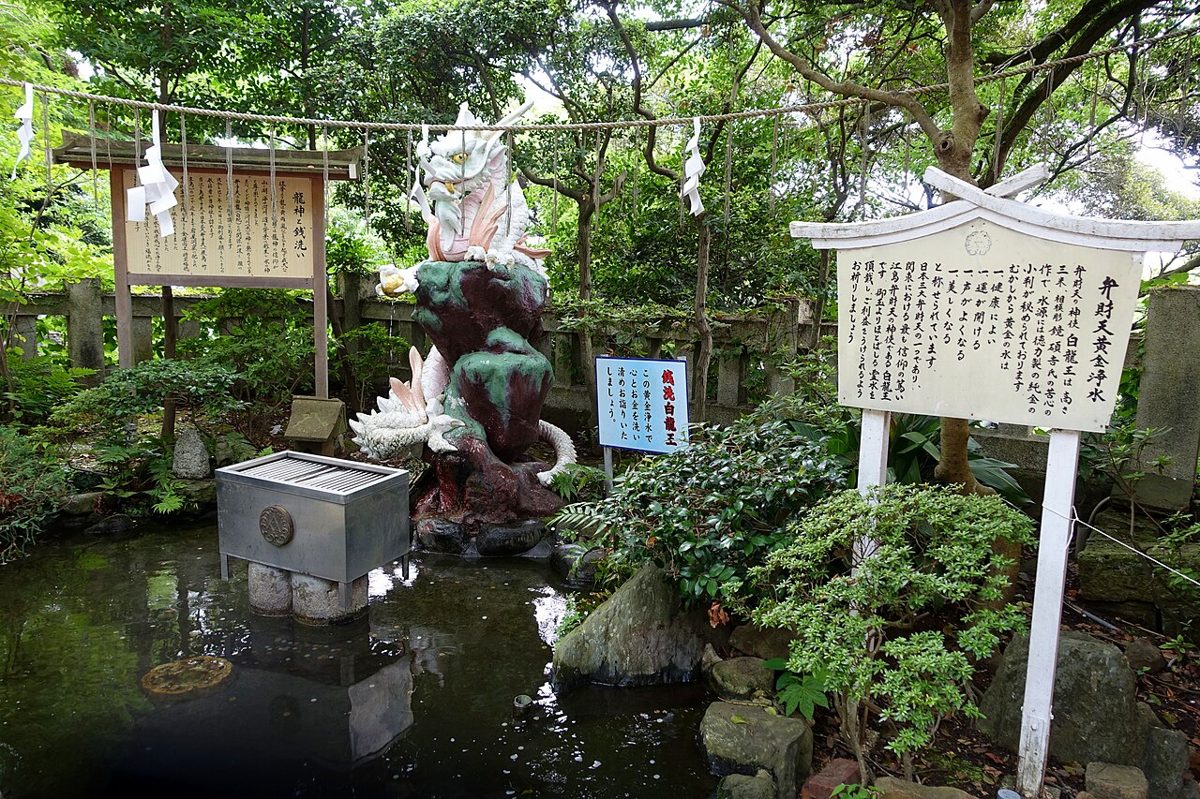
“Enoshima Shrine” is really three shrine sites spread across the island, all dedicated to Benten (Benzaiten). Entry to the grounds is free, open roughly 8:30–16:30, with a small ¥200 fee if you want to view the famous Benten statue indoors. Visiting all three in order is the natural spine of an Enoshima walk.
Hetsunomiya is the first and busiest hall, just up from the shopping street. Beside it sits the Hoanden, an octagonal hall housing one of Japan’s three most venerated images of Benten — including a striking naked Benten playing a biwa lute. Near here is the Zeniarai pond where visitors wash coins in the spring water, a ritual said to multiply your money since Benten governs wealth.
Nakatsunomiya, the middle shrine, sits higher up in a clearing of vermilion and lanterns. From here the path continues past the Samuel Cocking Garden toward the far side of the island. Okutsunomiya, the innermost shrine, is the quietest and closest to the sea caves; it once marked the spot where pilgrims prepared to descend to the Iwaya Caves. Walking Hetsunomiya to Nakatsunomiya to Okutsunomiya takes you from the crowded entrance to the wild, wave-battered tip — a satisfying arc. For more on shrine and temple etiquette across the region, see our guide to Tokyo temples and shrines.
Samuel Cocking Garden and the Sea Candle
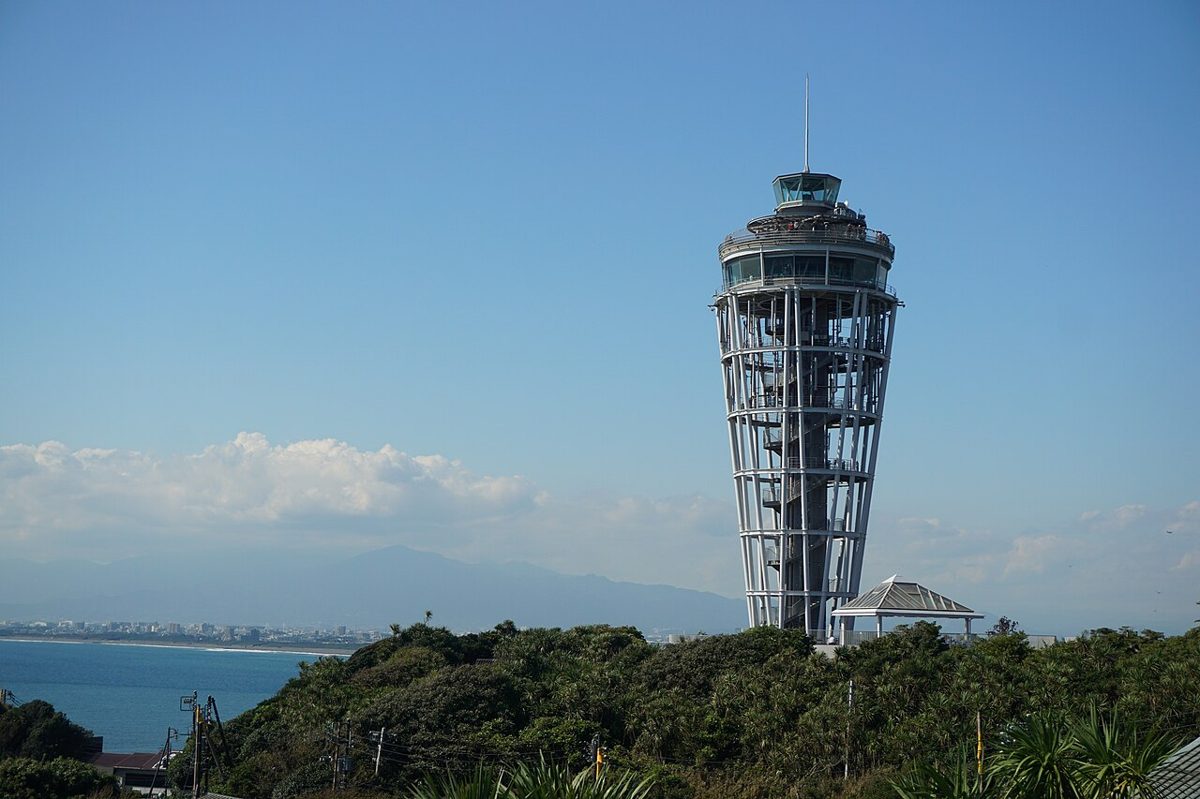
Near the top of the island lies the Samuel Cocking Garden, a botanical garden built on the former estate of a British merchant who bought much of Enoshima in the 1880s. By day the garden is free to enter (a ¥500 adult fee applies if you stay past 5pm for the seasonal illuminations). It is leafy, gently landscaped, and a calm contrast to the shrine crowds.
Rising from the middle of the garden is the Enoshima Sea Candle, a 60-metre observation tower that doubles as a lighthouse and is the island’s defining silhouette. Admission is about ¥800 for adults and ¥400 for children, or it is folded into the Enopass. From the open-air deck near the top you get a 360-degree sweep: the Miura Peninsula, the Izu mountains, the curve of the Shonan beaches and — on clear days, especially in winter — Mount Fuji. Come in the late afternoon if you can. The combination of sunset light, the lit tower and the winter “Shonan no Hoseki” illumination is the single best hour on Enoshima.
A short side trail from the garden leads to the Love Bell (Ryuren no Kane) on a clifftop overlook. Couples ring it together and clip a padlock to the surrounding fence, echoing the legend of Benten and the reformed dragon. Even solo, the viewpoint is worth the five-minute detour.
The Iwaya Caves
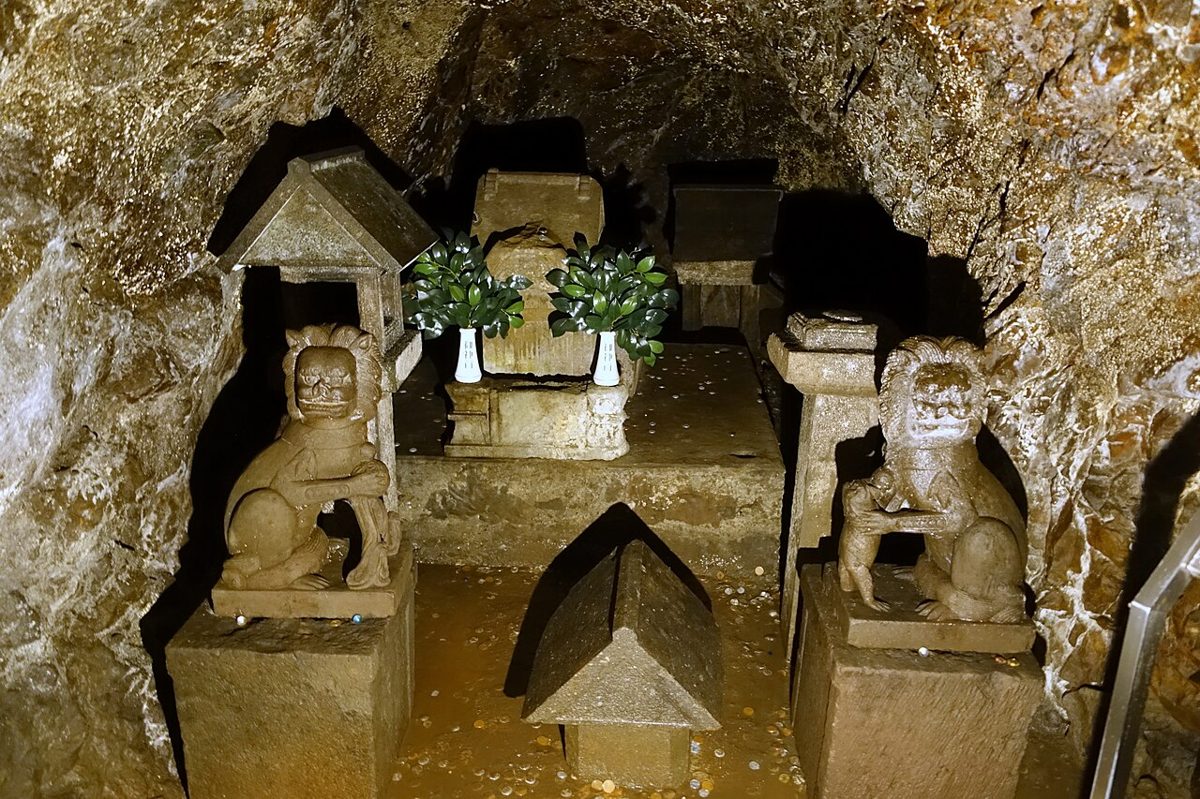
At the far southern tip, where the path drops to a shelf of flat sea-carved rock, you reach the Iwaya Caves — two sea caves bored into the cliff by centuries of waves. Admission is ¥500 for adults, with hours typically around 9:00–17:00 (they close in very rough weather, since the approach hugs the shore). Staff hand you a candle on a stick at the entrance to the first, dimmer cave, which adds to the atmosphere as you walk past rows of weathered Buddhist and Shinto stone statues.
The first cave is the longer one and is said to connect, in legend, all the way to a cave at the base of Mount Fuji. The second, shorter cave is dedicated to the five-headed dragon of the founding myth and ends with a small dramatic flourish. Outside, the wave-cut platform is a fine place to sit and watch anglers and the surf. To return, you climb back up — or, on weekends and holidays, you can sometimes take a small Bentenmaru boat from the caves back toward the bridge, saving the uphill walk.
What to Eat: Shirasu, Tako-senbei and More
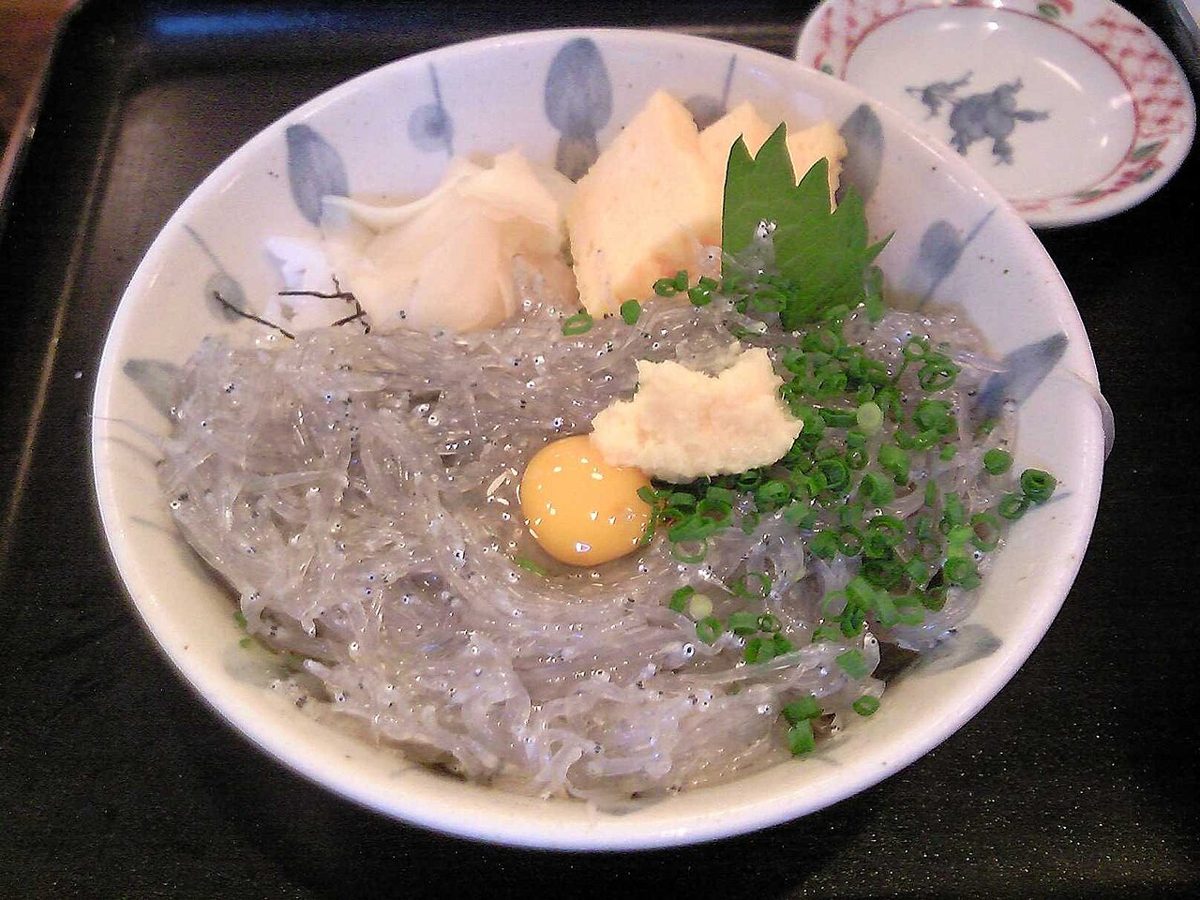
Enoshima’s signature dish is shirasu — tiny, near-transparent whitebait netted in Sagami Bay. The classic order is shirasu-don, a bowl of rice heaped with whitebait, often topped with nori, ginger and a raw egg yolk. You will see two versions: nama-shirasu (raw, silvery and only available when boats have landed a fresh catch, generally not during the January–March fishing ban) and kamaage-shirasu (briefly boiled, soft and white, available year-round). Many shops serve a half-and-half bowl so you can taste both, sometimes with salmon roe added. Expect to pay roughly ¥1,000–1,800.
The other essential is tako-senbei — a whole small octopus pressed flat between two scorching iron plates into a giant, crackly cracker the size of a face. There is usually a queue at the press near the start of the shopping street; it is theatre as much as snack, and worth the wait. Round things out with grilled sazae (turban shell), a soft-serve, or a beer with a sea view. If you want a sit-down meal, the restaurants on the bridge approach and around the harbour do generous seafood set meals; some upper-floor places frame Mount Fuji through the window. For how Enoshima’s whitebait fits into the bigger regional picture, from Tsukiji to the city’s best sushi counters, see our overview of the city’s food scene.
Pairing Enoshima with Kamakura in One Day
Enoshima alone is a relaxed half day. The classic full day combines it with Kamakura, linked by the Enoden, and the Freepass is built exactly for this. The trick is choosing a direction based on the light: do Kamakura first in the cooler morning, then end on Enoshima for the sunset and Fuji.
A proven plan: from Shinjuku, ride Odakyu to Fujisawa and switch to the Enoden toward Kamakura. Get off at Hase for the Great Buddha (Kotoku-in) and Hasedera temple, then continue to Kamakura for Tsurugaoka Hachimangu and the snacks of Komachi-dori. After lunch, ride the Enoden all the way back west to Enoshima Station, cross the bridge, and spend the late afternoon climbing the island, finishing at the Sea Candle for sunset before heading home via Katase-Enoshima or Fujisawa. It is a full but very doable day. Our Kamakura guide has the temple details to slot in.
Enoshima Day Trip Cost Breakdown (2026)
Here is what a typical Enoshima day costs per adult. Prices are 2026 figures and rounded; children are usually about half.
| Item | Cost (adult) | Notes |
|---|---|---|
| Enoshima-Kamakura Freepass (from Shinjuku) | ¥1,640 | Best value if you add Kamakura; transport only |
| Round trip Shinjuku–Katase-Enoshima (no pass) | ~¥1,300 | For Enoshima only |
| Romancecar surcharge (optional, one way) | +¥750 | Reserved panoramic seat from Shinjuku |
| Enoshima 1-Day Passport “Enopass” | ¥1,100 | Escar + Garden + Sea Candle + Iwaya Caves |
| Enoshima Escar (escalators) alone | ¥500 | One direction (up only) |
| Sea Candle tower alone | ¥800 | Free if using the Enopass |
| Iwaya Caves alone | ¥500 | Free if using the Enopass |
| Shirasu-don lunch | ¥1,000–1,800 | Half raw / half boiled is popular |
| Snacks (tako-senbei, soft serve) | ¥500–1,000 | Grazing along the shopping street |
| Typical day total | ¥4,500–6,000 | With pass, Enopass, lunch and snacks |
Best Time to Visit Enoshima
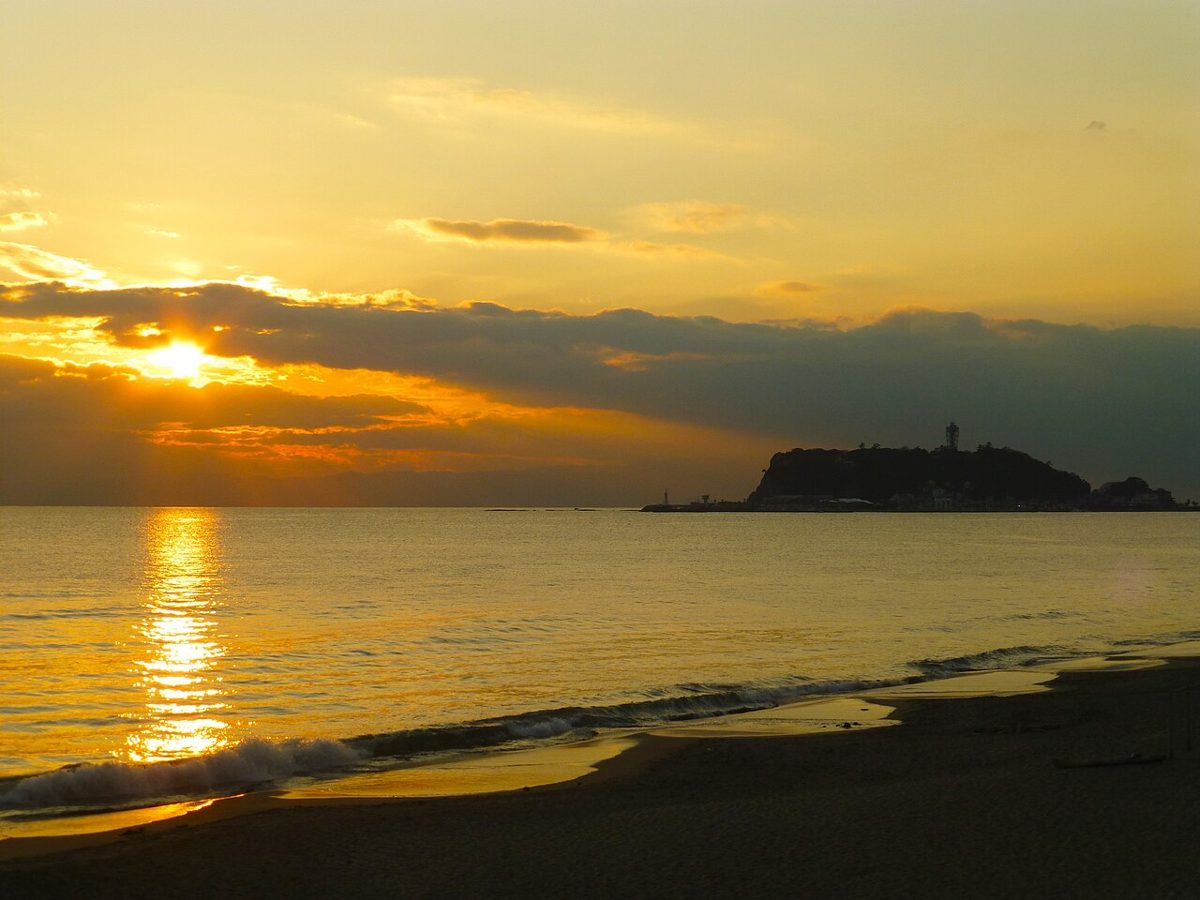
For Mount Fuji, come in the colder months. From roughly November to February the air is clearest and Fuji appears most reliably across the bay at dusk; this also overlaps the winter Sea Candle illumination, the prettiest evening on the island. For the beach, July and August fill the Katase shores beside the bridge with swimmers and beach houses — fun, but hot and crowded, and the raw-whitebait season is paused. For an easy walk, spring and autumn give mild weather and lighter crowds.
Whatever the season, weekdays are far calmer than weekends and holidays, when the bridge and the shopping street can clog by late morning. Arrive by mid-morning, or skew late and stay for sunset, to dodge the thickest crowds.
Mistakes to Avoid
- Buying the Freepass just for Enoshima. It only really pays off when you add Kamakura. For the island alone, a normal round trip is about the same or cheaper.
- Paying for each attraction separately. If you want the Sea Candle and the Iwaya Caves, the ¥1,100 Enopass beats buying tickets one by one and includes the escalators.
- Expecting an escalator down. The Escar only runs uphill. You walk down the stairs regardless, so wear shoes you can descend a hill in.
- Coming for raw whitebait in winter. Nama-shirasu disappears during the January–March fishing ban. Boiled kamaage-shirasu is available year-round, so ask which you are getting.
- Timing Fuji badly. Summer haze usually hides the mountain. If Fuji is your goal, come on a clear winter afternoon and stay for sunset.
- Rushing past Okutsunomiya and the caves. Most day-trippers stop at the Sea Candle and turn back. The best, wildest part of the island is the path down to the Iwaya Caves at the far tip.
- Carrying big bags. The island is all stairs and slopes. Use a coin locker at the station and travel light.
Beyond the Island: Aquarium, Beaches and the Monorail
Two things sit on the mainland side of the bridge and are easy add-ons. The Enoshima Aquarium (Enosui) faces the beach a few minutes from Katase-Enoshima Station and is excellent for families: a two-storey tank of Sagami Bay life, a famous jellyfish hall, plus dolphin and seal shows. Adult admission is around 2,800 yen. The Katase beaches on either side of the river mouth are some of the closest sandy beaches to Tokyo and turn into a wall of beach houses and music every July and August; the rest of the year they are quiet, good for a stroll and a clear line of sight to Fuji.
Rail fans and anyone who likes a view should ride the Shonan Monorail at least one way. It is a suspended monorail where the cars hang from the rail rather than sitting on it, and the 15-minute run between Ofuna and Shonan-Enoshima swoops over rooftops and through a hillside in a way that feels half theme-park, half commute. Stand at the very front for the best look down the line.
Practical Tips: Weather, Stairs and Timing the Light
Enoshima is essentially a small mountain ringed by sea, so the day is dictated by stairs and weather. The Escar escalators only help on the way up; the descent and the path out to the Iwaya Caves involve a lot of steps, and the caves close in storms. Travellers with limited mobility can still enjoy the shopping street, Hetsunomiya and the views from the lower island, but the full circuit to the caves is demanding.
Bring layers in winter, because the clifftop and the Sea Candle deck catch a cold sea wind even on sunny days, and bring sun protection in summer, when the open island offers little shade. Check the sunset time before you go and aim to be at the Sea Candle or a west-facing viewpoint 30 to 40 minutes beforehand; that golden window, with Fuji silhouetted and the tower beginning to glow, is what most people remember. For wider planning of timing, transport and etiquette, our guide to Tokyo’s transport network and day trips hub pair well with this one.
Frequently Asked Questions
How long does an Enoshima day trip from Tokyo take?
Allow about 70 minutes each way from Shinjuku on the Odakyu line. Enoshima itself needs three to four hours to walk the shrines, garden, Sea Candle and Iwaya Caves at a relaxed pace, so a half day covers the island. If you pair it with Kamakura, plan a full day from morning until after sunset.
Is the Enoshima-Kamakura Freepass worth it?
Yes if you are visiting both Enoshima and Kamakura in one day, because it covers the round trip from Tokyo plus unlimited Enoden and Odakyu rides between the two for ¥1,640 from Shinjuku. For Enoshima on its own it barely breaks even, so a plain round-trip ticket is fine.
How much does it cost to go up the Enoshima Sea Candle?
The Sea Candle observation tower costs about ¥800 for adults and ¥400 for children in 2026. It is also included in the ¥1,100 Enoshima 1-Day Passport (Enopass), which bundles the escalators, Samuel Cocking Garden, Sea Candle and Iwaya Caves, so the Enopass is better value if you plan to see more than one attraction.
Can you see Mount Fuji from Enoshima?
Yes, on clear days Mount Fuji rises across Sagami Bay, with the best views from the Sea Candle deck and the western side of the island. Visibility is far better in the cold, dry months from November to February, especially at sunset, and is usually poor in the summer haze.
What food is Enoshima famous for?
Shirasu (whitebait) is the local specialty, served as shirasu-don over rice either raw (nama, when in season) or boiled (kamaage, year-round). The other must-try is tako-senbei, a whole octopus pressed flat into a giant crisp cracker. Grilled turban shell, soft-serve and seafood set meals round out the options.
Photo Credits
- The Enoshima Sea Candle, the island’s 60-metre lighthouse observation tower — Photo: Maksym Grinenko / CC BY-SA 4.0 via Wikimedia Commons
- One of the three Enoshima Shrine sites, dedicated to Benten, goddess of fortune — Photo: Daderot / CC0 via Wikimedia Commons
- The footbridge to Enoshima, with the island’s green hill ahead — Photo: Guilhem Vellut from Annecy, France / CC BY 2.0 via Wikimedia Commons
- The Iwaya Caves, carved by the sea into Enoshima’s southern cliffs — Photo: Daderot / CC0 via Wikimedia Commons
- Enoshima island, just off the Shonan coast and linked to the mainland by a bridge — Photo: Dandy1022 / CC BY-SA 4.0 via Wikimedia Commons
- Katase-Enoshima Station, built to resemble a mythical dragon palace — Photo: Kirin7739 / CC BY-SA 4.0 via Wikimedia Commons
- Shirasu-don, raw or boiled whitebait over rice, the signature Enoshima dish — Photo: 投稿者 / CC BY-SA 3.0 via Wikimedia Commons
- Sunset over Sagami Bay from Enoshima, when Mount Fuji is often visible — Photo: Nesnad / CC BY 3.0 via Wikimedia Commons