Tokyo Events & Festivals · Guide №115
Tokyo Summer Festivals (Matsuri): Best Events & How to Join
The best Tokyo summer festivals (matsuri): Mitama, Fukagawa Hachiman, Koenji Awa Odori, Bon Odori and more — when they happen, what to wear, and how to join in.

目次 — Contents
- What Is a Matsuri?
- The Best Tokyo Summer Matsuri
- Tokyo Summer Matsuri at a Glance
- How to Join In (and What to Just Watch)
- Festival Food: A Quick Yatai Guide
- What to Wear: Yukata and the Festival Look
- Festival Survival Tips
- Mikoshi, Happi and the Wasshoi Chant
- Tanabata, Samba and More Summer Events
- Finding a Neighbourhood Matsuri
- How to Spend a Festival Evening
- The Three Great Festivals of Edo
- Want to Go Bigger? Festivals Beyond Tokyo
- Photographing a Matsuri
- Frequently Asked Questions
- Photo Credits
This article contains advertising. Our booking links are routed through a partner that adds commission tracking automatically, so if you book through one we earn a commission from the provider, at no extra cost to you. It never affects what we recommend. Affiliate disclosure
Tokyo summer festivals — matsuri — turn ordinary neighbourhoods into a wall of taiko drums, paper lanterns and grilled-squid smoke from May through August. Crews shoulder heavy portable shrines through packed streets, thousands of dancers fill avenues, and anyone can step into a Bon Odori circle. Here are the best ones, when they happen and how to take part rather than only watch.
What Is a Matsuri?
A matsuri is a festival tied to a local shrine or temple — part religious rite, part neighbourhood block party. At its heart is the mikoshi, a portable shrine that teams of dozens carry on their shoulders through the streets, bouncing and rocking it to a chant of ‘wasshoi, wasshoi’ so the resident deity can tour and bless the district. Add taiko drumming, dance, lantern light and rows of food stalls, and you have the template that has run in Tokyo’s old downtown (shitamachi) neighbourhoods for centuries.
Summer is peak matsuri season because the festivals double as a way to get through the heat and, historically, to ward off the diseases that came with it. The atmosphere is loud, communal and completely unpretentious — children with goldfish in plastic bags, retirees in matching happi coats, office workers in yukata still holding their work bags. To understand the shrines these festivals belong to, our guide to Tokyo’s temples and shrines is good background, and the whole calendar lives on our seasonal events hub.
The Best Tokyo Summer Matsuri
These are the festivals worth planning a trip around. Exact dates shift year to year — most are fixed to a weekend or a set of mid-month days rather than a calendar date — so confirm the current year before you book, but the timing below is reliable.

Mitama Matsuri — 30,000 lanterns (mid-July, Yasukuni Shrine)
If you can catch one festival, make it Mitama Matsuri, held over four days around 13-16 July at Yasukuni Shrine near Kudanshita Station. Some 30,000 paper lanterns line the long approach — 10,000 large ones overhead and 20,000 smaller ones at the inner grounds — turning the whole avenue gold after dark. There’s a nightly programme of regional dance (Awa Odori, Nebuta floats), food stalls and a mikoshi procession. Go in the evening when the lanterns are lit; it’s free and one of the most beautiful sights of the Tokyo summer.
Fukagawa Hachiman Festival — the water-throwing matsuri (mid-August, Tomioka Hachiman)
Tomioka Hachiman Shrine in Fukagawa (Monzen-nakacho Station) hosts one of Edo’s three great festivals, and it’s the wettest. More than 50 mikoshi parade through the streets while spectators hurl buckets and hoses of water over the bearers to ‘purify’ them and, frankly, cool everyone down in the August heat. The full grand version, with all the shrines out together, runs only once every three years; smaller versions happen annually in mid-August. Wear clothes you don’t mind soaking — standing near the front means you will get drenched, and that’s the whole point.

Bon Odori — the dance you can join (all August, citywide)
Bon Odori are the summer dance festivals held during Obon, the mid-August period when ancestors’ spirits are said to return. A wooden tower (yagura) goes up in a temple yard, park or plaza; drummers and singers perform on top; and everyone circles it doing simple, repetitive steps. Crucially, these are open to all — watch for a minute, copy the person in front, and you’re dancing. They run at temples and shrines across the city through August. Standouts include the lively Shibuya Bon Odori in front of Shibuya 109, the elegant one at Tsukiji Hongwanji temple, the international crowd at Roppongi Hills, and countless neighbourhood versions you’ll stumble on by accident. This is the single easiest way for a visitor to actually take part in a matsuri.
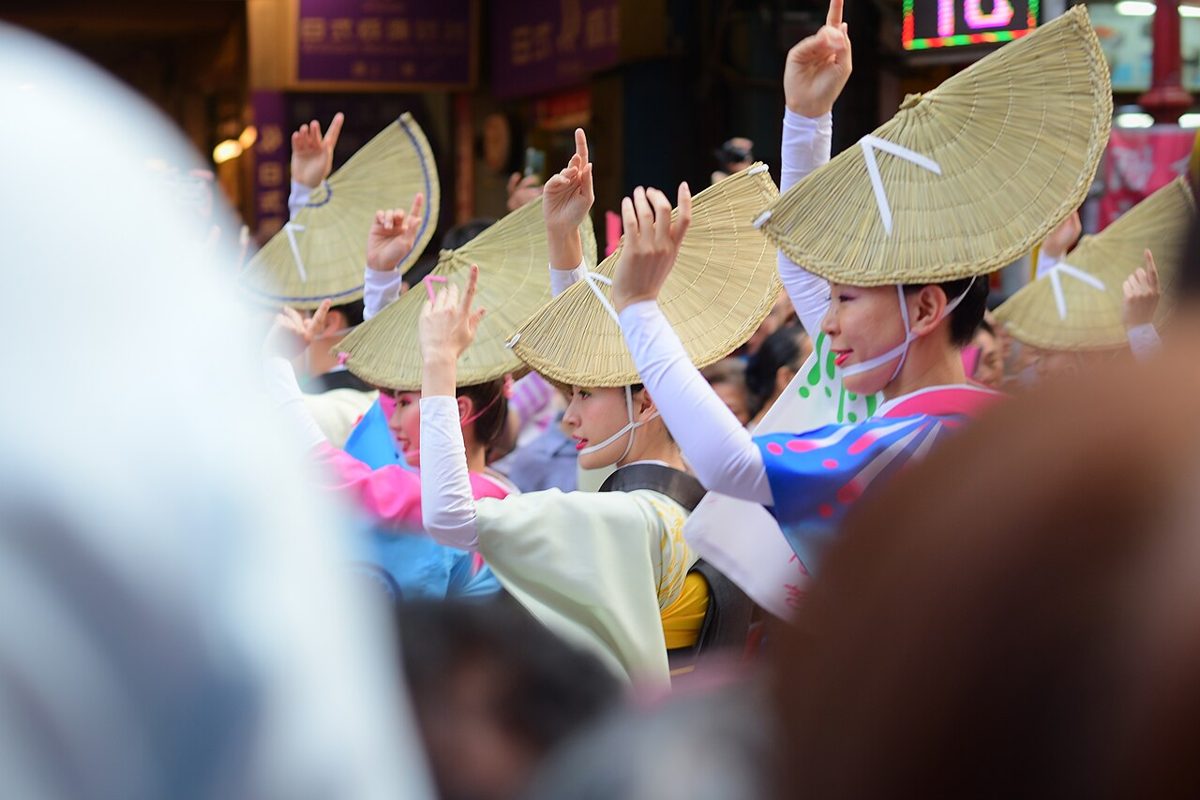
Koenji Awa Odori — 10,000 dancers (late August, Koenji)
On the last weekend of August, the laid-back neighbourhood of Koenji (JR Chuo line, two stops west of Shinjuku) hosts the biggest Awa Odori dance festival outside its home of Tokushima. Around 10,000 dancers in teams (ren) move through the streets over two evenings to the insistent shamisen-and-drum rhythm, chanting that ‘the dancers are fools and the watchers are fools, so you may as well dance.’ Hundreds of thousands come to watch. The streets are tight and the energy is infectious; it’s free, and a great pairing with Koenji’s vintage shops and cheap bars afterward.
Sanja Matsuri and the season’s openers (mid-May, Asakusa)
Technically late spring, but no Tokyo matsuri roundup is complete without Sanja Matsuri, which kicks off the season over the third weekend of May at Asakusa Shrine, beside Senso-ji. Around a hundred mikoshi and close to two million people flood the old streets of Asakusa over three days — it’s the loudest, most crowded and most tattooed festival of the year (you’ll spot members of traditional associations in full irezumi). Two other giants share the May-June window: Kanda Matsuri at Kanda Myojin (odd-numbered years) and Sanno Matsuri at Hie Shrine (even-numbered years), the grand processions that, with Fukagawa, make up the ‘three great festivals of Edo.’ For the temple at the centre of Sanja, see our guide to the oldest temple in the city.
Tokyo Summer Matsuri at a Glance
| Festival | Usual timing | Where / station | What makes it special |
|---|---|---|---|
| Sanja Matsuri | Mid-May (3rd weekend) | Asakusa Shrine / Asakusa | 100+ mikoshi, ~2 million people |
| Sanno / Kanda Matsuri | May–June | Hie / Kanda Myojin | Edo’s grand processions (alt. years) |
| Mitama Matsuri | Mid-July (13–16) | Yasukuni / Kudanshita | 30,000 lanterns at night |
| Shibuya & temple Bon Odori | Through August | Citywide | Dance circles anyone can join |
| Fukagawa Hachiman | Mid-August | Tomioka Hachiman / Monzen-nakacho | Water-throwing mikoshi parade |
| Koenji Awa Odori | Late August (last weekend) | Koenji | 10,000 street dancers |
How to Join In (and What to Just Watch)
The line between taking part and spectating is simpler than it looks. The Bon Odori dancing is genuinely open — no registration, no costume, no skill. Just join the outer ring of the circle and copy the steps; locals are delighted when visitors try. You can also play the stall games, buy a fan, and eat your way down the food row as a full participant.
Carrying the mikoshi is the part you’ll usually watch rather than do. Each shrine is hoisted by registered neighbourhood teams who’ve trained together, and spots are tightly organised — it’s heavy, coordinated and tied to local membership. Some community groups and tour operators do arrange ways for foreigners to carry a mikoshi at certain festivals, so if that’s a dream, look for an organised programme well in advance. Otherwise, get near the front of the route, feel the ground shake as the shrine passes, and add your own ‘wasshoi’ to the chant — that counts too.
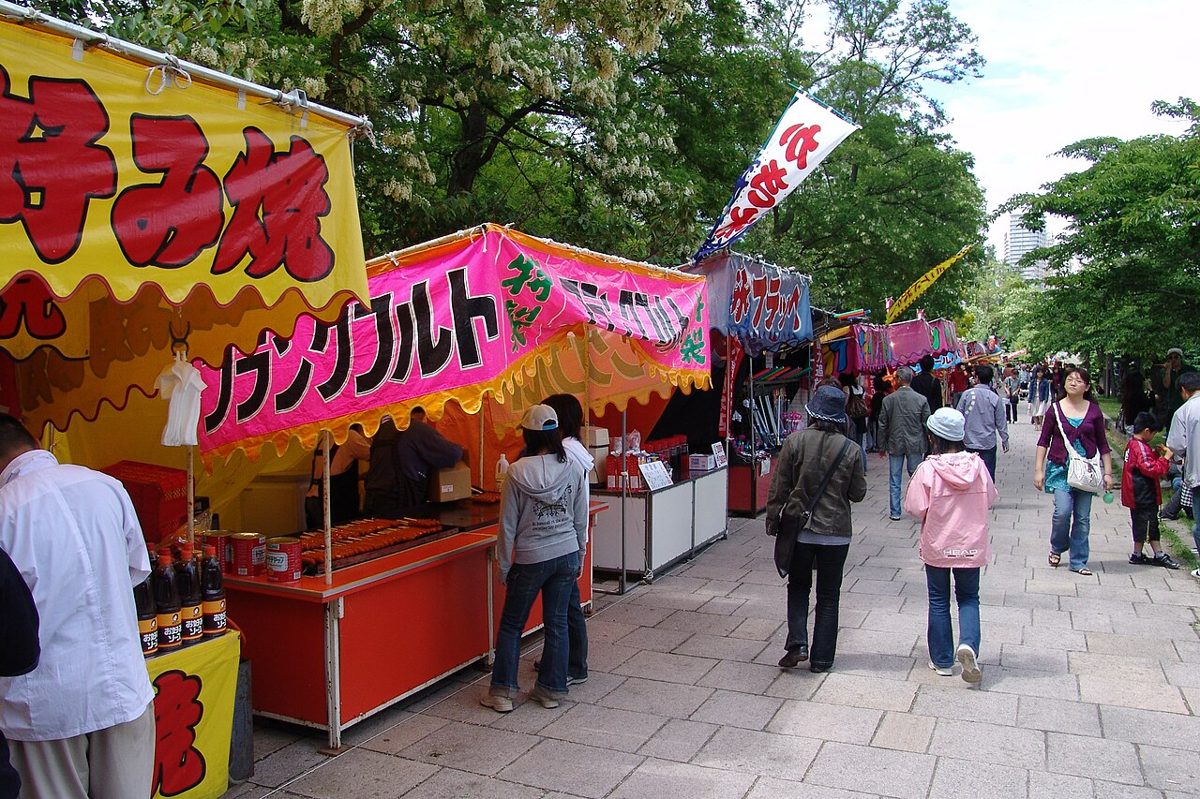
Festival Food: A Quick Yatai Guide
Half the reason to go is the food. Yatai (stalls) line every matsuri, run on cash only, and price most things between ¥400 and ¥800. The classics worth seeking out:
- Takoyaki — molten balls of batter with a chunk of octopus, brushed with sauce and bonito flakes. Let them cool; the inside is lava.
- Yakisoba — griddled noodles with cabbage and sauce, the smell that defines a festival.
- Kakigori — fluffy shaved ice in lurid syrups (strawberry, blue Hawaii, matcha with condensed milk). The summer essential.
- Yaki-tomorokoshi — whole grilled corn glazed with soy. Ikayaki — grilled squid on a stick.
- Choco-banana and ringo-ame (candy apples) — bright, sticky and aimed at kids but eaten by everyone.
- Karaage, frankfurters, and kara-age for something hot and savoury between the sweets.
Don’t miss the games either: goldfish scooping (kingyo-sukui) with a flimsy paper net, ring toss, and lucky-draw stalls. They’re cheap, hopeless and part of the ritual. Hungry for more? Our guide to snacking your way around Tokyo covers the city’s stall and market food year-round.

What to Wear: Yukata and the Festival Look
You don’t need a costume, but a yukata makes the night. These lightweight cotton summer kimono are what locals slip into for a matsuri — cool in the heat, tied with an obi sash and worn with geta wooden sandals. Men’s versions are simpler and quicker to put on. If you want to wear one, rental shops near Asakusa and other festival districts will dress you, do your hair and lend you the sandals for roughly ¥3,000-6,000, often with same-day return. Our Tokyo kimono and yukata rental guide walks through the best shops and how booking works.
If you’d rather stay casual, that’s completely fine — most of the crowd is in shorts and t-shirts. Whatever you wear, choose breathable fabric and shoes you can stand in for hours, and bring a folding fan (uchiwa); they’re often handed out free at the stalls.
Festival Survival Tips
Beat the heat
Tokyo summers are brutally humid — 30-35°C with sticky nights. Hydrate constantly (vending machines are everywhere, around ¥130-160 a bottle), carry a small towel like the locals do, and use the ¥100 stick-on cooling sheets or a battery hand-fan. Evenings are far more bearable than midday, which is why most matsuri come alive after 17:00.
Arrive early and carry cash
Popular festivals fill up fast, and for processions or fireworks, two hours early is normal to get a good spot. Stalls and games are cash-only, so bring a stack of ¥100 and ¥1,000 notes — there won’t be an ATM in the crowd, and the konbini ones nearby empty out.
Mind the etiquette
Don’t block the mikoshi route or push into a team’s path, don’t touch the portable shrine, and keep to the edges when you stop to photograph. Bag your rubbish and carry it out — public bins are scarce and festivals stay famously clean. A quick read of our guide to local manners covers the basics that keep you on the right side of the crowd.
Pair it with the fireworks
Summer matsuri and fireworks (hanabi) are two halves of the same season, and they often overlap on the calendar. Many of the same skills — arriving early, claiming a spot, wearing a yukata, eating from the stalls — carry straight over. See our Tokyo fireworks festivals guide for the best hanabi taikai and where to watch them.
Mikoshi, Happi and the Wasshoi Chant
Once you’ve seen a few matsuri, the details start to make sense. The mikoshi is a miniature shrine — gilded, roofed and topped with a golden phoenix — that houses the local deity for the day so it can be paraded through the neighbourhood it protects. The bearers deliberately rock and bounce it, sometimes violently; the belief is that the more it’s shaken, the more the deity’s energy spreads over the district and the better the year ahead. A big mikoshi can weigh over a tonne and need 40 or more people rotating underneath it.
The crews wear happi — short, straight-sleeved coats dyed with the shrine or association’s crest — over close-fitting dako trousers, with a twisted towel headband. The ‘wasshoi, wasshoi’ chant that drives the rhythm is part work-song, part prayer; some neighbourhoods use ‘soiya’ or ‘seiya’ instead. You’ll also hear the constant shime-daiko drum and a whistle keeping the team in step. None of it is performance for tourists — it’s a working ritual that happens to be spectacular, which is exactly why it’s worth watching closely rather than just snapping a photo and moving on.
Tanabata, Samba and More Summer Events
Beyond the shrine festivals, Tokyo’s summer is stuffed with events that don’t involve a mikoshi at all.
Tanabata — the star festival (early-to-mid August)
Tanabata celebrates the once-a-year meeting of two star-crossed lovers from legend, and people write wishes on coloured paper strips (tanzaku) and hang them on bamboo. The biggest Tokyo version is the Asagaya Tanabata Festival on the JR Chuo line, where the covered shopping street is filled with enormous handmade papier-mâché decorations — anime characters, animals, current memes — dangling overhead for about a week in early August. The Shitamachi Tanabata in the Kappabashi area near Asakusa is a more traditional, low-key alternative.
Asakusa Samba Carnival and Harajuku Yosakoi (late August)
Tokyo’s summer also borrows from further afield. The Asakusa Samba Carnival, usually the last Saturday of August, sends elaborately costumed samba teams dancing down Umamichi-dori in a genuine Rio-style parade — one of the largest outside Brazil. The same weekend, the Harajuku Omotesando Genki Matsuri Super Yosakoi fills Omotesando with high-energy yosakoi dance teams waving wooden clappers. Both are free, loud and a complete contrast to the lantern-lit shrine festivals.
Beer gardens and summer nights
Less a festival than a season-long institution, rooftop beer gardens open across the department stores and hotels from June to early September — all-you-can-drink-and-eat for a couple of hours, usually ¥4,000-6,000, with a view over the city lights. After a sweaty evening at a matsuri, it’s where a lot of the crowd ends up. For more after-dark options, see our guide to Tokyo bars and late-night spots.
Finding a Neighbourhood Matsuri
Here’s a tip the big lists miss: you don’t have to chase the famous festivals. Almost every shrine in Tokyo holds its own reitaisai (annual festival) over a summer weekend, and the small ones — a single mikoshi, a couple of food stalls, a Bon Odori in the local park — are often the most charming and the least crowded. You’ll hear the drums before you see anything.
To find them, watch for red-and-white striped tents and strings of lanterns going up around a local shrine, check the noticeboards outside shrines (often in Japanese, but the dates are in numerals), and ask at your hotel — staff usually know what’s on nearby. Neighbourhoods like Nezu, Yanaka, Shibamata and the backstreets of Asakusa and Fukagawa are reliable for the old-Tokyo feel. Stumbling into a tiny local matsuri by accident, with kids scooping goldfish and grandmothers dancing, tends to be the memory people keep. It’s also a great, low-stress outing with children — see our guide to Tokyo with little ones for more family-friendly ideas.
How to Spend a Festival Evening
Put it together and a matsuri evening runs something like this. Arrive around 17:00-18:00 as the heat eases and the lanterns flick on. Do a slow first lap of the stalls to see what’s cooking, then start eating — yakisoba or takoyaki first, kakigori to cool down, something on a stick to finish. Stake out a spot along the route before the mikoshi comes through, and when it does, give it your full attention: the noise, the strain on the bearers’ faces, the surge of the crowd.
Later, find the Bon Odori circle and take a few turns around the yagura — badly is fine, everyone’s bad. Cool off with a cold drink, play a stall game you’ll definitely lose, and let the night wind down with the drums still going. If you’ve worn a yukata, you’ll be in every local’s holiday photos by accident. Then walk it off toward a beer garden or a late ramen shop. For a fuller plan of where this fits in a trip, drop it into our events and festivals hub and build the rest of the day around it.
The Three Great Festivals of Edo
Three festivals stand above the rest by history, and they’re worth knowing as a set. The Kanda Matsuri at Kanda Myojin and the Sanno Matsuri at Hie Shrine were so important in the Edo period that their processions were allowed inside the shogun’s castle — the only festivals granted that honour. To avoid them overwhelming the city in the same year, the two grand versions alternate: Kanda in odd-numbered years (mid-May), Sanno in even-numbered years (mid-June). Each sends a procession of priests, court costumes, ornate floats and mikoshi winding for hours through central Tokyo, a moving picture of the old capital.
The third is the Fukagawa Hachiman Festival covered above, whose full water-soaked version completes the trio. If your trip lands in a year when one of the grand processions is running, reorganise your plans around it — these only come around every two years each, and the scale and pageantry are on another level from the neighbourhood festivals. Check which year you’re visiting against the alternating schedule before you assume it’s on.
Want to Go Bigger? Festivals Beyond Tokyo
Tokyo’s matsuri are excellent, but Japan’s most jaw-dropping summer festivals are elsewhere, and several are reachable as an overnight or a bullet-train trip if your timing lines up. Aomori’s Nebuta Matsuri (early August) parades gigantic illuminated warrior floats; Sendai’s Tanabata (early August) drapes the whole downtown in paper streamers; and the original Awa Odori in Tokushima (mid-August) is the vast ancestor of the Koenji version. Kyoto’s month-long Gion Matsuri in July is the most famous of all.
None of these are day trips from Tokyo, but if you’re already travelling in August and want the biggest version of what you’ve sampled in the city, they’re worth routing toward. For inspiration on getting out of the capital, see our pick of trips beyond the city. Otherwise, the city’s own festivals more than hold their own — and you won’t have to leave to find drums, lanterns and a circle of dancers waving you in.
Photographing a Matsuri
Festivals are a photographer’s dream — lanterns, motion, colour and faces full of effort — but a little care goes a long way. Shoot the mikoshi from the edges of the route rather than stepping into its path, and never reach over a barrier or a team to get a frame. For the lantern-lit night shots at Mitama or a Bon Odori, brace your phone against a railing or pole; the light is low and movement blurs easily. Ask before pushing a lens into a stranger’s face, especially with children. And put the camera down for at least one mikoshi pass and one trip around the dance circle — the sound, heat and crush of a matsuri are the half you can’t photograph, and they’re the part you’ll actually remember.
Frequently Asked Questions
What are the best summer festivals in Tokyo?
For sheer spectacle, Mitama Matsuri at Yasukuni Shrine (mid-July) and its 30,000 lanterns are unforgettable, while Koenji Awa Odori (late August) packs 10,000 dancers into the streets. The Fukagawa Hachiman water-throwing festival (mid-August) is the wettest fun in the city. And Bon Odori dance circles pop up at temples everywhere through August — those are the easiest to join. Asakusa’s huge Sanja Matsuri in mid-May kicks off the matsuri season.
Can tourists join a matsuri in Tokyo?
Absolutely. Bon Odori dances are designed for everyone — watch the simple steps for a minute, then step into the circle; no skill or costume needed. Food, music and lantern-lit grounds are open to all. Carrying a mikoshi (portable shrine), though, is usually reserved for registered local teams, so you’ll watch that part rather than join unless you’re invited through a community group.
When is matsuri season in Tokyo?
The big traditional festivals run from mid-May to late August. Sanja Matsuri opens the season in May, the giant Kanda (odd years) and Sanno (even years) processions also fall in May and June, and the classic hot-weather festivals — Mitama, the Bon Odori dances, Fukagawa Hachiman and Koenji Awa Odori — fill July and August. Fireworks festivals run alongside them through late July and August.
What do you wear to a Japanese summer festival?
A yukata — a lightweight cotton summer kimono — is the traditional choice, paired with geta sandals, and you’ll see plenty of locals (and tourists) wearing them. It’s optional; shorts and a t-shirt are completely fine in the heat. If you’d like to wear one, rental shops near Asakusa and other festival areas will dress you for roughly ¥3,000-6,000.
Are Tokyo festivals free?
Yes — the festivals themselves are free to attend. You can watch the processions, join the dancing and soak up the atmosphere without paying anything. You only spend on what you choose: festival food from the stalls (most items ¥400-800, cash only), drinks, games, and a yukata if you rent one. Reserved fireworks seating is the main paid exception.
Photo Credits
- Teams shoulder a mikoshi through Asakusa at Sanja Matsuri, Tokyo’s rowdiest festival — Photo: Eckhard Pecher / CC BY 2.5 via Wikimedia Commons
- The 30,000 lanterns of Mitama Matsuri at Yasukuni Shrine each July — Photo: Eiko Z / CC BY 3.0 via Wikimedia Commons
- A Bon Odori dance circle around the yagura tower — anyone can join in — Photo: Mr.ちゅらさん / CC0 via Wikimedia Commons
- Koenji Awa Odori brings around 10,000 dancers to the streets each August — Photo: Taiwankengo / CC BY-SA 4.0 via Wikimedia Commons
- Yatai food stalls — takoyaki, yakisoba and shaved ice — line every matsuri — Photo: MIKI Yoshihito from Sapporo City,Hokkaido., JAPAN / CC BY 2.0 via Wikimedia Commons
- Lightweight yukata are the unofficial uniform of a Tokyo summer festival — Photo: Misaochan / CC BY-SA 3.0 via Wikimedia Commons