Best Things to Do in Tokyo · Guide №016
Senso-ji Temple Guide: Tokyo’s Oldest & Most Visited Temple
目次 — Contents
- The History of Senso-ji Temple
- What to See at Senso-ji: A Complete Walking Tour
- Temple Rituals and Traditions
- Visiting Senso-ji at Night
- Best Food Near Senso-ji
- Practical Visitor Information
- Insider Tips for Visiting Senso-ji
- What It Costs to Visit Senso-ji
- Accessibility at Senso-ji
- Photography Tips for Senso-ji
- More to Do Around Asakusa
- Frequently Asked Questions
This article contains advertising. Our booking links are routed through a partner that adds commission tracking automatically, so if you book through one we earn a commission from the provider, at no extra cost to you. It never affects what we recommend. Affiliate disclosure

Standing in the heart of Asakusa for over 1,400 years, Senso-ji (also written Sensoji) is Tokyo’s oldest temple and one of Japan’s most significant Buddhist sites. With over 30 million visitors annually, it’s the most visited religious site in the world — yet it manages to remain genuinely spiritual and culturally rich beneath the crowds.
Most people give Senso-ji about twenty minutes, snap the Kaminarimon lantern, and move on. That is a mistake. Spend a little longer and you get a working Buddhist temple, a 250-meter market street that has sold the same sweets for three centuries, a serene Shinto shrine that outlived the war, and one of Tokyo’s best neighborhoods for cheap, excellent food. This Senso-ji Temple guide walks you through what to see, how to behave at the prayer hall, when to come so you are not fighting the crowds, and what to eat afterward — with real hours, prices in yen, and the timing tricks that actually work.
It pairs naturally with the rest of a Tokyo trip. Asakusa is the classic opening morning on most plans, and it is the first stop in our 3-day Tokyo itinerary, so you can fit it into a wider route without backtracking. If you want the bigger picture of what else is worth your time in the city, start with our guide to Tokyo’s top attractions.
The History of Senso-ji Temple
Senso-ji’s origin story reads like a legend — because it is one. In the year 628 CE, two fishermen brothers, Hinokuma Hamanari and Hinokuma Takenari, pulled a small golden statue of Kannon (the Buddhist goddess of mercy) from the Sumida River in their fishing nets. Despite returning the statue to the water multiple times, it kept coming back to them. The village headman, Hajino Nakatomo, recognized the statue’s significance, converted his home into a small temple, and dedicated his life to Buddhist worship. That humble shrine became Senso-ji.
The temple’s importance grew dramatically in 1590 when Tokugawa Ieyasu, the first shogun of the Tokugawa dynasty, designated Senso-ji as the official prayer temple of the shogunate. This patronage funded major expansions and cemented Asakusa’s position as one of Edo’s (old Tokyo’s) most important cultural and commercial districts. The area around the temple became a thriving entertainment quarter with kabuki theaters, restaurants, and markets.
During World War II, the temple was largely destroyed in the March 1945 Tokyo air raids. The main hall was rebuilt in 1958 using reinforced concrete, and the five-story pagoda was reconstructed in 1973. While the buildings are modern reconstructions, the spiritual significance and cultural traditions spanning nearly 14 centuries remain unbroken.
What to See at Senso-ji: A Complete Walking Tour
Kaminarimon (Thunder Gate)
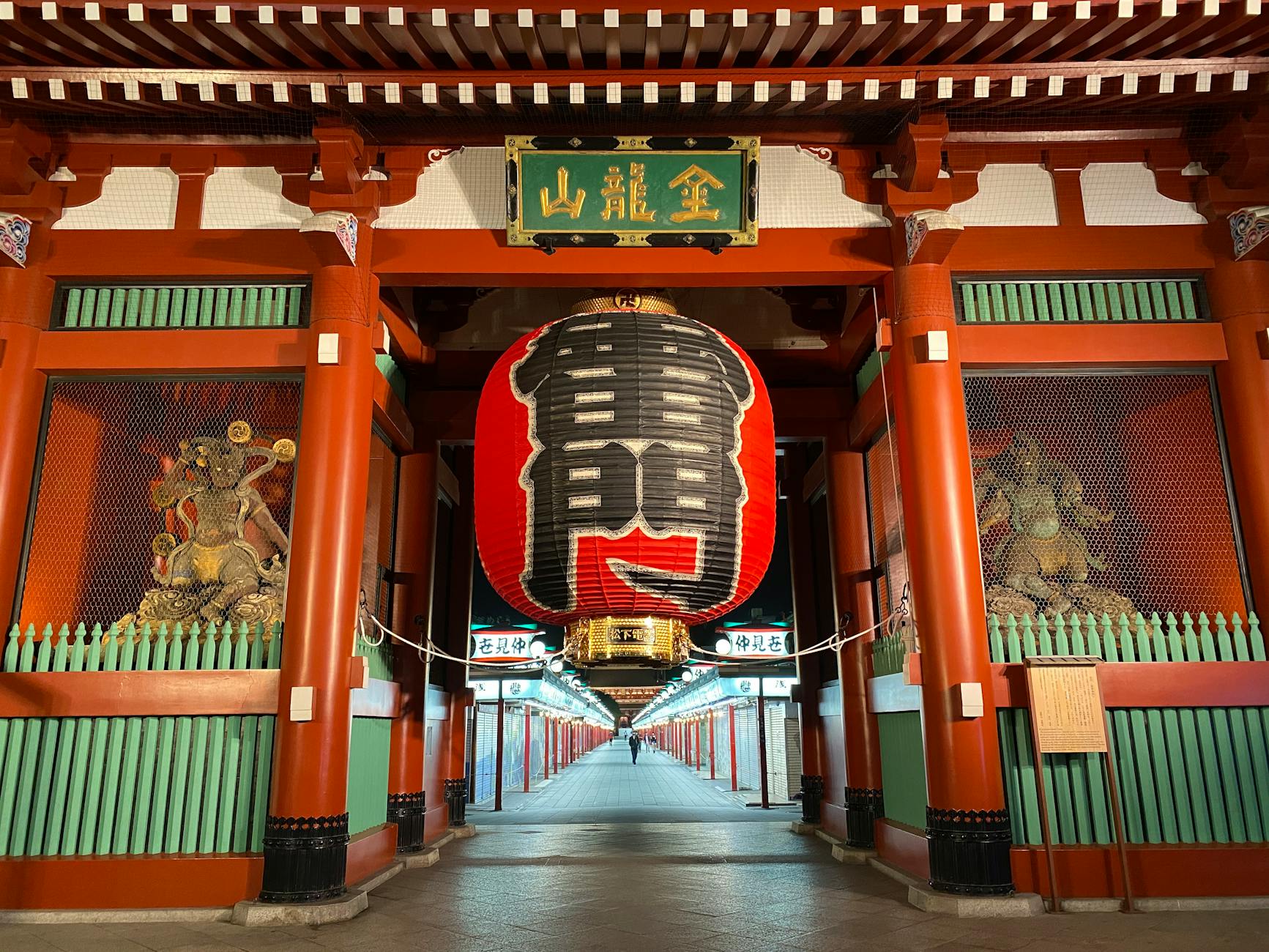
Your visit begins at the Kaminarimon — the massive outer gate that has become the symbol of both Asakusa and Tokyo itself. The gate features an enormous red paper lantern (chochin) weighing 700 kg, painted with the characters for “Thunder Gate.” Two fierce guardian statues flank the entrance: Fujin (god of wind) on the right and Raijin (god of thunder) on the left. The current gate dates from 1960, rebuilt with funding from Panasonic founder Konosuke Matsushita (whose company name is inscribed on the lantern’s base).
Photo tip: The most dramatic photos come early in the morning (before 8am) when the lantern is still lit and the crowds haven’t arrived. For the classic straight-on shot looking through the gate down Nakamise-dori, position yourself directly in front of the gate.

Nakamise-dori Shopping Street
Beyond Kaminarimon stretches Nakamise-dori, a 250-meter shopping street lined with approximately 90 shops on both sides. This is one of Japan’s oldest shopping streets, with roots dating back to the early 18th century when nearby residents were granted permission to set up stalls along the temple approach.
Today, the shops sell a mix of traditional crafts, souvenirs, and food. The best items to look for include:
- Ningyo-yaki — small baked cakes filled with red bean paste, shaped like temple landmarks
- Kaminari-okoshi — Asakusa’s signature puffed rice crackers with sugar and nuts
- Senbei — hand-grilled rice crackers in soy sauce or other flavors
- Edo-style crafts — folding fans, chopsticks, tenugui hand towels, and woodblock print goods
- Japanese sweets — seasonal wagashi, dango (rice dumplings), and melon pan
The street gets extremely crowded by mid-morning. For a more relaxed shopping experience, come before 9am (though some shops won’t open until 9:30-10:00) or visit the parallel side streets, which have their own shops and far fewer people.
Hozomon (Treasure House Gate)
At the end of Nakamise-dori stands the Hozomon, the imposing inner gate to the temple grounds. Larger than Kaminarimon, it stores a collection of Buddhist sutras on its upper floors (hence “Treasure House Gate”). The gate features another massive red lantern and a pair of enormous waraji (straw sandals) hanging on the back side, each measuring about 4.5 meters tall and weighing 500 kg. These sandals symbolize the Buddha’s power and are said to ward off evil.

Main Hall (Hondo)
The Main Hall is the spiritual heart of Senso-ji, housing the secret golden Kannon statue that the fishermen brothers pulled from the Sumida River in 628. The statue itself is never displayed to the public — it remains permanently enshrined behind closed doors, and some scholars debate whether it even still exists. Regardless, the faith it represents has drawn worshippers for nearly 1,400 years.
In front of the hall stands the jokoro — a large bronze incense burner. Visitors purchase bundles of incense, light them, and waft the smoke over themselves. The tradition holds that the smoke has healing properties: direct it toward any part of your body that needs healing (many people waft it over their heads for wisdom).

Five-Story Pagoda
The striking five-story pagoda (gojunoto) rises 53 meters and is the second-tallest pagoda in Japan. The current structure was rebuilt in 1973 with a modern steel frame but traditional exterior design. The top floor houses sacred relics from Sri Lanka’s Sripada Temple. While you can’t enter the pagoda, it makes a stunning photographic subject, especially when lit up at night.

Asakusa Shrine (Sanja-sama)
Adjacent to the main hall, Asakusa Shrine is a separate Shinto shrine honoring the three men who founded Senso-ji — the two fishermen brothers and the village headman. Unlike the temple, the shrine survived the 1945 air raids and is an original structure from 1649, designated an Important Cultural Property. The shrine is home to the Sanja Matsuri, one of Tokyo’s largest and most exciting festivals, held annually in May with over 100 portable shrines (mikoshi) paraded through the streets.
Temple Rituals and Traditions
Drawing Omikuji (Fortune Slips)
Senso-ji is famous for its omikuji — paper fortune slips that predict your luck. For a ¥100 donation, shake a metal cylinder until a numbered stick falls out, then find the matching drawer to retrieve your fortune. Fortunes range from dai-kichi (great blessing) to kyo (curse/bad luck).
Senso-ji is known for handing out an unusually high share of bad fortunes — somewhere around 30%, against the 10-15% you get at most temples. Locals will tell you the temple simply never watered down its old slips. Draw a bad one and there is nothing to worry about: fold it lengthwise and tie it to the wire racks beside the drawers, which leaves the bad luck at the temple rather than carrying it home. Keep the good ones in your wallet. If rituals like this interest you, they sit inside a much wider set of living customs we cover in our overview of Japanese traditions.

Prayer Etiquette
At the main hall, the way you pray at a Buddhist temple is not the same as at a Shinto shrine, and getting it slightly wrong is the most common thing visitors do here. The full rundown lives in our guide to temple etiquette, but the short version for Senso-ji’s prayer hall is this:
- Approach the offering box (saisen-bako) at the front of the hall
- Toss a coin into the box — ¥5 coins are considered lucky (go-en sounds like the word for “connection with the gods”)
- Put your hands together in prayer (gassho) and bow once
- Make your prayer or wish silently
- Bow once more when finished
Important: Unlike at Shinto shrines, do NOT clap your hands at Buddhist temples. The double-clap (kashiwade) is a Shinto practice only.
Visiting Senso-ji at Night
One of Senso-ji’s best-kept secrets is its nighttime illumination. Every evening from sunset until approximately 11pm, the main hall, pagoda, and gates are beautifully lit, creating an atmospheric and almost mystical experience. The Nakamise shops are closed and shuttered at night, but their painted metal shutters feature beautiful murals depicting Asakusa’s history — an art gallery in themselves.
Night visits offer the dramatic advantage of far fewer crowds. You can take photos without dozens of other tourists in the frame, and the temple grounds take on a serene, contemplative quality that’s impossible to experience during the day. While you can’t enter the main hall at night, you can still pray at the outer area and admire the architecture.

Best Food Near Senso-ji
Asakusa is one of Tokyo’s best neighborhoods for traditional Japanese street food and dining. Here’s what to eat:
Street Food on Nakamise-dori and Surrounds
- Age-manju — deep-fried sweet buns filled with red bean, matcha, or pumpkin paste (¥100-200 each)
- Kibi-dango — small millet dumplings served with kinako (roasted soybean flour) — a centuries-old Asakusa specialty
- Jumbo melon pan — oversized sweet bread with a crispy cookie-dough crust, often sold at the intersection near Kaminarimon
- Gyukatsu — breaded and deep-fried beef cutlet, the modern answer to tonkatsu
- Taiyaki — fish-shaped waffles filled with custard, red bean, or seasonal fillings
Sit-Down Restaurants
Sometaro — a legendary okonomiyaki restaurant where you grill your own savory pancakes at your table, operating since 1937. Daikokuya — Asakusa’s most famous tempura restaurant, known for massive golden-fried shrimp with a line that stretches down the block. Asakusa Kagetsudo — famous for its giant melon pan, often with a 30-minute queue. For a more refined experience, Komagata Dozeu has served loach fish hot pot (dozeu-nabe) since 1801.

Practical Visitor Information
Hours and Admission
- Temple grounds: Open 24 hours, every day
- Main hall: 6:00 AM – 5:00 PM (April–September) / 6:30 AM – 5:00 PM (October–March)
- Admission: Completely free
- Nakamise shops: Most open 9:30 AM – 6:00 PM daily
How to Get There
Senso-ji is a 1-minute walk from Asakusa Station, served by:
- Tokyo Metro Ginza Line (orange) — Exit 1
- Toei Asakusa Line (pink) — Exit A4
- Tobu Skytree Line — direct connection from Tokyo Skytree
- Water bus — Sumida River ferry from Hinode Pier or Odaiba (a scenic way to arrive)
How Long to Spend
A basic walk from Kaminarimon through Nakamise to the main hall takes about 30-45 minutes. Add time for shopping on Nakamise-dori (30 minutes), exploring side streets and Asakusa Shrine (30 minutes), and eating (30-60 minutes). A thorough visit including a meal takes 2-3 hours. If you’re also visiting nearby attractions like Tokyo Skytree (a 15-minute walk) or taking a Sumida River cruise, plan for a half-day.
Best Time to Visit
For the smallest crowds, visit early morning (before 8am) or evening (after sunset). Weekdays are significantly less crowded than weekends. The worst crowds occur during cherry blossom season (late March–early April), Golden Week (late April–early May), and New Year’s (January 1-3, when Hatsumode visitors can number in the millions).
Seasonally, the temple is stunning in every season: cherry blossoms in spring, the Sanja Matsuri festival in May, the Sumida River fireworks visible from the area in July, autumn foliage in November, and the Hagoita-Ichi (battledore fair) in December.
Insider Tips for Visiting Senso-ji
- Explore the side streets — Denpoin-dori and Hoppy-dori (also called Hoppy Street) are parallel to Nakamise and far less crowded, with excellent izakayas, traditional shops, and local character
- Visit Denpoin Garden — this beautiful Edo-period garden adjacent to the temple occasionally opens to the public (usually spring and autumn) and is one of Asakusa’s hidden gems
- Combine with Kappabashi — “Kitchen Town” (Kappabashi-dori) is a 10-minute walk away, famous for its shops selling professional kitchen equipment, plastic food replicas, and beautiful Japanese ceramics
- Take the Sumida River water bus — arriving by river from Hinode Pier gives you a scenic cruise past multiple bridges and a dramatic approach to Asakusa
- Look for the painted shutters — the closed shop shutters on Nakamise at night feature beautiful painted murals depicting Asakusa’s Edo-era history
- Don’t skip the back streets — the area behind the temple (north side) has some of Asakusa’s best local restaurants and craft shops, away from tourist pricing
What It Costs to Visit Senso-ji
Here is the honest answer: almost nothing. Entry to the temple grounds, the gates, the main hall, the pagoda, and Asakusa Shrine is completely free, and the grounds never close. You can walk the whole site, pray at the hall, and photograph everything without paying a yen. The only money you spend at Senso-ji is money you choose to spend.
- Omikuji fortune: ¥100 (drop the coin in the box yourself)
- Incense bundle at the jokoro: around ¥100
- Offering at the hall: a ¥5 coin is traditional, but any amount is fine
- Omamori (protective charms) from the temple office: ¥500-1,000
- Goshuin (calligraphic temple stamp) for collectors: ¥300-500, bring a goshuincho stamp book
- Kimono rental nearby (optional): ¥3,000-6,000 for a half-day, a popular way to wander Asakusa
Budget travelers can experience the whole temple for free and still walk away having eaten well for under ¥1,500. That is rare for a landmark this famous.
Accessibility at Senso-ji
Senso-ji is more wheelchair- and stroller-friendly than most old temples, though it is not flawless. Asakusa Station has elevators on the Ginza Line and the Toei Asakusa Line, and the temple sits on flat ground from Kaminarimon all the way up Nakamise-dori to the main hall, so the core approach is step-free along the central path.
- The main hall has a flight of stone steps at the front, but there is a side ramp on the left as you face the building that leads up to the worship area
- Nakamise-dori is flat but gets dense; a stroller or wheelchair is far easier before 9:30 AM or after the shops shutter in the evening
- Accessible restrooms are available within the temple grounds and inside the Asakusa Culture Tourist Information Center across from Kaminarimon, which also has a free top-floor observation deck and a lift
- The side streets (Denpoin-dori, Hoppy-dori) have some uneven paving and a few small steps into shops, so factor that in
If you are traveling with someone who tires easily, the temple itself is a short, flat visit. It is the surrounding exploration — Kappabashi, the back streets, the river — that adds the distance.
Photography Tips for Senso-ji
This is one of the most photographed places in Japan, which means the good angles are claimed by 9 AM. A few things genuinely change your shots:
- Shoot Kaminarimon before 7:30 AM. The lantern is still lit, the light is soft, and you can get the straight-through shot down Nakamise with almost no one in frame. By mid-morning that same composition is wall-to-wall people
- Use the pagoda as a layering element. Frame the five-story pagoda behind the main hall’s roofline, or catch it rising above the Nakamise rooftops — it gives photos depth that a flat front-on shot lacks
- Get low for the incense smoke. Crouch near the jokoro burner and shoot through the smoke toward the hall; the haze separates foreground from background and adds atmosphere
- Come back at night. The gates, hall, and pagoda are floodlit until about 11 PM and the crowds vanish. A phone in night mode handles it well; a steady ledge helps for reflections off wet pavement after rain
- Respect the one hard rule: no photos inside the main hall itself. Everything outdoors — gates, pagoda, grounds, Nakamise — is fair game
- For the storybook shot, place someone in a rented kimono on the Nakamise approach with the Hozomon and pagoda behind them. It is a cliche because it works
More to Do Around Asakusa
Treat Senso-ji as the anchor, not the whole outing. Asakusa rewards an extra hour or two, and most of what is worth doing sits within a fifteen-minute walk.
- Tokyo Skytree is a 15-20 minute walk across the Sumida River, or one stop on the Tobu Skytree Line. The observation decks at 350m and 450m run ¥2,100-3,100 (cheaper booked online), and on a clear day you can pick out Mount Fuji
- Kappabashi “Kitchen Town” sits about 10 minutes west — a street of shops selling chef’s knives, ceramics, and the uncannily realistic plastic food samples you see in restaurant windows. The knives make excellent souvenirs
- A Sumida River cruise from Asakusa Pier glides down to Hinode and on to Odaiba, passing under a string of distinctively colored bridges. Arriving or leaving by boat beats the train for views
- Hanayashiki, just behind the temple, is Japan’s oldest amusement park (opened 1853) — tiny, retro, and charming, with a coaster that threads between the buildings
- A rickshaw tour with one of the English-speaking pullers near Kaminarimon is a fun, if pricey, way to learn the back-street history (roughly ¥4,000-9,000 depending on length)

More sacred Tokyo: Senso-ji is the most famous of the city’s holy sites, but hardly the only one. See our roundup of Tokyo’s best temples and shrines and the full Meiji Shrine guide to plan a temple-and-shrine route.
Frequently Asked Questions
What is the best time of day to visit Senso-ji?
Early morning, before 8 AM, is the clear winner. The temple grounds are open 24 hours, the light is soft for photos, and you get the gates and Nakamise approach almost to yourself before the tour groups and day-trippers arrive around 10 AM. The second-best window is after sunset, when the buildings are illuminated and the crowds have thinned. Avoid the late-morning to mid-afternoon peak, especially on weekends.
How long does a visit to Senso-ji take?
A quick walk from Kaminarimon through Nakamise to the main hall takes 30-45 minutes. Add shopping, a stop at Asakusa Shrine, drawing an omikuji, and a street-food snack and you are looking at 1.5 to 2 hours. If you fold in nearby Asakusa — the back streets, Kappabashi, or a Sumida River cruise to Skytree — set aside a comfortable half-day.
Is Senso-ji a temple or a shrine?
Senso-ji is a Buddhist temple (indicated by the suffix “-ji”). However, Asakusa Shrine (a Shinto shrine) sits right next to it within the same complex. This side-by-side arrangement of Buddhist and Shinto sites is common throughout Japan, reflecting centuries of religious syncretism.
Is Senso-ji worth visiting?
Absolutely. Despite being Tokyo’s most touristic site, Senso-ji offers genuine cultural and historical depth. The key is timing — visit early morning or at night to experience its spiritual atmosphere without overwhelming crowds. The surrounding Asakusa neighborhood is equally rewarding, with traditional architecture, excellent food, and a distinctly old-Tokyo character you won’t find elsewhere.
Do I need to dress conservatively?
While there’s no strict dress code, respectful attire is appreciated. Avoid very revealing clothing (very short shorts, bare midriffs). Shoes stay on throughout the outdoor temple grounds. If you’re renting a kimono from one of the many nearby rental shops, Senso-ji is one of the most popular places in Tokyo to wear one.
Can I take photos inside Senso-ji?
Photography is allowed throughout the temple grounds and exterior, but photography is prohibited inside the main hall. The outdoor areas, gates, pagoda, and Nakamise-dori are all fair game for photos.
What’s the difference between Senso-ji and Meiji Shrine?
Senso-ji is a Buddhist temple in Asakusa with a 1,400-year history, traditional shopping street, and old-Tokyo atmosphere. Meiji Shrine is a Shinto shrine in Harajuku surrounded by a forest, dedicated to Emperor Meiji (19th century). Both are must-visits but offer very different experiences — Senso-ji is bustling and commercial, while Meiji Shrine is serene and nature-focused.