Tokyo Transportation · Guide №066
Tokyo Taxi Guide: Costs, Apps & When It Makes Sense to Ride
What a Tokyo taxi really costs in 2026, the apps to use (GO, Uber, S.Ride), how to pay, the late-night surcharge, and exactly when a cab beats the train.
目次 — Contents
- How much does a Tokyo taxi cost in 2026?
- The cars: JPN Taxi and the classic sedans
- Paying: cash, IC card, credit card, no tipping
- The taxi apps: GO, Uber, S.Ride and DiDi
- Hailing vs taxi ranks
- What a Tokyo taxi ride is actually like
- When a taxi beats the train
- Taxi vs train: an honest comparison
- Language tips for taking a taxi
- Airport taxis and flat-rate fares
- Accessibility
- A few real-world scenarios
- Frequently Asked Questions
- Photo Credits
This article contains advertising. Our booking links are routed through a partner that adds commission tracking automatically, so if you book through one we earn a commission from the provider, at no extra cost to you. It never affects what we recommend. Affiliate disclosure
This Tokyo taxi guide is about cost, apps and timing: a metered Tokyo cab starts at ¥500 for the first kilometre, then adds ¥100 every 232 metres, with a 20% surcharge late at night. They are clean, honest and easy to hail — and they add up fast. Here is what a ride really costs in 2026, which apps to use, and when a taxi genuinely beats the train.
I take Tokyo taxis maybe once a week, almost always after the last train or in the rain with shopping bags. They are some of the best in the world: spotless, the drivers are courteous, the rear door swings open by itself, and nobody expects a tip. But the meter is not cheap, so the skill is knowing when to spend the money. This guide covers fares, payment, the apps, where to catch one, the honest taxi-versus-train maths, and the language tricks that make it painless. For the full picture of getting around, see our Tokyo transportation guide.
How much does a Tokyo taxi cost in 2026?
Tokyo’s metered fares were revised on 20 April 2026 — the first change in years, a rise of about 10%. The base ¥500 flagfall stayed the same, but it now covers a shorter distance and the increments tick over faster. Here are the current numbers for the 23 wards of Tokyo plus Musashino and Mitaka.
- Starting fare (flagfall): ¥500 for the first 1 km (reduced from 1.096 km).
- Distance charge: ¥100 for every 232 m after that (the increment used to be 255 m, so the meter now climbs a little quicker).
- Time charge: when the cab is crawling in traffic below about 10 km/h, the meter also adds roughly ¥100 per minute and a half of slow running, so heavy congestion costs you.
- Late-night surcharge: a flat 20% extra on the whole metered fare between 22:00 and 05:00.
In practice that means a very short hop — a kilometre or two — runs around ¥500–900 by day. A typical cross-neighbourhood ride of 4–5 km is roughly ¥1,800–2,500. After 10pm, add a fifth on top. The meter is visible on the dashboard the whole time, so there are no surprises and no haggling; the figure on the meter is the figure you pay, plus any expressway toll.
Example fares for short hops
| Trip | Approx. distance | Daytime fare | After 22:00 (+20%) |
|---|---|---|---|
| Quick hop (e.g. Shibuya to Harajuku) | ~1.5 km | ~¥700–900 | ~¥840–1,080 |
| Short cross-town (e.g. Ginza to Tokyo Station) | ~2.5 km | ~¥1,100–1,400 | ~¥1,320–1,680 |
| Medium ride (e.g. Shinjuku to Shibuya) | ~4 km | ~¥1,800–2,200 | ~¥2,160–2,640 |
| Longer ride (e.g. Roppongi to Asakusa) | ~8 km | ~¥3,200–3,800 | ~¥3,840–4,560 |
These are estimates — the exact figure depends on the route and the traffic — but they give you the order of magnitude. Compare that with a ¥150–200 train fare for the same hops and you can see why a taxi is a deliberate choice, not a default.

The cars: JPN Taxi and the classic sedans
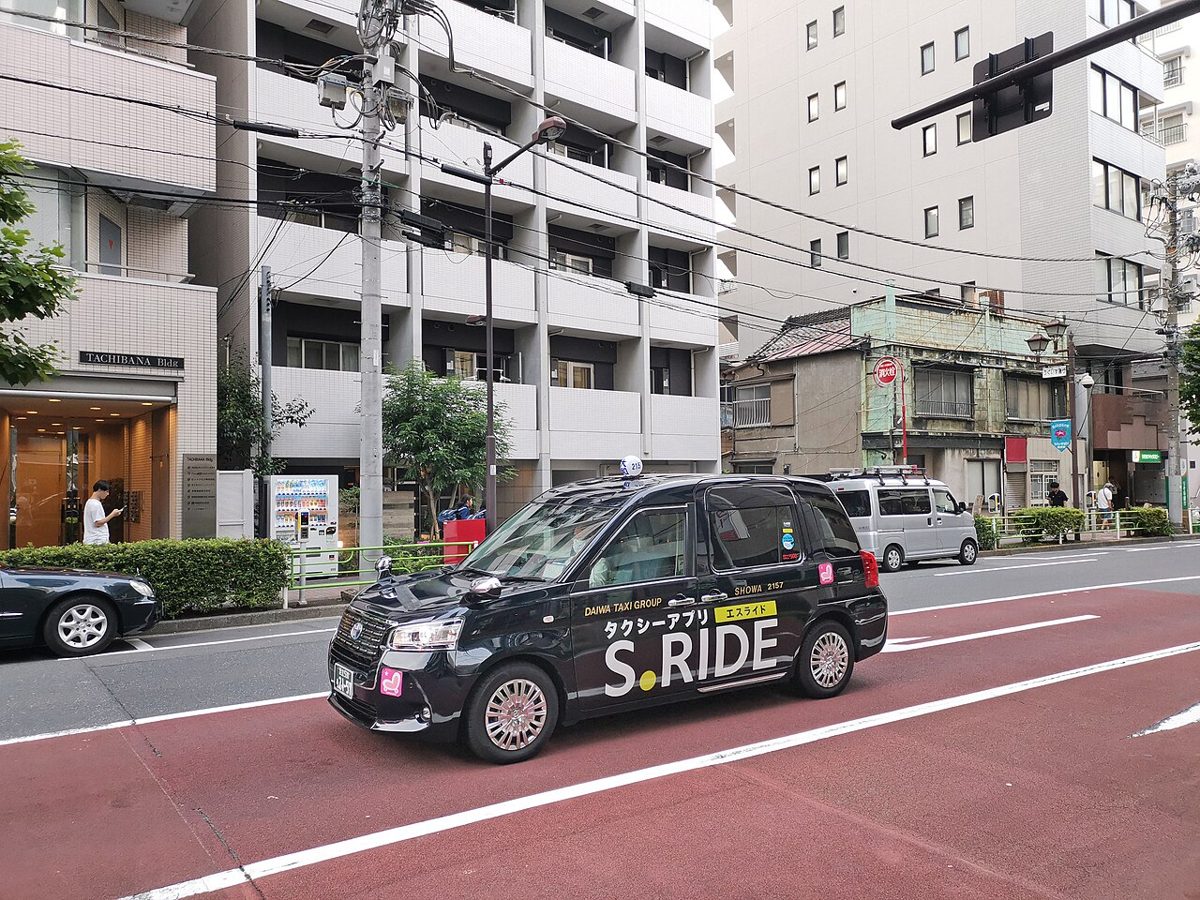
Most Tokyo cabs you will see today are the boxy, deep-blue Toyota JPN Taxi — a purpose-built model with a high roof, a sliding door and room for a suitcase. Alongside them you still find the older black and silver sedans (Toyota Crown Comforts). Both work identically and charge the same metered fare; the JPN Taxi is just roomier and easier to get in and out of, and it is wheelchair-accessible with a built-in ramp.
A few things that surprise first-timers: the rear left door opens and closes automatically — do not grab it or try to shut it yourself, the driver operates it. Sit in the back; the front passenger seat is not normally used. The seats often have white lace covers, the car is immaculate, and the driver may wear a cap and white gloves. A red light in the windscreen means the taxi is available (the kanji reads “空車”, kūsha); a different colour or character means it is taken or out of service.
Paying: cash, IC card, credit card, no tipping
Payment is easy and increasingly cashless. As of 2026, the overwhelming majority of Tokyo taxis — well over 99% — take cashless payment.
- Credit cards: Visa, Mastercard, Amex and JCB are accepted in almost every cab. Just hand over your card at the end.
- IC cards: tap a Suica or PASMO on the reader exactly as you would at a station gate.
- Mobile wallets: Apple Pay, PayPay and similar are widely supported.
- Cash: always works. Carry some smaller notes; paying a ¥1,500 fare with a ¥10,000 note is fine but not ideal late at night. For more on cash and cards in Japan, see our Tokyo money guide.
Crucially, there is no tipping in Japan, taxis included. You pay exactly what the meter shows plus any toll, and that is it. Trying to tip usually causes polite confusion. The driver will often give you a printed receipt automatically; just say “ryoshusho” if you want one and it does not appear.

The taxi apps: GO, Uber, S.Ride and DiDi
You do not have to stand on a street corner waving. Several apps dispatch taxis to your exact location, show the route in English, and let you pay in-app. All of that assumes you have mobile data sorted before you land. These are a godsend in the rain or when you cannot explain where you are.
- GO — the dominant app, holding roughly an 80% share of taxi-app usage in Japan and available nationwide. English interface, card or in-app GO Pay, and the widest pool of cars. This is the one to install first. A small dispatch fee (around ¥100, sometimes a ¥500 reservation fee) applies on top of the meter.
- Uber — in Tokyo, Uber dispatches licensed taxis rather than private drivers, plus premium options. Familiar interface, upfront pricing on some trips, foreign cards accepted.
- S.Ride — a slick Tokyo-focused app backed by a big taxi fleet; fast to hail and offers fixed airport fares.
- DiDi — another taxi-dispatch app with good coverage and frequent promo codes.
All four summon a metered taxi, so the fare is the same as a street hail plus the small dispatch fee. The win is convenience and the language barrier vanishing: you set the destination on the map, so the driver does not need you to pronounce anything.
Hailing vs taxi ranks
You can flag a passing cab anywhere it is legal to stop — raise your hand and look for the red kūsha light in the windscreen. But the easiest places to find one are the taxi ranks outside every major station (Tokyo, Shinjuku, Shibuya, Ueno and the rest), at big hotels, and at department stores. There is almost always a queue of cabs waiting at a rank, and a marshal during busy periods. Late at night near the entertainment districts — Shibuya, Roppongi, Shinjuku — demand spikes when the trains stop, and you may wait or find an app faster than the street.

What a Tokyo taxi ride is actually like
If you have only taken cabs elsewhere, a Tokyo taxi can feel almost formal. You wait for the rear door to swing open on its own, slide in, and the driver greets you with a polite phrase and usually a small bow. You give the destination — ideally by showing a map or address — and off you go. There is no chit-chat unless you start it, no music blaring, and no negotiating. The driver follows the meter and a sensible route; Tokyo taxis are famously honest, and deliberately taking the long way to pad the fare is extremely rare.
Safety is a non-issue. Drivers are licensed professionals, often older men who have done the job for decades and know the city cold. Cars are inspected and immaculate, seatbelts work, and solo travellers — including women late at night — can use taxis with confidence. If anything, the biggest culture shock is how quiet and courteous it all is. When you arrive, the meter shows the fare, you pay by card, IC or cash, take your receipt if you want one, and the door opens automatically again as you leave. You never touch it.
When a taxi beats the train
Tokyo’s trains are so good that a taxi is rarely the rational default — but there are clear situations where it wins, and I take one without hesitation in each of these.
- After the last train. The network shuts down roughly between midnight and 1am and does not restart until around 5am. In that window a taxi (or a long wait for a night bus) is your only option. Fares carry the 20% surcharge, but split between a few people it is reasonable.
- Heavy luggage. Hauling big suitcases through Shinjuku Station at rush hour is misery. A door-to-door cab to your hotel is worth every yen, especially with the roomy JPN Taxi.
- Groups of three or four. Once you split the fare, a short taxi ride can cost about the same per person as the train — and it drops you at the door.
- Rain, or you are exhausted. A sudden downpour, sore feet at the end of a long day, a sleeping child — sometimes ¥1,500 to skip the walk and the transfer is simply the right call.
- An awkward cross-town trip. If your route needs two or three train changes for a short distance, a direct taxi can be quicker once you count the walking and waiting.
For everything else — getting between the big neighbourhoods by day — the Tokyo Metro and the JR lines are faster, far cheaper and immune to traffic. Think of the taxi as the tool for the edges of the day and the awkward moments, not the main way around.
Taxi vs train: an honest comparison
| Factor | Taxi | Train (Metro / JR) |
|---|---|---|
| Typical short trip cost | ¥700–2,500 | ¥150–320 |
| Speed in light traffic | Direct, door to door | Fast, but plus walking and transfers |
| Speed in heavy traffic | Slow, meter still running | Unaffected |
| After ~1am | Available (with surcharge) | Not running until ~5am |
| With luggage or a group | Excellent | Crowded, stairs |
| Language needed | Some (or use an app) | Minimal — signs in English |
| Pay with | Cash, card, IC, mobile | IC card or ticket |
Language tips for taking a taxi
Most drivers speak limited English, so make the destination easy to understand and you will have no trouble.
- Show, do not say. Have your destination on a map on your phone (Google Maps pin works perfectly), or the hotel’s address card in Japanese. Pointing at a screen beats pronouncing a place name.
- Learn two words. “Koko” (here) for “stop here”, and “massugu” (straight ahead). “Migi” is right, “hidari” is left.
- Use an app for hard addresses. Setting the destination in GO or Uber removes the language problem entirely.
- Carry your hotel’s card. Pick one up at the front desk; it has the name, address and phone in Japanese, which is all the driver needs.

Airport taxis and flat-rate fares
From the airports a metered taxi into central Tokyo is expensive, so flat rates and other options matter. From Haneda, which is close to town, a fixed Airport Flat Rate via the GO app starts around ¥8,800 to central wards (plus expressway tolls and a small service fee); a metered Haneda run is roughly ¥8,000–12,500. From Narita, far to the east, expect roughly ¥25,000–35,000 on the meter, or a fixed fare from around ¥23,000–28,400 depending on the app and your destination, before tolls. Both Haneda and Narita have official flat-rate taxi desks and stands; for app fixed fares you request them at the airport taxi stand and tell the driver you want the set rate.
For most travellers the trains and limousine buses are far cheaper than an airport taxi — a Narita cab can cost ten times the train. A taxi from the airport really only makes sense with a big group, lots of luggage, a very late arrival, or young kids in tow.
Accessibility
The Toyota JPN Taxi that now makes up most of the fleet is wheelchair-accessible: it has a fold-out ramp and space to secure a chair, though the driver may need a few minutes to set it up, so allow time. Booking through the GO app lets you request a wheelchair-accessible vehicle specifically. Guide dogs are accepted. The low, flat floor and sliding door also make the JPN Taxi easier than the old sedans for anyone with limited mobility or a stroller.
A few real-world scenarios
To make the cost-versus-convenience call concrete, here is how I actually decide in a few typical situations.
- Last train just left Shibuya, hotel is in Shinjuku. That is a roughly 4 km ride, about ¥2,000–2,400 with the night surcharge. Split between two or three people it is fine, and far better than waiting an hour for a night bus. I open GO and grab the first car.
- Arriving at the hotel from the station with two big suitcases. The station is only 1.5 km away, so a daytime cab is about ¥800. For dragging heavy bags up and down station stairs, I pay it every time.
- Dinner in Ginza, heading to a bar in Roppongi, raining. About 3 km, ¥1,300–1,600. Two of us, late evening, in the rain — an easy yes over a transfer and a wet walk.
- Midday sightseeing between Asakusa and Ueno. Two stops on the train for ¥180, no traffic risk. Here the taxi makes no sense; I take the Metro and keep the cab money for later.
The pattern is consistent: taxis earn their keep at night, in the rain, with luggage, and in groups. By day, on your own, for a normal hop between neighbourhoods, the train wins on every count. Keep a little cash and a working IC card, install GO before you need it, and you will always have the right option to hand.
Most new Tokyo taxis are the tall JPN Taxi model with a fold-out side ramp, which fits a manual wheelchair and a companion. Setting it up can take several minutes and some drivers are unpractised, so asking your hotel to book a Universal Design vehicle works better than hailing one. Our guide to accessible Tokyo covers taxis, trains and specialist transfers for power chairs.
Frequently Asked Questions
How much does a taxi cost in Tokyo?
Since the April 2026 revision, the meter starts at ¥500 for the first kilometre, then adds ¥100 every 232 metres. A short 1–2 km hop runs roughly ¥700–900 and a 4–5 km cross-town ride about ¥1,800–2,500. A 20% surcharge applies between 22:00 and 05:00.
Do Tokyo taxis take credit cards?
Yes. Over 99% of Tokyo taxis accept cashless payment, including major credit cards, Suica and PASMO IC cards, and mobile wallets like Apple Pay and PayPay. Cash always works too, and there is no tipping — you pay exactly what the meter shows plus any toll.
What is the best taxi app in Tokyo?
GO is the most widely used, with about an 80% share and nationwide coverage, an English interface and in-app payment. Uber (which dispatches licensed taxis in Tokyo), S.Ride and DiDi are good alternatives. All summon a metered cab, so you pay the normal fare plus a small dispatch fee.
Is it cheaper to take a taxi or the train in Tokyo?
The train is almost always cheaper — a short trip costs ¥150–320 versus ¥700–2,500 by taxi. A taxi makes sense after the last train (around midnight to 5am), with heavy luggage, in a group of three or four where you split the fare, or in the rain.
How do I tell a taxi driver where to go if I do not speak Japanese?
Show the destination on a map on your phone or hand over your hotel’s address card in Japanese rather than trying to pronounce the name. Better still, set the destination in the GO or Uber app, which removes the language barrier entirely.
Photo Credits
- The Toyota JPN Taxi, the deep-blue cab now common across Tokyo — Photo: Nord794ub / CC BY-SA 4.0 via Wikimedia Commons
- A taxi works a central Tokyo street — Photo: Nord794ub / CC BY-SA 4.0 via Wikimedia Commons
- Inside a Tokyo cab – rear doors open automatically, no tipping needed — Photo: くーさん / CC BY 2.0 via Wikimedia Commons
- A taxi rank outside a Tokyo station, the easiest place to grab a cab — Photo: Pedro Ribeiro Simões from Lisboa, Portugal / CC BY 2.0 via Wikimedia Commons
- After the last train, a taxi is often your only way home — Photo: Syced / CC0 via Wikimedia Commons
- Taxis are plentiful but the meter climbs fast in traffic — Photo: Stéphane Bureau Du Colombier / CC BY 3.0 via Wikimedia Commons