Tokyo Cafes & Coffee · Guide №149
Animal Cafes in Tokyo: Owls, Hedgehogs, Capybaras and the Ethics
Owls, hedgehogs, otters, capybaras, micro pigs and more, animal by animal: what each Tokyo cafe costs, what the animal actually needs, and which formats we think you should walk past.
目次 — Contents
- Why animal cafes exist in Tokyo
- The quick verdict
- A five-question test for any animal cafe
- Owl cafes: skip
- Hedgehog cafes: skip
- Otter cafes: skip, without exception
- Capybara cafes: not recommended
- Micro pig cafes: not recommended
- Rabbit cafes: think twice
- Dog cafes: acceptable if well run
- Bird cafes: fine, with one condition
- Reptile cafes and other exotics
- What Japanese law does and does not do
- If you are going anyway
- Better ways to see animals in and around Tokyo
- Animal cafes and children
- The bottom line
- Frequently Asked Questions
- Photo Credits
This article contains advertising. Our booking links are routed through a partner that adds commission tracking automatically, so if you book through one we earn a commission from the provider, at no extra cost to you. It never affects what we recommend. Affiliate disclosure
The animal cafes Tokyo has become famous for run from the defensible to the indefensible, and the price tells you nothing about which is which. Cats, and to a lesser degree dogs and birds kept behind glass, can live reasonably well in a cafe. Owls, hedgehogs and otters cannot. Capybaras, micro pigs and rabbits sit somewhere uncomfortable in between.
That is the short answer, and we will not pretend otherwise. This guide goes animal by animal: what each kind of cafe costs, how it works, what the animal actually needs, and whether we think you should go. If you have already decided on cats, our cat cafe guide covers them in much more detail, and the wider Tokyo cafe guide covers everything that does not involve animals.
Why animal cafes exist in Tokyo
The cat cafe came first, and it made sense. Most Tokyo rental flats ban pets, and an hour with a cat was a cheap substitute for owning one. The format worked so well that operators started asking what else could go on the other side of the counter. From the early 2010s the answer was: nearly anything small and photogenic. Owls, then rabbits, hedgehogs, reptiles, otters, micro pigs and, most recently, capybaras.
The logic of the business matters, because it explains the welfare problem. A cafe has to make money from a small room, in daytime hours, with a steady turnover of customers who want to touch something. Cats cope with that reasonably well. Most of the animals that followed them were never going to, and the ones that attract queues are often exactly the species least suited to it.
Most visitors genuinely love animals, which is why they go. Nothing here is meant as a lecture. But the difference between the good and bad formats is not a matter of opinion or cultural preference — it comes down to what these animals need to stay healthy, and that is knowable.
The quick verdict
| Animal | Typical price | Where | Our verdict |
|---|---|---|---|
| Cats | ¥1,200–2,500 per hour; rescue cafes by donation | Everywhere | Go, and choose a rescue cafe |
| Dogs | Similar to cat cafes | Harajuku, Shibuya | Acceptable if the cafe enforces rest |
| Birds behind glass | A drink and cake | Omotesando, Shibuya | Fine: you watch, you do not handle |
| Rabbits | Similar to cat cafes | Harajuku | Think twice; choose low-handling cafes |
| Micro pigs | Roughly ¥3,000+ for half an hour plus a drink | Harajuku, Meguro | Not recommended |
| Capybaras | ¥2,800–4,000 for 40–45 min | Takadanobaba, Kichijoji | Not recommended; see them at a zoo |
| Reptiles | Varies | Scattered | Not recommended for handling |
| Hedgehogs | From ¥2,310 for 45 min | Harajuku, Asakusa | Skip |
| Owls | About ¥3,800 per hour | Akihabara, Harajuku | Skip |
| Otters | Varies | Scattered | Skip, without exception |
Prices here are the ones posted by named cafes in 2026 where we could find them, and typical ranges otherwise. They change frequently, as do the cafes themselves, which open and close at a rate that makes any list out of date within a year.
A five-question test for any animal cafe
You do not need to be a vet to judge an animal cafe. Ask these five questions before you pay, and if you get more than one “no,” walk away.
- Is the animal domesticated? Cats, dogs and rabbits have lived with people for centuries. Owls, otters and hedgehogs have not, and being hand-reared does not change their biology.
- Is it awake during the day? A nocturnal animal in a lit room from 11:00 to 20:00 is being kept awake during its sleeping hours, every day.
- Can it get away from you? Look for hiding places, high shelves and a room the public cannot enter. A tethered or penned animal cannot opt out.
- Does it live in groups? Solitary animals put in a room with others of their species, and a rotating crowd of strangers, are stressed in ways that are easy to miss.
- Where did it come from? Some species in Japanese cafes are linked to the illegal wildlife trade. If the answer is vague, assume the worst.
By that test, cats pass comfortably, dogs and birds behind glass mostly pass, and the popular exotic formats fail on nearly every count.
Owl cafes: skip
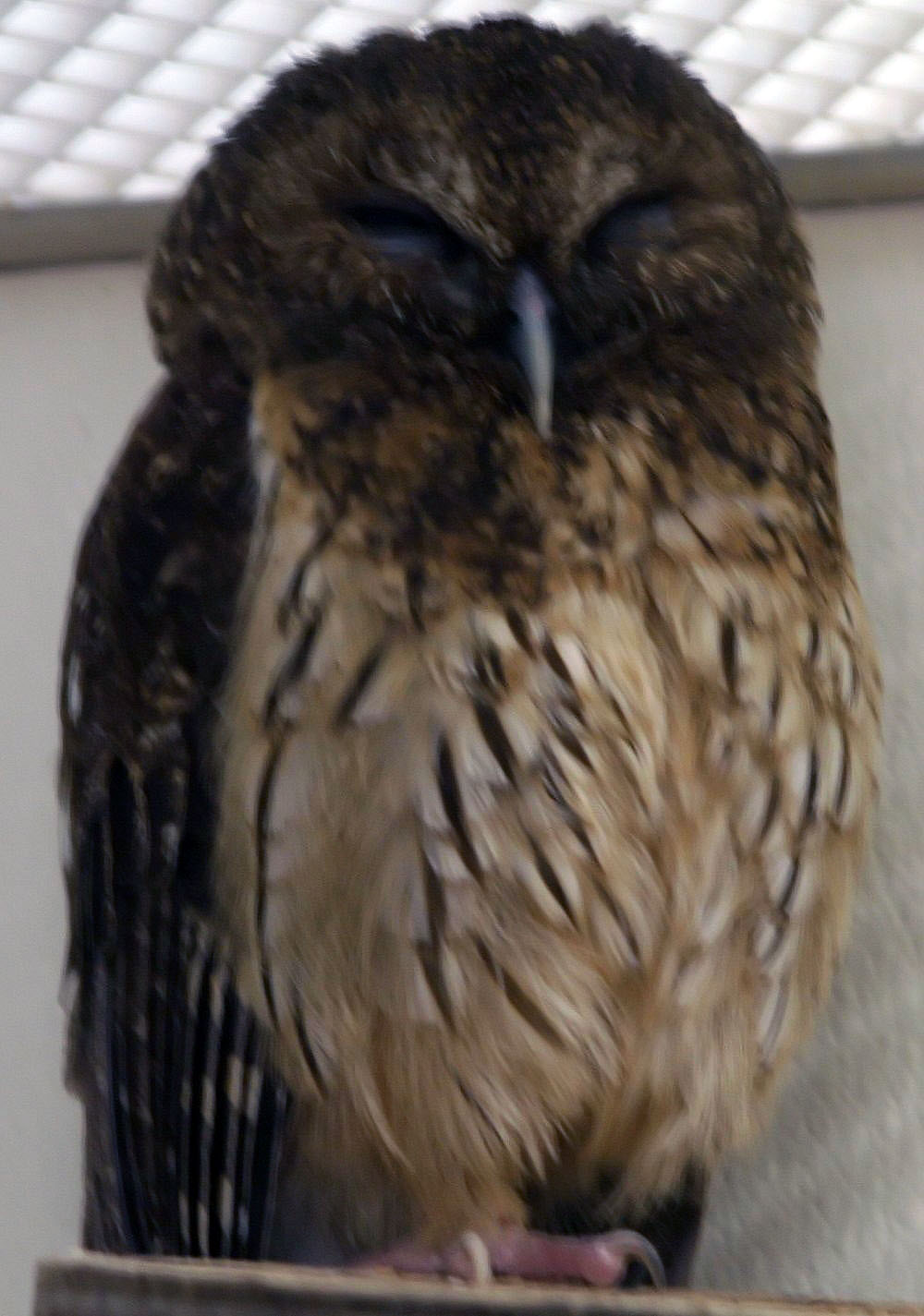
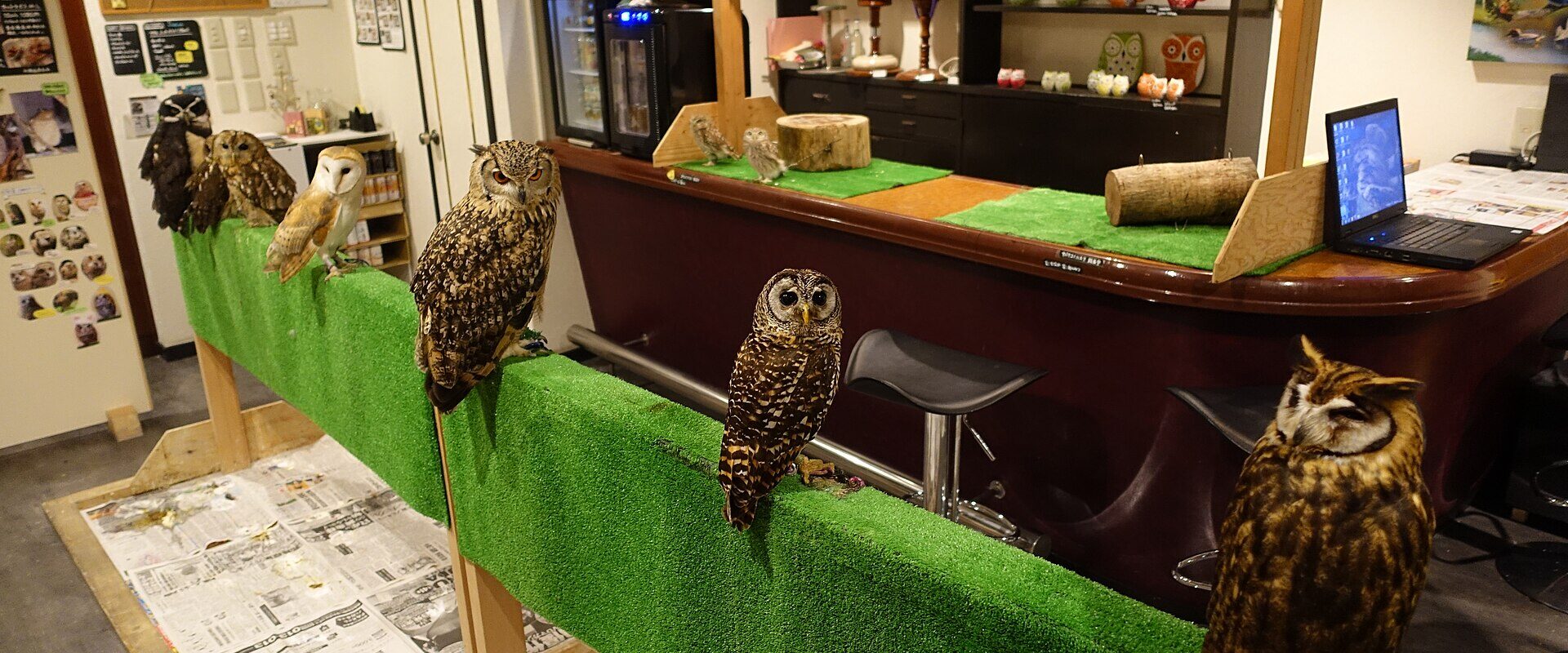
Owl cafes are the most famous of the exotic formats. Akiba Fukurou in Akihabara is the best known, with around forty owls ranging from the tiny Eurasian pygmy owl to the huge Eurasian eagle-owl, charging about ¥3,800 for an hour, cash only. Other owl rooms operate around Harajuku.
To be fair to the better operators, some limit visitor numbers, enforce quiet, ban flash and rotate birds off the floor. Akiba Fukurou in particular has a reputation for being stricter than most. But the underlying problems are structural, and good rules do not fix them:
- Most owls are nocturnal or crepuscular. A cafe keeps them in light and noise during the hours they would sleep.
- To keep them on their perches, cafe owls are tethered by the leg. Falconers tether birds too, but falconry birds fly daily; cafe owls largely do not.
- Owls are not social with people. A still, wide-eyed owl is not calm and curious. Owls that are frightened often freeze, flatten their feathers or go tall and thin.
- Their feathers are designed for silent flight and are easily damaged by the oils on human hands, which is one reason even falconers minimise stroking.
The honest verdict: no version of an owl cafe is good for owls. If you want to see owls, visit a zoo or a proper raptor display where the birds fly. Walk past the cafes.
Hedgehog cafes: skip
HARRY is the main hedgehog cafe brand, with branches in Harajuku and Asakusa (and Yokohama). The Harajuku station-front branch charges from ¥2,310 for 45 minutes for adults and ¥2,090 for children aged 4 to 12. You sit at a table, staff bring a hedgehog in a small container, and you can hold it with a glove or on a cloth, with mealworms to feed.
The animal involved is the African pygmy hedgehog, and it has three characteristics that make this a bad idea. It is nocturnal, so the cafe’s opening hours are its sleep. It is solitary, and does not seek company from other hedgehogs, let alone people. And it has one defence: rolling into a ball and raising its spines. A hedgehog huffing and curling up in your hand is not shy. It is scared.
Well-intentioned staff and gloves do not change any of that. Skip.
Otter cafes: skip, without exception
This is the one format with a clear line under it. Otter cafes are the part of Japan’s animal cafe business most directly tied to the illegal wildlife trade.
In 2018, a TRAFFIC and WWF study called Otter Alert found that at least 39 mostly juvenile Asian small-clawed otters had been seized in five smuggling incidents in 2016 and 2017, all bound for Japan and all originating in Thailand. It also noted that CITES trade records showed no legal imports of the species from Thailand into Japan since 1988. In 2019 both the small-clawed and smooth-coated otter were moved to CITES Appendix I, which bans commercial international trade. And in 2025, a DNA study reported by Mongabay linked otters in Japanese cafes to poaching hotspots in southern Thailand.
Beyond the sourcing, otters are semi-aquatic, very active, highly social animals that live in family groups and range over large territories. A cafe tank and a play area are not a life for them. Otters in cafes have been filmed pawing through small gaps at customers’ hands for treats, which is often described as affection and is closer to the behaviour of a bored animal whose world is very small.
There is no welfare argument for an otter cafe, and your fee helps create demand for animals that may have been taken from the wild. Skip, and if an otter “experience” appears in an itinerary or tour package, ask for it to be removed.
Capybara cafes: not recommended
Capybaras are the current boom. They are calm, sociable, extremely photogenic and, crucially for the business, tolerant of people. CAPPINESS in Takadanobaba charges about ¥4,000 for 45 minutes all in, and Capyneko in Kichijoji, which mixes capybaras and cats, about ¥2,800 for 40 minutes. They sell out regularly.
Capybaras are a harder call than owls, because they are social, awake by day and relatively relaxed around humans. They also do not suffer the leg-tethering and nocturnal problems. So why not recommend them?
- Size and space. Capybaras are the world’s largest rodent, with adults weighing 35 to 65 kg. They are semi-aquatic grazers that in the wild live in herds and spend hours in water. An urban cafe cannot give them anything close to that.
- Water. They depend on water to regulate body temperature and to escape stress. Ask whether they have a pool deep enough to submerge in, and check whether it is available during opening hours.
- The format is new. Dedicated capybara cafes are a few years old. There is very little track record on long-term welfare, and the rush of new openings since the animal went viral does not suggest caution.
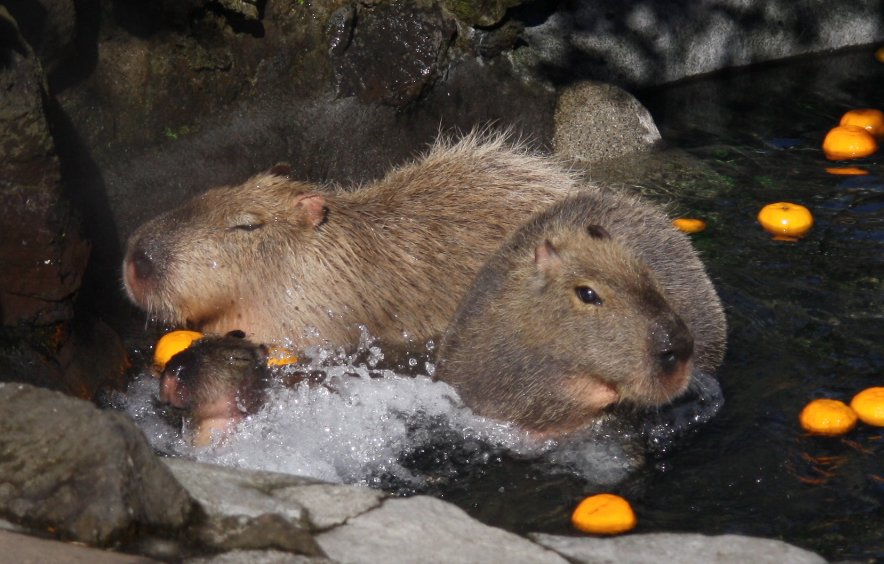
The better way to meet a capybara in Japan is at a zoo that has built for them. The most famous is Izu Shaboten Zoo, on the Izu peninsula south-west of Tokyo, where the capybaras have their own open-air hot spring bath in winter and have become a national institution. It is a long day trip, but it is the real thing.
Micro pig cafes: not recommended
Mipig is the main brand, with cafes in Harajuku and Meguro, where you sit on a floor cushion and pigs climb into your lap. Prices shift and are hard to pin down, but expect roughly ¥3,000 or more for about half an hour, plus a compulsory drink; check the site for the current figure.
The problem with micro pigs is the word “micro.” Pigs sold as micro, mini or teacup are small breeds, often shown when very young, and many grow much bigger than buyers expect. Pigs are also extremely intelligent, social animals that need space to root and forage. A lap-sitting format rewards small, young, docile animals, and that is not a stable basis for a lifetime of care. Our concern is less with any one company than with a format that presents pigs as lap animals for small city flats.
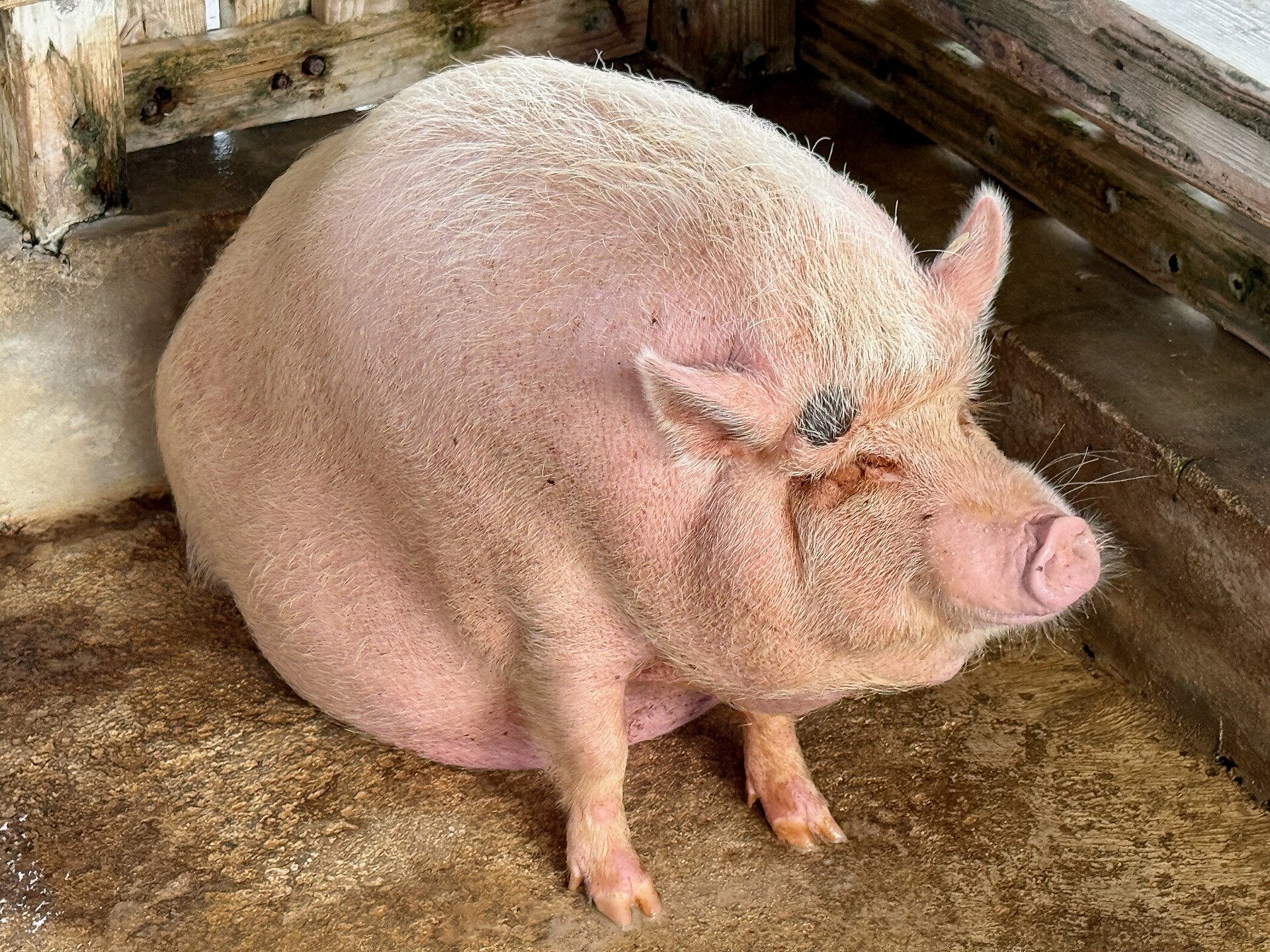
Our verdict: not recommended. If you do go, choose a quiet weekday slot, do not pick the pigs up, and do not treat a lap-sitting piglet as evidence that pigs make good flat pets.
Rabbit cafes: think twice
Rabbits are domesticated, most active around dawn and dusk rather than at night, and Harajuku has had rabbit cafes for years. But rabbits are a prey species, and being picked up — lifted off the ground by something much larger — is one of the most frightening things that can happen to a rabbit. They freeze rather than struggle, which looks like calm.
The better rabbit cafes do not let you pick rabbits up, give them large floor areas with shelters, and let you sit on the floor while rabbits come to you. The worse ones put a rabbit on your lap for photographs. That is the difference to look for. If there is a pen of rabbits with no places to hide and a queue of people lifting them for pictures, leave.
Dog cafes: acceptable if well run
Dogs have been bred for thousands of years to want to be around people, which makes a dog cafe fundamentally easier to justify than most. Harajuku and Shibuya have a handful, including Shiba Inu and Samoyed rooms, usually charging by the half hour or hour at prices close to a cat cafe’s. The same rules apply as for cats: the dogs need somewhere to rest away from customers, enforced break times, visitor caps and no picking up.
The warning sign specific to dogs is puppies. A cafe full of young puppies is usually a sales operation as much as a cafe, and Japan’s pet-shop puppy trade has its own well-documented welfare problems. Adult dogs, calm behaviour, and a closed door the dogs can use to leave are what to look for.
Bird cafes: fine, with one condition
There are small bird cafes in Tokyo where parakeets, finches and small parrots live in a glass-walled room beside the seating, and you drink your coffee and watch. That is the format to support: the birds are in a room designed for them, they are not handled, and they can fly. Places that hand you a parrot to hold for a photo are another matter.
Reptile cafes and other exotics
Reptile cafes come and go, as do occasional rooms with more unusual animals. Reptiles have precise temperature and humidity needs that are difficult to meet in a room built for people, and many species are stressed by handling. Viewing enclosures that are properly heated and lit is a different thing from passing a snake around a table. Anything involving primates, foxes or other wild mammals should be avoided entirely.
What Japanese law does and does not do
Animal cafes must register as animal-handling businesses under the Act on Welfare and Management of Animals, and national standards cover things like display hours for cats and dogs, space and staffing. Wildlife trade is regulated under CITES and Japan’s domestic species laws.
But the law sets minimums, and it was written mainly with pet shops, cats and dogs in mind. Many species in cafes are covered only by general provisions, enforcement varies between local governments, and “legal” is not the same as “good for the animal.” An owl cafe can be fully licensed and still be a poor life for an owl. That is why the five-question test above is more useful than any licence on the wall.
If you are going anyway
Some readers will go regardless, and some will find themselves with a child who has set their heart on a hedgehog. If that is you, you can still reduce the harm.
- Go on a weekday morning, when rooms are quietest.
- Do not pick animals up, even if staff offer.
- No flash, and keep photos short.
- Sit still and let animals approach, and leave them alone if they move away or hide.
- Skip paid feeding unless it is clearly limited to a set time.
- Leave if the animals look stressed: frozen, hiding, panting, flattened, over-grooming, or trying to get out of the enclosure.
- Leave an honest review. Visitors reading reviews are the pressure these businesses respond to.
Better ways to see animals in and around Tokyo
Tokyo has an excellent alternative, and it is cheaper than an hour in any exotic animal cafe.
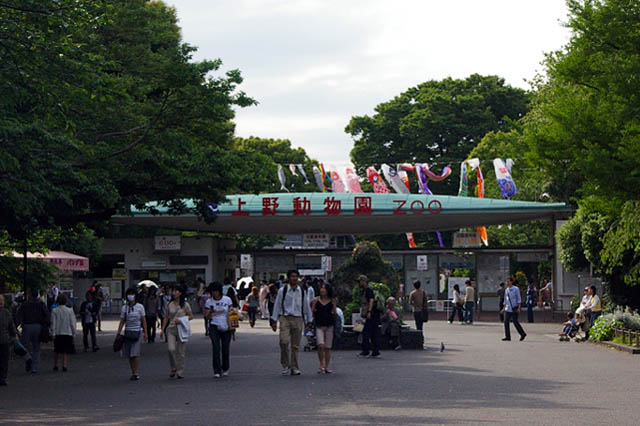
- Ueno Zoo. Japan’s oldest zoo, opened in 1882, inside Ueno Park. Admission is inexpensive (around ¥600 for adults), and it is closed on Mondays. It pairs naturally with the museums in the park — see our Ueno guide.
- Tama Zoological Park. Out in Hino in western Tokyo, a large, hilly zoo known for open, naturalistic enclosures. A half-day, and well worth it with children.
- Inokashira Park Zoo. A small, cheap zoo in Kichijoji, a pleasant add-on to a walk around Inokashira pond.
- Izu Shaboten Zoo. For capybaras, done properly. A long day trip south-west of Tokyo.
- A rescue cat cafe. If what you really want is an hour with an animal on your lap, this is the format where your money does the most good. Our cat cafe guide lists the rescue cafes.
Families will find more ideas in the Tokyo with kids guide, and the parks themselves are covered in our Tokyo parks and gardens guide.
Animal cafes and children
Children are the main audience for many exotic animal cafes, and they are also the reason many parents end up in one. A few practical points. Most exotic cafes have a minimum age or require children to be supervised closely, and small children often find animals more frightening close-up than on a phone screen. If a child is set on a hedgehog or an owl, a zoo’s small-animal area or a rescue cat cafe usually satisfies the same wish. And the conversation about why some animals should not be in cafes is, in our experience, one children understand very quickly.
The bottom line
Animal cafes in Tokyo are not one thing. A rescue cat cafe is a small, kind business worth supporting. An owl or otter cafe is a business built on animals that should not be there, however well run it is. Most of the rest fall somewhere between, and the five questions above will tell you which side of the line a particular room is on. If in doubt, go to the zoo, have a coffee in Harajuku without an animal attached, and spend the difference on something you will remember for the right reasons.
Frequently Asked Questions
Are animal cafes in Tokyo ethical?
Some are and many are not. Cat cafes, especially rescue cafes, can be ethical, and well-run dog cafes and bird cafes where you watch rather than handle are generally acceptable. Owl, hedgehog and otter cafes are not: those animals are nocturnal, solitary or semi-aquatic, and otters in Japanese cafes have been linked to the illegal wildlife trade. Capybara, micro pig and rabbit cafes sit in between and are hard to recommend.
How much do animal cafes in Tokyo cost?
Cat cafes cost roughly ¥1,200 to ¥2,500 per hour. HARRY hedgehog cafe in Harajuku starts from ¥2,310 for 45 minutes, Akiba Fukurou owl cafe about ¥3,800 for an hour, and capybara cafes ¥2,800 to ¥4,000 for 40 to 45 minutes. Micro pig cafes are roughly ¥3,000 or more for about half an hour plus a drink. Prices change often, so check each cafe’s own website.
Why are owl cafes bad?
Most owls are nocturnal, so a cafe keeps them in light and noise during their sleeping hours. They are usually tethered by the leg to perches, rarely fly, and are not social with people. Stroking damages their feathers, and a still owl is often a frightened owl rather than a calm one. Even well-run owl cafes cannot fix these problems.
Are there still otter cafes in Japan?
A small number of otter cafes and otter experiences still operate. Asian small-clawed and smooth-coated otters were moved to CITES Appendix I in 2019, banning their commercial international trade, and research by TRAFFIC and a 2025 DNA study linked otters in Japan to smuggling from Thailand. We recommend avoiding any otter cafe or otter encounter.
Where can I see capybaras near Tokyo?
Capybara cafes operate in Takadanobaba and Kichijoji, but we recommend a zoo instead. Izu Shaboten Zoo on the Izu peninsula is the most famous place to see capybaras in Japan, known for its winter open-air capybara bath. Several zoos in the Tokyo area also keep capybaras in larger, water-equipped enclosures.
Photo Credits
- Owls on a perch rail inside an owl cafe – Owls Looking at Me (21160358532) by Kainoki Kaede, CC BY 2.0, via Wikimedia Commons.
- A mottled owl asleep on a perch – Ciccaba virgata 0zz by David J. Stang, CC BY-SA 4.0, via Wikimedia Commons.
- An African pygmy hedgehog – Atelerix albiventris by Jkasvi, CC BY-SA 3.0, via Wikimedia Commons.
- Capybaras in the winter bath at Izu Shaboten Zoo – Capybara Izu Shaboten 001 by Tatsuo Yamashita, CC BY 2.0, via Wikimedia Commons.
- A fully grown miniature pig – Fat miniature pig by Oleg Yunakov, CC BY-SA 4.0, via Wikimedia Commons.
- The main gate of Ueno Zoo – Ueno-zoo by Los688, public domain, via Wikimedia Commons.