Tokyo Events & Festivals · Guide №128
Tokyo Winter Illuminations: Best Displays and When They Switch On
The best Tokyo illuminations are free, and the two Roppongi displays switch off on Christmas Day. Switch-on dates, costs and how to see them without the queue.
目次 — Contents
This article contains advertising. Our booking links are routed through a partner that adds commission tracking automatically, so if you book through one we earn a commission from the provider, at no extra cost to you. It never affects what we recommend. Affiliate disclosure
Tokyo illuminations start switching on in November and the best of them are free. The city hangs several million LEDs across office boulevards, plaza gardens and shopping streets, keeps them running until Christmas Day — and then, at some of the big-name locations, turns them off. Knowing which ones survive into January is the difference between a good winter trip and a disappointed one.
This guide covers the displays worth crossing the city for, what each actually costs, the switch-on and switch-off dates, and the two or three that are not worth the queue.
The short answer
| Display | Where | Typical run | Cost | Verdict |
|---|---|---|---|---|
| Marunouchi Illumination | Naka-dori, Tokyo Station | 12 Nov to 14 Feb | Free | The best of the free walks |
| Tokyo Midtown | Roppongi | 26 Nov to 25 Dec | Free | The most photogenic single installation |
| Roppongi Hills Keyakizaka | Roppongi | 5 Nov to 25 Dec | Free | Tokyo Tower framed by the avenue |
| Caretta Shiodome | Shiodome | Mid-Nov to mid-Feb | Free | A timed show, not just lights |
| Yebisu Garden Place | Ebisu | Nov to early Jan | Free | Baccarat chandelier; short visit |
| Yomiuriland Jewellumination | Inagi, west Tokyo | Oct to spring | Paid | Only if you have children |
| Ashikaga Flower Park | Tochigi | Oct to Feb | Paid | Worth the day trip; genuinely enormous |
When they switch on, and when they vanish
This is the part that catches people out. The Christmas programmes behind the two Roppongi displays, Tokyo Midtown and the Roppongi Hills Keyakizaka avenue, both end on 25 December in 2026. Arrive on 28 December for a New Year trip and those Christmas events are already over, with the city turning to New Year.
What runs longer are the office districts. Marunouchi keeps its champagne-gold lights on Naka-dori into mid-February, and Caretta Shiodome runs to a similar schedule. At Yebisu Garden Place the Baccarat chandelier stays up until 11 January 2027, and some of its other illuminations until 28 February. So a January visitor is not shut out — just limited to a different, smaller set.
Switch-on dates vary from one display to the next: in 2026 Marunouchi lights up on 12 November and Midtown on 26 November. Late November lets you photograph the ginkgo avenue in daylight and be under the illuminations after dark, as long as you check each display’s hours — see Tokyo in November for how to fit both into a day.
The displays worth going to
Marunouchi Illumination — the best one is free
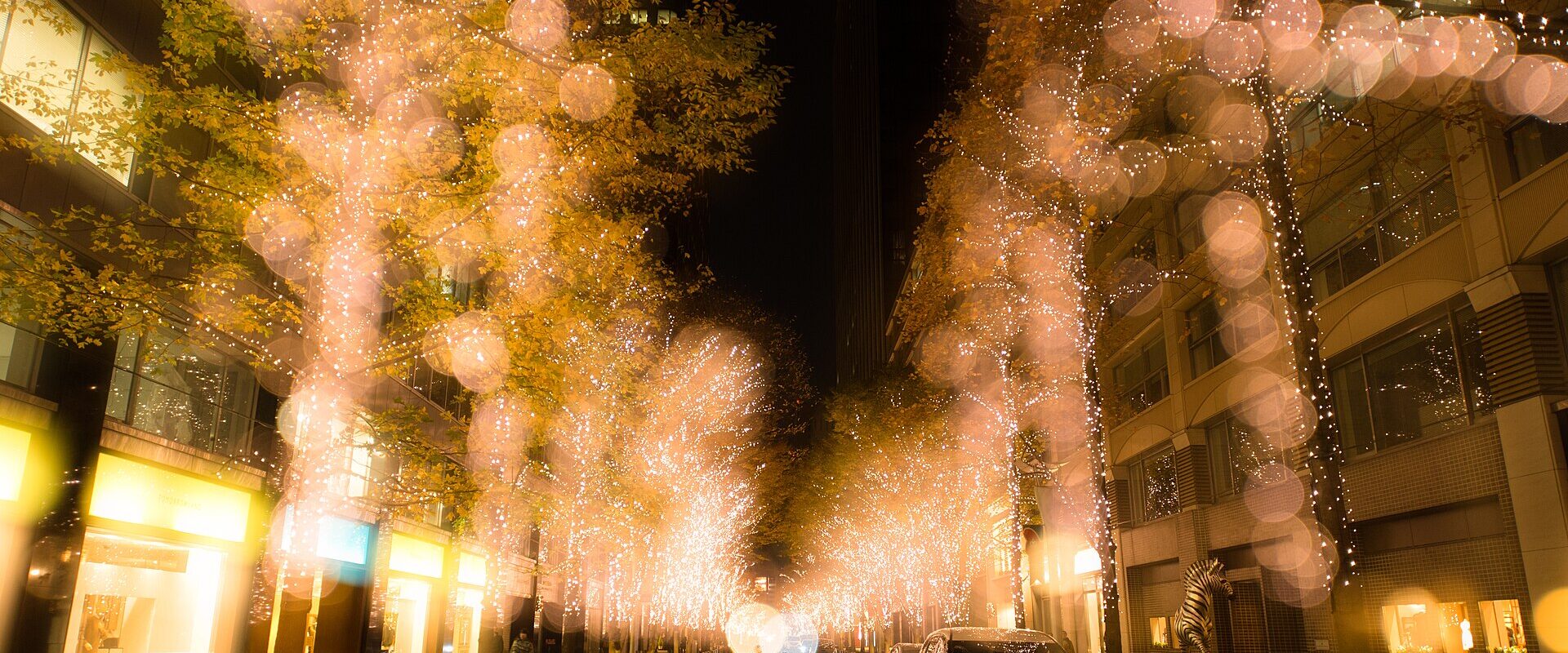
About 1.2 kilometres of Naka-dori, the boulevard through Marunouchi by Tokyo Station, wrapped in a warm champagne-gold LED. It works because it is restrained: one colour, a straight line of trees, and the light bouncing off the granite of a wealthy office district.
It is free, it is unfenced, and you walk down the middle of it. Nearest stations are Tokyo (Marunouchi exit) and Yurakucho. The 2025–26 edition lit about 250 trees; this season’s run is 12 November 2026 to 14 February 2027, and on a weekday evening at 18:00 it is busy but entirely walkable. Combine it with the Ginza department stores ten minutes south, which do their own window displays.
Tokyo Midtown — the photograph everyone wants
Midtown’s garden lawn in Roppongi is turned into a field of blue and white LEDs — a rolling, wave-like installation with arches over it and Tokyo Tower visible behind. It is the single most striking illumination in the city and it is also free, which makes the “is it worth it” question straightforward.
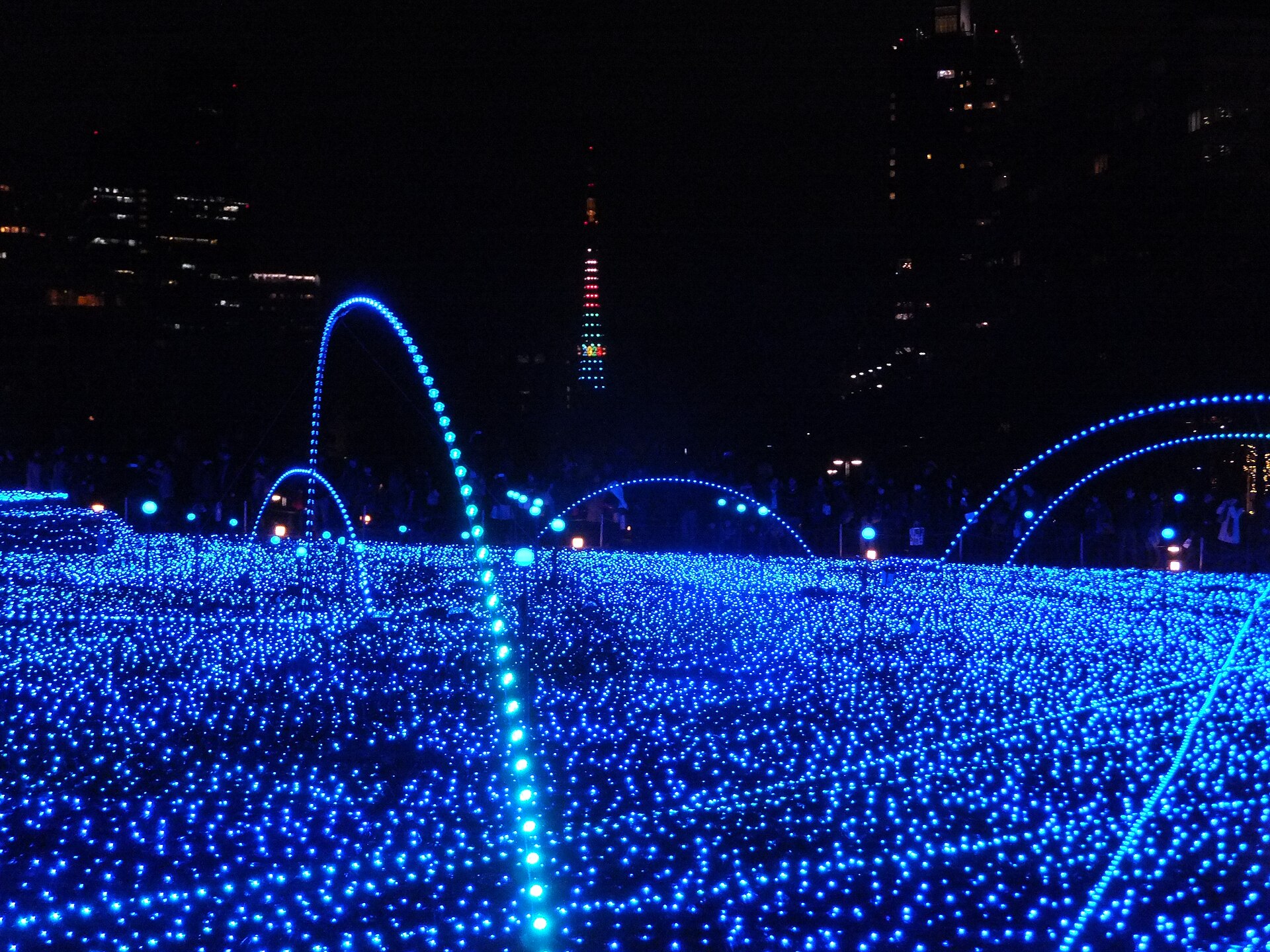
Go before 18:00 on a weekday or accept a genuine crush. The viewing area is a defined path around the lawn and it does not expand to fit the crowd. Nearest station is Roppongi on the Hibiya or Oedo lines; the Roppongi guide covers what else is worth doing in the area once the lights are behind you.
Roppongi Hills Keyakizaka — the Tokyo Tower shot
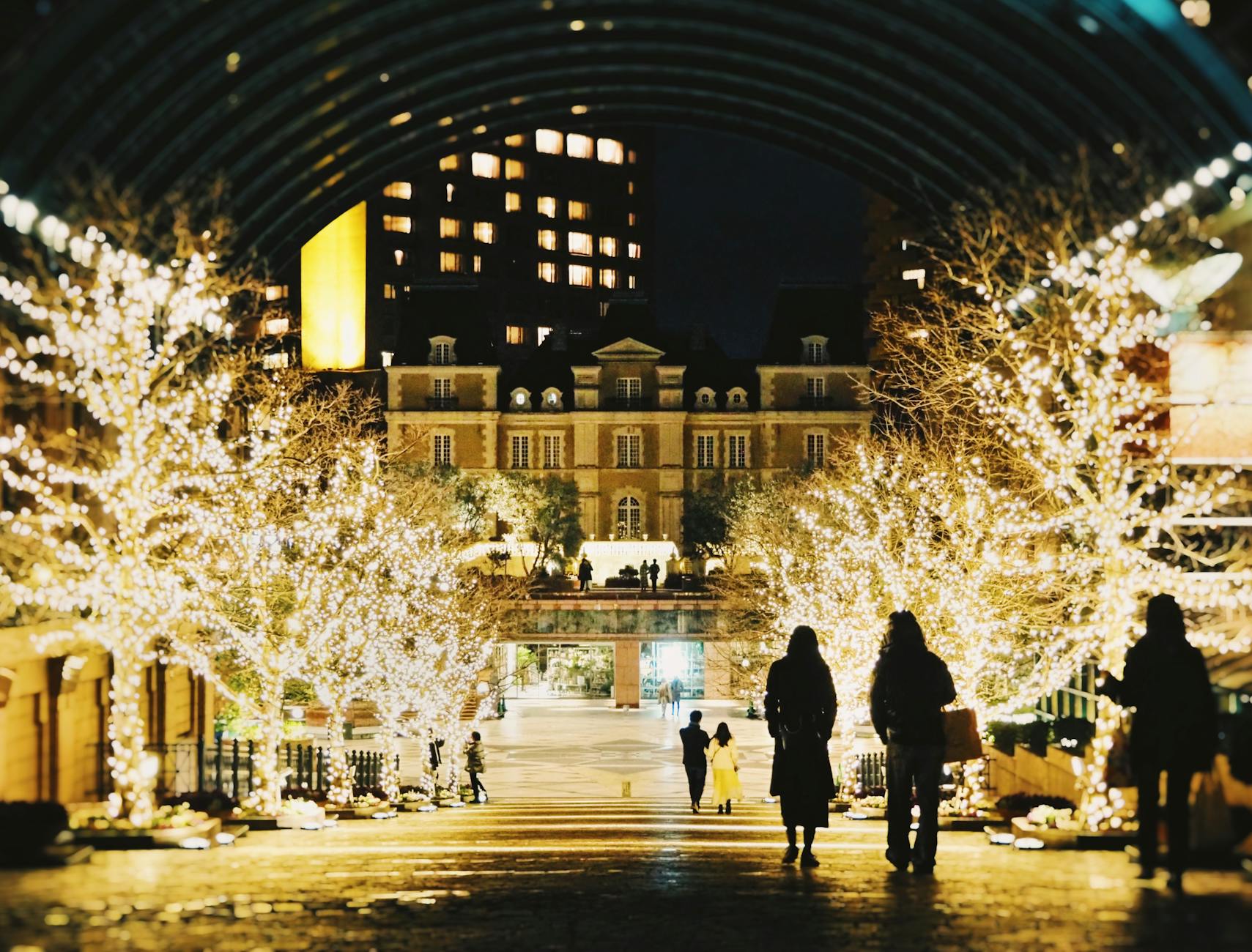
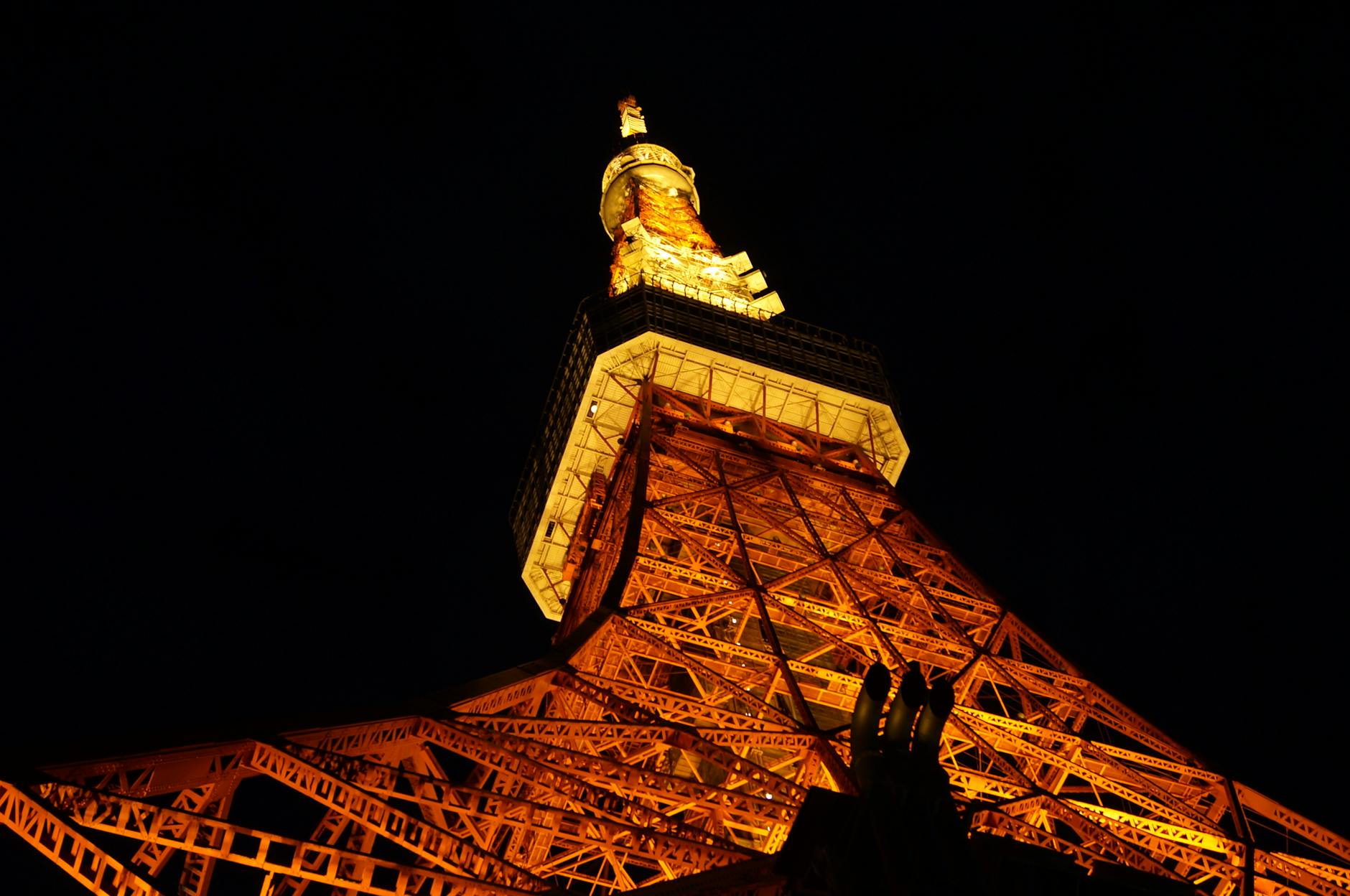
Four hundred metres of zelkova trees on Keyakizaka-dori, lit in blue-white, with Tokyo Tower sitting perfectly at the end of the slope. It is the postcard, it is a five-minute walk from Midtown, and doing both in one evening is the obvious plan.
The photograph everyone takes is from the pedestrian bridge partway down, which develops a polite but immovable queue on December weekends. For a better chance of a short wait, go on a weekday soon after sunset, which falls at 16:28 on 1 December. Our Tokyo photo spots guide has more on the blue-hour timing.
Caretta Shiodome — the one with a show
Caretta is a shopping complex above Shiodome station, and its illumination is a timed light-and-sound performance in a sunken plaza rather than a static display: a theme, a soundtrack, and a sequence that runs on a loop through the evening, typically every twenty minutes or so.
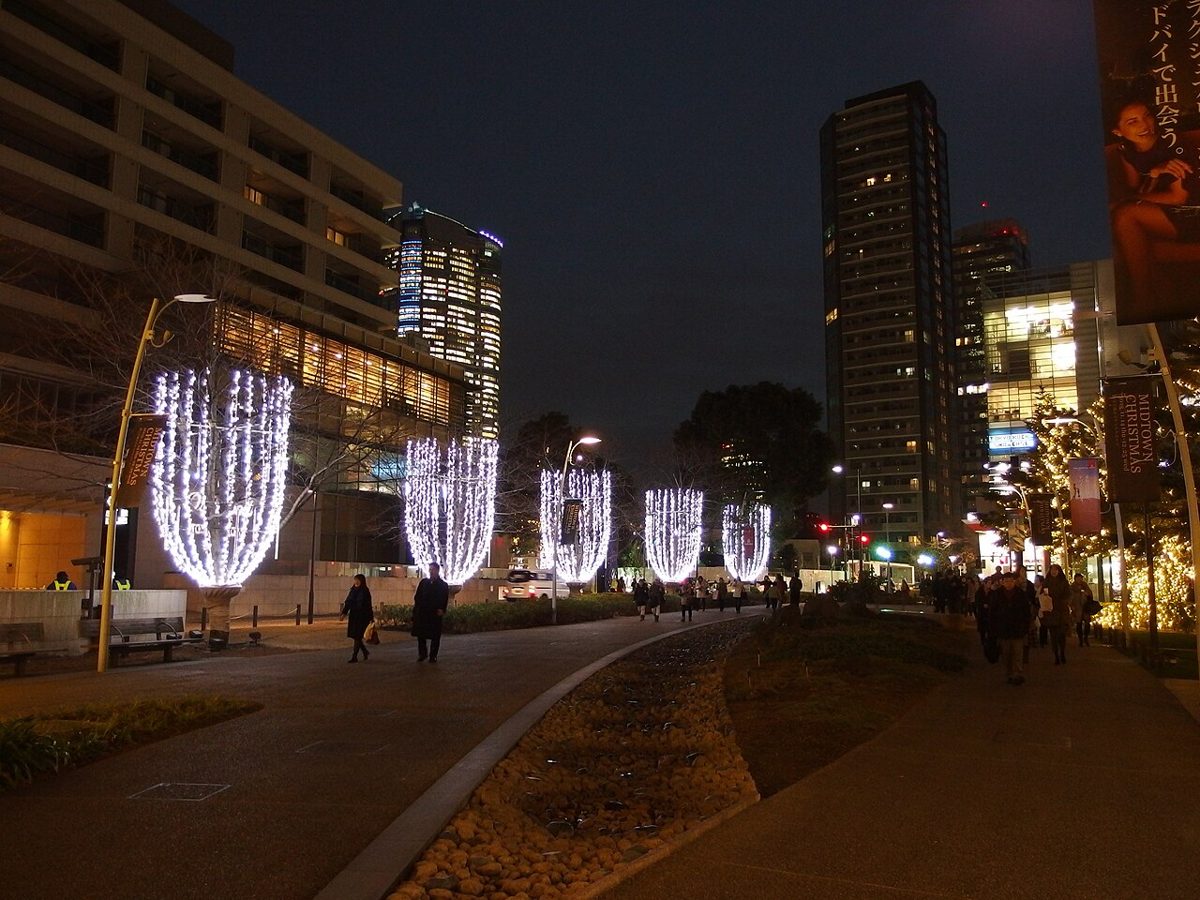
It is free, it is indoors-adjacent and sheltered, and it runs later in the winter than the Roppongi displays. It also suits a wet or brutally cold evening better than anything else on this list, which matters in January. Shiodome connects directly to Shimbashi on the Yamanote Line.
Yebisu Garden Place — twenty minutes, then dinner
The centrepiece is a five-metre Baccarat crystal chandelier under the glass canopy of the plaza, lit from November into early January, with a large tree alongside it. It is beautiful and it is small — this is a twenty-minute visit, not an evening.
What makes it worth the trip is what surrounds it. Ebisu is one of the better eating neighbourhoods in Tokyo, the plaza is a three-minute covered walk from Ebisu station on the Yamanote Line, and the sequence of chandelier, then a proper dinner, then a bar is a genuinely good night out. It appears in our Tokyo romantic itinerary for exactly that reason.
Shinjuku, Shibuya and the department stores
- Shinjuku Southern Terrace — a straightforward free walk-through beside the station, on the way to somewhere else. Fine, not a destination.
- Shibuya — the ward has run a large-scale “Blue Cave” style display in some years and not others, and the location has moved. Check before you plan an evening around it.
- Department store windows — Ginza’s Mitsukoshi and Wako, Nihombashi Mitsukoshi and Isetan Shinjuku all do serious Christmas windows from mid-November. Free, five minutes each, and better than several ticketed events.
- Tokyo Skytree and Tokyo Tower — both run winter colour schemes. If you are deciding between going up one of them, our Skytree vs Tokyo Tower comparison settles it.
The paid ones, and whether they are worth it
A whole category of Japanese illumination is ticketed and out in the suburbs or the neighbouring prefectures. Some of these are genuinely spectacular in a way nothing in central Tokyo is; others are a car park with LEDs and an entry fee. Check the current price on the operator’s own site — these change every season.
| Venue | Getting there | Worth it? |
|---|---|---|
| Ashikaga Flower Park, Tochigi | ~2h by regular JR trains, ~80 min by shinkansen via Oyama | Yes — its illumination is often ranked among Japan’s top three, a genuine day trip |
| Sagamiko Illumillion, Kanagawa | Check the route from your station | Yes if you like scale; the Rainbow Lift is the point |
| Yomiuriland Jewellumination, Inagi | ~35 min from Shinjuku, plus the Sky Shuttle gondola | Only with children — it is an amusement park first |
| Tokyo Mega Illumination, Oi Racecourse | ~20 min by bus from Shinagawa, then a 5-min walk | Marginal; convenient rather than beautiful |
| Tokyo German Village, Chiba | Bus, ~1h from Tokyo Station | No, unless you are driving and have children |
The honest position: with Marunouchi, Midtown, Keyakizaka and Caretta all free and all within thirty minutes of each other, paying for an illumination in Tokyo only makes sense if you want something the city cannot offer — hillside scale at Sagamiko, or the sheer size of Ashikaga. Everything else on the paid list is a worse version of something free.
Two routes that work
The displays cluster geographically, which makes this easy. Two evenings covers everything in central Tokyo worth seeing, and neither route needs a taxi.
Evening one: Roppongi, about two hours
Arrive at Roppongi station on the Hibiya or Oedo line around sunset. Tokyo Midtown is directly above the station — do the garden installation first while the sky still has colour, then cut through the complex, which is worth a look for the Christmas market stalls it runs in the plaza. Walk five minutes south-west to Roppongi Hills and down Keyakizaka-dori for the Tokyo Tower view, then either eat in Roppongi or take the Hibiya line two stops to Ebisu for the Yebisu Garden Place chandelier and a considerably better dinner.
Total cost: two train fares. Total walking: under two kilometres. This is the single highest-value winter evening in Tokyo and it is essentially free.
Evening two: Marunouchi, Ginza and Shiodome
Start at Tokyo Station’s Marunouchi side around 17:00 — the restored 1914 red-brick station building is itself floodlit and is the best thing at the north end of the walk. Head down Naka-dori through the gold-lit trees, which takes about twenty-five minutes at a slow pace, and continue into Ginza for the department store windows on Chuo-dori. Finish at Caretta Shiodome, ten minutes further south, timed to catch one of the light shows.
This route is entirely flat, entirely covered by the Yamanote Line if you tire of it, and works well in rain because so much of Ginza and Shiodome is under cover — see our rainy day guide for the wet-weather variants.
If you only have one evening
Do Roppongi. Midtown plus Keyakizaka in a single hour is the densest concentration of good illumination in Japan, and the Tokyo Tower backdrop is something no other city can offer. Marunouchi is the better walk, but Roppongi is the better photograph, and if you are choosing on a single December night the photograph wins.
How to actually do an illumination evening
Sunset in Tokyo is around 16:30 in December, which means the lights are on early in the evening and there is no need to stay out late.
- Dusk is the good light. Blue hour, when the sky still has colour and the LEDs are already on. Photographs taken at 19:00 against a black sky look flat by comparison.
- Weekdays, always. Friday and Saturday evenings in December at Midtown or Keyakizaka are two to three times busier than a Tuesday.
- Avoid 24 December entirely. Christmas Eve in Japan is a couples’ night, restaurants are booked out months ahead, and every illumination is at maximum density.
- Chain them. Midtown and Roppongi Hills are a five-minute walk apart. Marunouchi, Caretta Shiodome and Ginza are all on one Yamanote-and-walk loop. Two clusters, two evenings, done.
- Tripods are usually banned at the busy sites for crowd-flow reasons. A small camera with decent low-light performance beats a rig you cannot set up.
Staying warm, which is the real problem
Standing still outdoors for two hours on a December evening is colder than the forecast suggests, and the average December low in Tokyo is 3.8°C. Vending machines sell hot canned coffee and corn soup, and the cans double as hand warmers. Convenience stores sell adhesive kairo heat pads, which are well worth packing for an illumination night. The Tokyo winter guide has the rest of the cold-weather practicalities.
With children, and on a budget
Illuminations are one of the best free things to do with children in a Tokyo winter, with one caveat: the crowd density at Midtown and Keyakizaka is not pushchair-friendly on a December weekend. Caretta Shiodome is better — the show gives small children something to watch rather than just walk past, and the plaza is sheltered.
Because almost everything here is free, an illumination evening is close to a zero-cost activity: two train fares and a hot drink. It sits alongside the rest of our Tokyo free attractions, and it is a considerably better use of a December evening than most paid attractions. For families, the Tokyo with kids guide has the routes that work with short legs.
What is not worth it
Three honest warnings.
First, the queue-managed one-way viewing corridors. Some displays in peak week put you in a barriered line that moves continuously and does not let you stop. You will see the lights for ninety seconds after waiting forty minutes. If you arrive and see a queue with staff holding numbered signs, come back later in the evening instead, well before that display’s switch-off time.
Second, paying for a suburban display when you have not yet seen the free central ones. This happens because the paid ones market harder.
Third, planning an illumination trip for late December without checking end dates. It is an easy mistake to avoid: the Roppongi Hills Christmas programme ends on 25 December, while many other Tokyo illuminations continue into February. Our events and festivals calendar tracks what replaces them.
The lights are only part of what December does. Bonenkai season fills the izakaya from the first week, the Chichibu night festival runs on the 2nd and 3rd, Sensoji’s battledore market takes over Asakusa mid-month, and the city shuts down almost entirely after the 28th — our guide to Tokyo in December has the full month.
Several of these sites put market stalls out alongside the lights, and Roppongi Hills runs a full German-style Christmas market at the top of the Keyakizaka slope. If your trip lands in the last fortnight before the 25th, our guide to Christmas in Tokyo covers the markets, the date-night pricing and what needs booking in advance.
Frequently Asked Questions
When do Tokyo illuminations start and end?
Switch-on dates vary: in 2026 Roppongi Hills starts on 5 November, Marunouchi on 12 November and Tokyo Midtown on 26 November. End dates vary sharply too: the Midtown and Roppongi Hills Christmas programmes finish on 25 December, Marunouchi runs to 14 February 2027, and at Yebisu Garden Place the Baccarat display ends on 11 January while some of its other illuminations continue until 28 February. If you are visiting between Christmas and New Year, check each display’s end date before building an evening around it.
Are Tokyo illuminations free?
The best ones are. Marunouchi, Tokyo Midtown, Roppongi Hills Keyakizaka, Caretta Shiodome, Yebisu Garden Place and the department store windows are all free to walk through. Ticketed displays exist mainly in the suburbs and neighbouring prefectures — Yomiuriland, Sagamiko, Ashikaga Flower Park — and only Ashikaga and Sagamiko offer something central Tokyo does not.
What is the best illumination in Tokyo?
Tokyo Midtown’s garden installation in Roppongi is the most striking single sight, and Roppongi Hills Keyakizaka five minutes away gives you Tokyo Tower framed at the end of a lit avenue. For a longer walk rather than one view, Marunouchi Naka-dori’s 1.2 kilometres of champagne-gold trees is the best of them.
What time should I go to see the illuminations?
Around dusk. Sunset in Tokyo is around 16:30 in December, so shortly afterwards it is blue hour — the lights are on and the sky still has colour, which is when everything photographs best. If you miss that window, go later in the evening instead, checking the display’s switch-off time first.
Can you see Tokyo illuminations in January?
Yes, but a reduced set. The Roppongi displays end on Christmas Day. Marunouchi Illumination and Caretta Shiodome usually run to mid-February, Yebisu Garden Place keeps its Baccarat chandelier until 11 January (with some lights on until 28 February), and several department store and station displays continue. A January visitor sees perhaps half of what a mid-December visitor sees.
Photo Credits
- Champagne-gold illumination on Marunouchi Naka-dori – Light decoration in Marunouchi, Tokyo (11153980263) by Takashi Hososhima from Tokyo, Japan, CC BY-SA 2.0, via Wikimedia Commons.
- The blue LED garden at Tokyo Midtown, Roppongi – Tokyo Midtown Garden Christmas Illumination 20131225-2 by 掬茶, CC BY-SA 3.0, via Wikimedia Commons.