Tokyo Neighborhoods · Guide №071
Ginza Guide: Luxury Shopping, Fine Dining & Art in Tokyo
A complete Ginza guide: Chuo-dori flagship stores and the Wako clock tower, the weekend Pedestrian Paradise, depachika food halls, Edomae sushi, Kabuki-za single-act tickets, free galleries, and how to get there.
目次 — Contents
- Chuo-dori: Ginza’s flagship shopping spine
- Ginza Six: the district’s biggest complex
- The Pedestrian Paradise: Ginza on weekends
- Eating in Ginza: from ¥1,000 to ¥40,000
- Kabuki-za: traditional theater in Ginza
- Galleries, art, and the quieter side of Ginza
- How to get to Ginza
- A half-day Ginza plan
- Mistakes to avoid in Ginza
- Frequently Asked Questions
- Photo Credits
This article contains advertising. Our booking links are routed through a partner that adds commission tracking automatically, so if you book through one we earn a commission from the provider, at no extra cost to you. It never affects what we recommend. Affiliate disclosure
This Ginza Tokyo guide covers the city’s most polished district, where 19th-century department stores, glass-walled luxury flagships, basement food halls, and some of the world’s best sushi sit within a few blocks of each other. Ginza rewards a half day of slow walking. Come on a Saturday or Sunday afternoon, when the main avenue closes to cars and the whole place opens up.
Ginza is central Tokyo’s upscale shopping and dining quarter, just east of Tokyo Station in Chuo ward, and it has been the city’s address for money and taste since the 1870s. The name itself is a clue to its history: ginza means “silver mint,” and a government silver-coin foundry stood here during the Edo period before the area was rebuilt in Western brick after an 1872 fire. That rebuild made Ginza Japan’s first modern shopping street, and more than 150 years later it is still where heritage department stores, international maisons, art galleries, and Michelin kitchens compete for the same few thousand square meters. For how Ginza fits among the city’s districts, start with our complete guide to Tokyo’s neighborhoods.
Here is the honest framing: Ginza can be as expensive as you let it be. You can drop ¥40,000 on dinner or ¥0 wandering free rooftop gardens and window-shopping flagship architecture. This guide breaks down the shopping spine of Chuo-dori, the weekend Pedestrian Paradise, where to eat at every budget, Kabuki at the Kabuki-za, the galleries and rooftops, exactly how to get here, and the mistakes that cost first-timers time and money.
Chuo-dori: Ginza’s flagship shopping spine

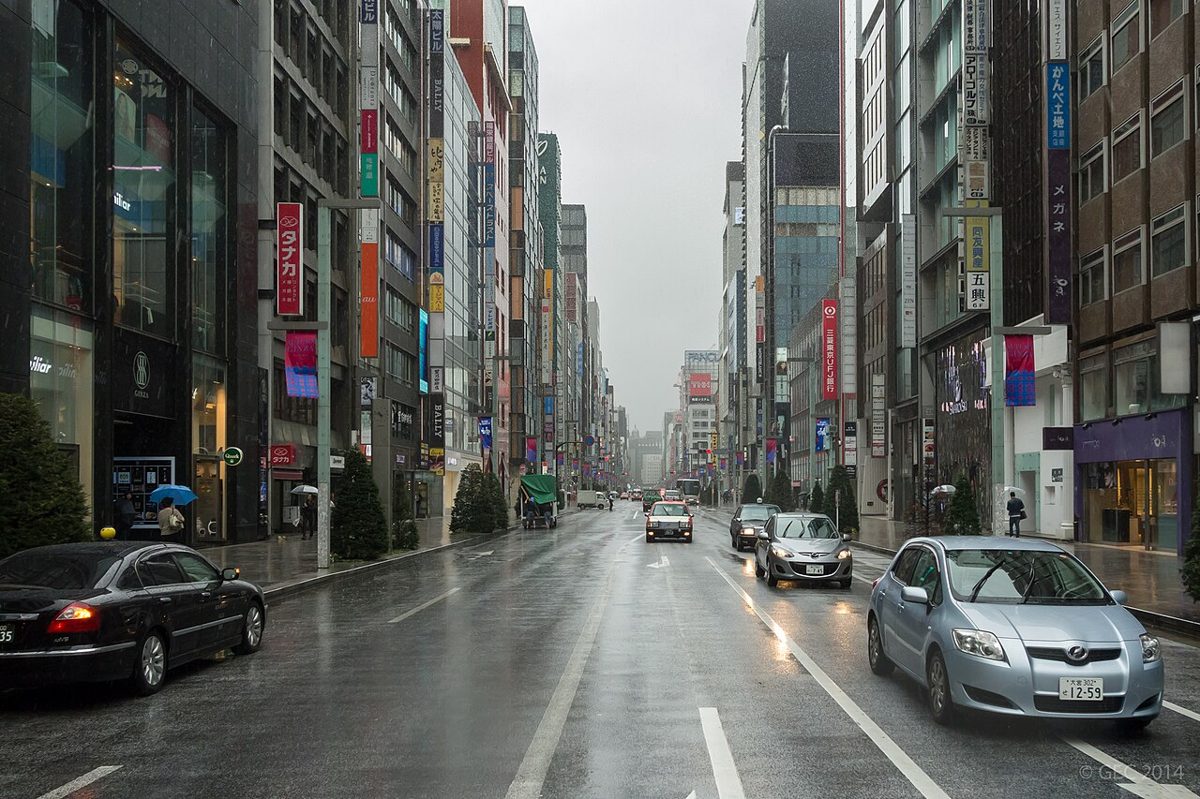
Chuo-dori (“Central Street”) is Ginza’s main artery, running roughly north-south through the district, and it is lined nose-to-tail with flagship stores. The symbolic heart is the Ginza 4-chome crossing, the intersection of Chuo-dori and Harumi-dori, anchored by a building everyone photographs without knowing its name.
That building is Ginza Wako, the elegant curved-corner department store crowned by the Hattori Clock Tower. Seiko founder Kintaro Hattori started selling watches on this corner in 1881, and the current Neo-Renaissance building (1932) has become the unofficial emblem of Ginza. Its clock chimes the Westminster melody on the hour. Wako sells watches, jewelry, and luxury goods at serious prices, but the ground-floor windows and the building itself are free to admire, and the chocolate and confectionery in the basement annex make a more affordable souvenir.
Working along Chuo-dori, the stores you will pass include:
- Ginza Mitsukoshi — the grande dame of Japanese department stores, with one of the city’s great depachika (food basements) downstairs. The rooftop has a small shrine and a terrace.
- Matsuya Ginza — a refined department store known for design, homewares, and another excellent food hall.
- Uniqlo Ginza — the brand’s 12-floor global flagship, the largest Uniqlo in the world, with a flower shop and an in-store coffee stand. The neighboring GU flagship (Uniqlo’s cheaper sister) is a few doors away.
- Itoya — a stationery temple since 1904, now spread over an 18-floor tower organized floor by floor: fountain pens, notebooks, wrapping paper, travel goods, even an 11th-floor hydroponic vegetable garden feeding the top-floor cafe. The red paperclip sign is a landmark.
- Dover Street Market Ginza — Comme des Garcons’ seven-floor concept store, part avant-garde fashion, part installation art. Free to browse and genuinely strange in the best way; the rooftop Rose Bakery does good cakes.
- Luxury maisons — Chanel (its top-floor restaurant Beige is run by Alain Ducasse), Louis Vuitton, Hermes (whose facade is made of thousands of glass blocks), Cartier, Bulgari, Dior, and more, each in an architect-designed flagship. Even if you buy nothing, the buildings are an open-air architecture tour.
For a wider view of where Ginza sits among Tokyo’s retail districts — versus Shibuya’s youth fashion or Akihabara’s electronics — see our Tokyo shopping guide, which maps out which neighborhood to hit for what.
Ginza Six: the district’s biggest complex

Two blocks south of the 4-chome crossing, Ginza Six (GSIX) is the largest shopping complex in the district, opened in 2017 on the site of the old Matsuzakaya department store. Inside are more than 240 brands, with shopping spread from B2 to 6F and part of 13F, a cavernous Tsutaya bookstore curated like an art gallery (with a coffee counter and a Starbucks Reserve), and a basement depachika food hall that is one of the best places in Ginza to assemble a cheap, delicious lunch from premium counters.
The free highlight is the rooftop garden on the 13th floor — about 4,000 square meters of lawns, trees, water features, and benches, with open views over the Ginza rooftops. It is one of the best free vantage points in the area and stays open into the evening (until around 11:00 p.m.), which makes it a quiet sunset stop after a day of walking. Take the elevator straight to 13F; you do not need to buy anything. Note that the building itself typically closes around 8:30 p.m. even though the garden hours run later, so check signage on the day.
Those department-store and complex basements deserve their own visit. Tokyo’s depachika are a genuine attraction: floor after floor of glistening bento, wagashi sweets, imported cheese, and free samples. We go deep on the best ones — including Ginza’s — in our guide to Tokyo’s depachika food halls, and it is the single smartest way to eat well in Ginza for under ¥1,500.
The Pedestrian Paradise: Ginza on weekends

The best time to experience Ginza is on a weekend afternoon, when a stretch of Chuo-dori roughly a kilometer long closes to traffic and becomes the Hokosha Tengoku — the “Pedestrian Paradise.” Cars vanish, café-style umbrellas and seating appear in the middle of the road, and you can stroll straight down the center of one of the world’s most expensive avenues.
The car-free hours run on Saturdays, Sundays, and public holidays, generally from 12:00 noon to 6:00 p.m. (April through September) and 12:00 noon to 5:00 p.m. (October through March), weather permitting. It is free, it is a Tokyo institution dating to 1970, and it completely changes the feel of the district — suddenly Ginza is relaxed rather than rushed. If you only have one window to visit Ginza, make it a weekend afternoon.
Eating in Ginza: from ¥1,000 to ¥40,000

Ginza is one of the densest fine-dining neighborhoods on earth, but it also hides plenty of affordable food if you know where to look. The trick is the gap between lunch and dinner: the same kitchens that charge a fortune at night often serve a fraction-of-the-price set at midday.
Splurge: Edomae sushi
Ginza is the spiritual home of Edomae sushi (Tokyo-style, traditionally using fish from the bay). The famous name is Ginza Kyubey, open since 1935, where chefs build the meal piece by piece in front of you. A full omakase dinner runs from roughly ¥15,000 upward, but the lunch sets are far gentler — the “Oribe” lunch (around ten pieces plus tamago and soup) and similar courses land in the ¥5,000-¥8,000 range, which for sushi of this caliber in Ginza is genuinely reasonable. Lunch service starts at 11:30 a.m.; reserve ahead, though the main counter is large enough that walk-ins sometimes work.
Ginza holds one of the highest concentrations of Michelin stars in Tokyo, from sushi to kaiseki to French. If a starred meal is the goal of your trip, our guide to Tokyo’s Michelin restaurants covers how booking works, what to expect, and how to land a lunch reservation for far less than dinner.
Mid-range and budget
- Department-store and Ginza Six depachika — build a luxe bento or grab counter sushi, tempura, and sweets for ¥800-¥1,500. Eat it on the Ginza Six rooftop or in a nearby park.
- Lunch sets at fine-dining restaurants — tempura, tonkatsu, unagi, and kaiseki spots across Ginza offer weekday lunch courses for ¥1,500-¥3,500 that would cost three times as much at dinner.
- Ramen, gyudon, and standing bars — even in Ginza you will find ramen shops and beef-bowl chains around ¥1,000, plus standing sushi and wine bars tucked into the side streets and the basements under the railway near Yurakucho.
- Cafes with a view — the cafe atop Itoya, the Tsutaya coffee counter in Ginza Six, and the various department-store tea salons let you sit in style for the price of a coffee.
One more tip: the area under and beside the elevated JR tracks toward Yurakucho, a few minutes’ walk from central Ginza, is full of cheap, smoky izakaya and yakitori joints in the railway arches — the affordable flip side of glossy Ginza, and a great place for an early evening beer.
Kabuki-za: traditional theater in Ginza

A short walk southeast of the 4-chome crossing, toward Higashi-Ginza Station, stands the Kabuki-za, Tokyo’s principal theater for kabuki — the 400-year-old stylized Japanese drama of elaborate costumes, dramatic makeup, and all-male casts. The current building (rebuilt in 2013 behind its iconic gabled facade, with a modern office tower rising behind) is a sight in itself, and you do not need a full ticket to step inside the ground-floor arcade and basement Kobikicho Hiroba, which has souvenir and snack shops.
Full performances are long — a program can run three to four hours across multiple acts, with reserved seats typically from around ¥4,000 to ¥20,000-plus depending on the seat and the month. For first-timers and short-on-time visitors, the smart option is the single-act ticket (makumi-seki): a same-day, top-tier (4th-floor) seat that lets you watch just one act, usually for a fraction of the full price. These are sold only at the theater’s dedicated single-act box office on the day, often non-reserved, and an English audio guide is available to rent. Prices and act times change every month with the program, so check the official Kabuki Web schedule before you go and arrive early, as single-act seats are limited and sell out. It is one of the most accessible ways to experience a piece of living Japanese tradition right in the middle of Ginza.
Galleries, art, and the quieter side of Ginza
Ginza has more commercial art galleries than any other Tokyo district — well over a hundred, many tucked into upper floors and side streets, and most free to enter. They range from blue-chip dealers to tiny rental spaces showing emerging artists, and gallery-hopping is a pleasant, no-cost way to spend an hour. A few anchors and stops worth knowing:
- Shiseido Gallery — Japan’s oldest existing gallery, in the basement of the Shiseido building, with free contemporary-art shows.
- Ginza Maison Hermes Le Forum — a free art space on the upper floors of the glass-block Hermes flagship.
- The Artizon Museum — a short walk toward Kyobashi, holding an outstanding collection of Impressionist and modern art (paid admission; reserve online).
- Pola Museum Annex and dozens of small commercial galleries clustered around Ginza 1-chome to 8-chome.
This is also the part of Ginza that costs nothing. Between the free galleries, the rooftop gardens of Ginza Six and Tokyu Plaza Ginza, the flagship architecture, the depachika samples, and the weekend Pedestrian Paradise, you can spend a rich half-day here and barely open your wallet.
How to get to Ginza
Ginza is exceptionally well connected. The three stations you will use:
- Ginza Station — the main hub, served by three Tokyo Metro lines: the Ginza Line (orange), the Marunouchi Line (red), and the Hibiya Line (silver). Exits A2-A4 put you right at the 4-chome crossing by Wako and Mitsukoshi.
- Higashi-Ginza Station — on the Hibiya Line and the Toei Asakusa Line, directly connected underground to the Kabuki-za. Use this one if theater or the eastern end of Ginza is your target.
- Yurakucho Station — on the JR Yamanote and Keihin-Tohoku lines (plus the Yurakucho subway line), a five-minute walk from central Ginza. This is the most useful entry if you are arriving by JR with a Japan Rail Pass or coming from Tokyo Station (which is itself one stop away, or about a 10-minute walk).
Because so many lines converge, Ginza is an easy add-on to almost any Tokyo day. It pairs naturally with Tokyo Station and the Imperial Palace to the north, Tsukiji Outer Market to the south (about a 15-minute walk for a morning of seafood before Ginza opens), and Hibiya Park to the west.
A half-day Ginza plan
A relaxed half-day, ideally on a weekend, that mixes free sights with one good meal:
- 11:30 a.m. — Start with a sushi or tempura lunch set (¥3,000-¥6,000) before prices and crowds peak, or assemble a depachika bento.
- 12:30 p.m. — Walk the Pedestrian Paradise down the middle of Chuo-dori, photographing Wako and the 4-chome crossing.
- 1:30 p.m. — Browse the flagships: Itoya for stationery, Uniqlo/GU, Dover Street Market, and the luxury maisons (window-shopping is free).
- 2:30 p.m. — Duck into a couple of free galleries (Shiseido Gallery, Hermes Le Forum).
- 3:30 p.m. — Catch a single-act kabuki performance at the Kabuki-za (check the day’s schedule) or explore the basement Kobikicho Hiroba.
- 5:00 p.m. — Finish on the Ginza Six rooftop garden for sunset, then dinner under the Yurakucho railway arches if you want something cheap and lively.
Mistakes to avoid in Ginza
- Visiting on a weekday expecting the car-free street. The Pedestrian Paradise only runs on weekends and holidays. On weekdays Chuo-dori is open to traffic and far less atmospheric.
- Assuming everything is unaffordable. Skip dinner prices; do lunch sets, depachika, free rooftops, and free galleries. Ginza can be a budget day if you plan it.
- Going only for the brands. The luxury flagships are the same the world over. Ginza’s real character is the heritage (Wako, Mitsukoshi), the food halls, the galleries, and the kabuki.
- Skipping the basements. The depachika under Mitsukoshi, Matsuya, and Ginza Six are an attraction in their own right and the best-value food in the district.
- Buying a full kabuki ticket when you are short on time. The single-act seat lets you sample kabuki for a fraction of the price and time.
- Not looking up. Much of Ginza’s best stuff — cafes, galleries, the Itoya garden, restaurants — is on the upper floors. Check the building directories at street level.
Frequently Asked Questions
Is Ginza worth visiting if you are not going to shop?
Yes. Beyond shopping, Ginza offers free architecture (the Wako clock tower, the glass-block Hermes building, dozens of designer flagships), free rooftop gardens at Ginza Six and Tokyu Plaza, well over a hundred free art galleries, kabuki at the Kabuki-za, and superb food halls in the department-store basements. A half-day of walking, gallery-hopping, and people-watching costs almost nothing.
When is the Ginza Pedestrian Paradise, and is it free?
The Pedestrian Paradise closes Chuo-dori to cars on Saturdays, Sundays, and public holidays, generally from noon to 6:00 p.m. between April and September, and noon to 5:00 p.m. from October to March, weather permitting. It is completely free and is the best time to experience Ginza, since you can walk down the center of the avenue with seating set up in the road.
How can I eat well in Ginza on a budget?
Eat lunch, not dinner. Fine-dining restaurants serve set lunches for a fraction of their evening prices — even Ginza Kyubey’s sushi lunch sets run around ¥5,000-¥8,000 versus ¥15,000-plus at night, and many tempura, tonkatsu, and kaiseki spots do ¥1,500-¥3,500 lunches. Better still, assemble a bento or counter sushi from the depachika food halls under Mitsukoshi, Matsuya, or Ginza Six for ¥800-¥1,500, and head to the Yurakucho railway arches for cheap izakaya in the evening.
Can I watch kabuki at the Kabuki-za without buying a full ticket?
Yes. The Kabuki-za sells single-act tickets (makumi-seki) that let you watch just one act from the top (4th) floor for a fraction of a full ticket’s price. They are sold on the day at the theater’s dedicated single-act box office, often as non-reserved seats, and an English audio guide is available to rent. Prices and act times change monthly with the program, so check the official Kabuki Web schedule and arrive early, as these seats are limited.
How much time do you need in Ginza?
A half day, about three to four hours, is enough to walk Chuo-dori, browse the flagships and a couple of galleries, see the Kabuki-za, and finish on the Ginza Six rooftop. Add a meal and a single-act kabuki performance and it becomes a comfortable full afternoon and evening. Ginza pairs easily with nearby Tokyo Station, the Imperial Palace, or a morning at Tsukiji Outer Market.
Photo Credits
- Chuo-dori, Ginza’s main shopping avenue, lined with flagship stores — Photo: Gary This photo was taken with Sony DSC-RX100 / CC BY-SA 2.0 via Wikimedia Commons
- Ginza Wako and the Hattori Clock Tower at the 4-chome crossing, the symbol of Ginza — Photo: geraldford / CC BY-SA 2.0 via Wikimedia Commons
- Ginza Six, the district’s largest complex, with a free rooftop garden on the 13th floor — Photo: Alejandro / CC0 via Wikimedia Commons
- The weekend Pedestrian Paradise, when Chuo-dori closes to cars — Photo: Sjaak Kempe from Groningen, The Netherlands / CC BY 2.0 via Wikimedia Commons
- Ginza after dark, when the illuminated storefronts come into their own — Photo: Basile Morin / CC BY-SA 4.0 via Wikimedia Commons
- The Kabuki-za, Tokyo’s home of kabuki, near Higashi-Ginza Station — Photo: Tak1701d / Public domain via Wikimedia Commons