Tokyo Food · Guide №048
Best Tonkatsu in Tokyo: Where to Eat Tokyo’s Crispiest Pork Cutlets
Where to eat the best tonkatsu in Tokyo: rosu vs hire, brand pork, how a teishoku set works, top shops by neighborhood with prices, katsu variations, and queue tips.

目次 — Contents
- What Is Tonkatsu? A Tokyo Invention
- Rosu vs Hire: The One Choice That Matters Most
- Regular Pork, Brand Pork, and the Wagyu Detour
- How a Tonkatsu Set (Teishoku) Actually Works
- Where to Eat the Best Tonkatsu in Tokyo, by Neighborhood
- Beyond the Cutlet: Katsudon, Katsu Curry, Menchi-Katsu & More
- Tonkatsu Tokyo Comparison: Shops, Prices & Vibe
- Queue Strategy: How to Skip the Worst of the Wait
- Ordering Without Japanese, and Mistakes to Avoid
- Frequently Asked Questions
- Photo Credits
This article contains advertising. Our booking links are routed through a partner that adds commission tracking automatically, so if you book through one we earn a commission from the provider, at no extra cost to you. It never affects what we recommend. Affiliate disclosure
The best tonkatsu in Tokyo is a thick slab of pork, breaded in panko, deep-fried until the crust shatters and the meat inside stays pink and juicy. You eat it sliced, with a mountain of shredded cabbage, a bowl of rice, and miso soup. Tokyo invented the dish, and the city still does it best, from ¥850 lunch sets near Ueno Station to ¥8,000 reservation-only counters in the suburbs. This guide covers what to order, where to go by neighborhood, and how to eat a set the way locals do.
Spend a week eating here and you start to understand why Tokyoites argue about tonkatsu the way other cities argue about pizza or barbecue. The gap between a forgettable cutlet and a great one is enormous, and it comes down to four things: the cut of pork, the breed of pig, the frying technique, and how you eat it. Get those right and a humble fried-pork lunch turns into one of the most satisfying meals in the city. For the bigger picture of what to eat across town, start with our Tokyo food guide; this is the deep dive on the cutlet.
What Is Tonkatsu? A Tokyo Invention
Tonkatsu (とんかつ) combines ton (pork) and katsu, a shortening of katsuretsu, the Japanese take on the European “cutlet.” It is classed as yoshoku, Western-inspired Japanese food, the same family as curry rice and hamburg steak. The dish was born in central Tokyo. In 1895 a Ginza restaurant called Rengatei began serving thin, schnitzel-style pork cutlets and is credited with pairing them with the raw shredded cabbage that still comes with every set in the country.
The thick-cut version you picture today came later. Around 1929, a shop called Ponchiken in Ueno started deep-frying chunky slabs of loin and is widely credited as the first to use the word “tonkatsu.” Ponta Honke (ぼん多本家), opened in Okachimachi in 1905 and still running, has its own claim on the cutlet’s development, inspired by Wiener schnitzel. The exact origin story has a few authors, but the geography is consistent: tonkatsu was developed in the Ginza, Ueno, and Nihonbashi area during the late Meiji and early Showa eras. When you eat it here, you are eating it where it was invented.

Rosu vs Hire: The One Choice That Matters Most
Every tonkatsu menu opens with the same decision: rosu (ロース) or hire (ヒレ). This is the cut, and it shapes the whole meal. Most first-timers order without knowing the difference, so here it is.
Rosu is loin. It has a band of fat running along one edge and marbling through the meat. Fried properly, that fat renders and bastes the pork from the inside, giving you a rich, juicy, faintly sweet bite. Rosu is the default in Japan, what most people mean when they just say “tonkatsu.” If you want the full experience, fat and crunch and an indulgent finish, order rosu.
Hire is fillet (tenderloin). It is the lean inner muscle along the spine, with almost no visible fat, a fine grain, and a soft, buttery texture. The flavor is lighter and lets the pork itself come through. A whole pig yields only about a kilo of hire versus roughly four-and-a-half kilos of loin, so hire usually costs ¥200–¥500 more on the menu. One quirk: because hire is so lean, it actually absorbs more frying oil than rosu, whose fat repels some of it, so the calorie gap between the two is smaller than you would think. If you are ordering hire purely to “eat light,” the advantage is modest.
Neither cut is better; they are different meals. At most shops a rosu set runs ¥1,200–¥1,800, with hire a few hundred yen more. At premium shops the gap narrows or the prices flip.
Regular Pork, Brand Pork, and the Wagyu Detour
Standard tonkatsu uses commercial pork, and at a good shop, fried well, it is a genuinely excellent meal. But “brand pork” (meigara-buta) is a real step up, and Tokyo’s better specialists make a point of naming theirs.
Kurobuta and named brands
Kurobuta (黒豚, “black pig”) is the Berkshire breed, brought to Kagoshima in southern Japan during the Meiji era. Kagoshima kurobuta is the famous one: purebred Berkshire, raised in Kagoshima, fed sweet potato for the final 60 days, which gives the fat a cleaner, sweeter taste. The muscle fibers are finer, so it eats more tender; the fat has a lower melting point, so it dissolves faster on your tongue. In a side-by-side, most people can tell the difference. Beyond kurobuta you will see brands like Tokyo X, Hayashi SPF pork from Chiba (“Specific Pathogen Free,” prized for flavorful fat), Sangenton (a three-breed cross) from Yamagata, and farm-named pork listed by producer. A kurobuta or premium-brand rosu set typically runs ¥2,500–¥3,500, roughly double a standard lunch. If you are eating tonkatsu once, splurge; if you are eating it several times, have one premium meal as a benchmark and let your palate decide.
Gyukatsu and beef katsu
Pork is the original, but Tokyo also runs hard on gyukatsu (牛かつ), breaded beef cutlet served rare. At chains like Gyukatsu Motomura you get a pink, lightly fried slab plus a personal hot stone to sear each slice to your liking; wasabi-soy is the move. At the top end, shops fry wagyu and Kuroge (Japanese Black) beef. It is a different dish with a different texture, leaner and beefier, and worth a meal if you have already had your fill of pork. For more carnivorous splurges across the city, our Tokyo food guide maps out where wagyu fits in.
How a Tonkatsu Set (Teishoku) Actually Works
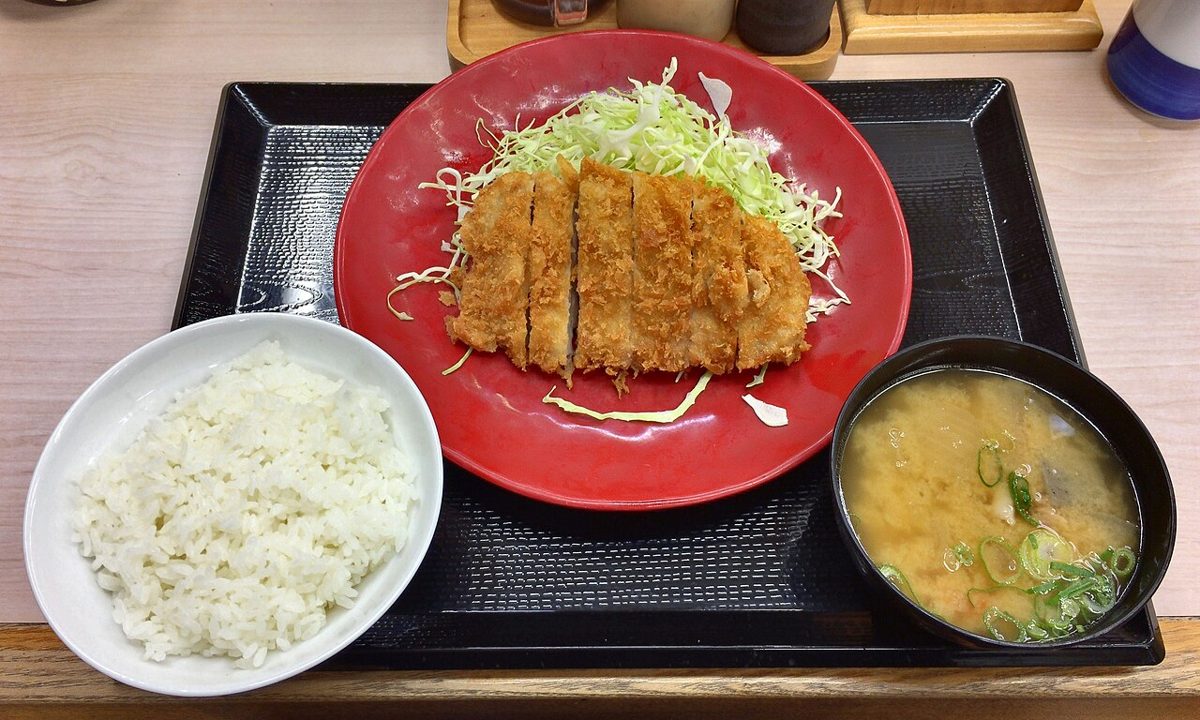
A tonkatsu teishoku (定食, set meal) lands as a tray with several parts, and how you handle them makes a difference. Here is the ritual locals follow.
The cabbage, sauce, and sesame ritual
At many shops the first thing on the table is a small mortar of toasted sesame seeds and a wooden pestle. You grind the sesame yourself until it is fragrant, then pour the tonkatsu sauce into the bowl to make a nutty, custom dip. The cabbage, a mound of finely shredded raw cabbage beside the cutlet, is not garnish; its cold crunch resets your palate between rich, fried bites. Most shops refill it for free, so eat it generously, dressed with sauce, a squeeze of lemon, or a sesame-ponzu dressing. The standard sauce (Bull-Dog is the classic brand) is thick, dark, and fruitier than Worcestershire. Pour a small pool and dip; do not drown the cutlet, or the crust goes soggy and you have wasted the whole point.
Mustard, salt, rice, and miso
A dab of karashi (hot Japanese mustard) usually sits on the plate; a thin swipe on a piece or two gives a sinus-clearing contrast, but not every bite needs it. Better shops offer flavored or rock salt as an alternative to sauce, especially with premium pork; try the first bite with salt only, the way you would eat good sushi with just a touch of soy, so the meat’s natural sweetness comes through. Rice and miso soup are always included, and at most shops both, along with the cabbage, are refillable (ask for okawari). The order that works: cabbage first, then a bite of pork with salt or a light dip, alternate pork-rice-cabbage, and finish with the miso. The principle is contrast: rich then fresh, fried then plain.
Where to Eat the Best Tonkatsu in Tokyo, by Neighborhood
Tonkatsu exists at every price point here. Below are reliable picks grouped by area and budget, with the kind of detail you need to actually get fed. Hours and prices shift, so treat figures as a guide and check before a special trip. For more wallet-friendly meals around these same stations, pair this with our guide to cheap eats in Tokyo.
Ueno & Okachimachi: the birthplace
This is where tonkatsu was born, and the Ueno-Okachimachi blocks still hold the heavyweights. Ponta Honke (3-23-3 Ueno; roughly 11:00–14:00 and 16:30–20:20, closed Mondays) has run since 1905. It uses only the lean part of the loin and fries low and slow in house-rendered lard for over ten minutes, producing a richer, old-fashioned cutlet; sets land around ¥2,000–¥3,000. A short walk away, Tonpachitei in the Tanuki-koji alley (4-3-4 Ueno; lunch only, about 11:30–14:30, closed Mondays) is a 15-seat lunch spot with English menus, a lighter rose-colored cutlet, and a choice of sauce, Worcestershire, soy, or salt; expect a line, so arrive before opening. For budget, Tonkatsu Yamaya near Ameyoko does a loin set with rice, cabbage, miso, and pickles for around ¥850, one of the best cheap cutlets in the city. And Isen Honten near Okachimachi (since 1930) is famous as the birthplace of the katsu sandwich, with chopstick-tender pork; great for a souvenir box to eat on the shinkansen.
Harajuku, Aoyama & the west side
Maisen‘s Aoyama main store (4-8-5 Jingumae, Omotesando) is the famous one: a former bathhouse turned tonkatsu hall, open all day, with everything from an affordable loin set to Kurobuta and Okinawan Agu pork. It is tourist-friendly and reliable, and its hire-katsu sandwiches sold at station counters are a citywide snack institution. Nearby in Harajuku, Tonkatsu Nanaido (Bib Gourmand) fries gently in lard at low temperature and rotates brand pork like Tokyo X and Hayashi SPF, served on Imari porcelain with mustard, pink salt, and a plum-tinged house sauce. Further west, Tonkatsu Keita in Nishi-Ogikubo (Bib Gourmand, Chuo line) and Tonkatsu Aogi in Kamata (a Tabelog Hyakumeiten regular) are pilgrimage shops where locals queue 30-plus minutes; budget ¥1,500–¥2,500.
Central Tokyo: Ginza, Nihonbashi & the business districts
For an omakase-style splurge, Ginza Katsukami serves tonkatsu piece by piece like a tasting course, with the chef pairing each cut to a condiment; lunch from around ¥3,800, dinner from about ¥7,700, using Yonezawa and Tokyo X pork. Nihonbashi Tonkatsu Hajime built a cult following on a thick yaki-katsudon (deep-fried pork over rice with egg, from roughly ¥1,980); queues can hit a couple of hours, but its second branch nearby eases the wait. In the office districts, the Maruya lunch counters near Shinbashi, Otemachi, and Hamamatsucho do a loin set from ¥700–¥800 with free rice and miso refills, the salaryman special; arrive at 11:30 or after 1pm to dodge the rush.
Reliable chains when you just want a good cutlet
If you are not hunting a specific shop, the chains feed Tokyo every day and rarely miss. Tonkatsu Wako (30-plus branches, easy to find in department stores and station buildings) pioneered the free rice-miso-cabbage refill model; a loin set runs about ¥1,000–¥1,200. Saboten works as both a sit-down restaurant and a takeaway counter you will spot in depachika basements. These are also among the most reliable cheap eats in Tokyo sit-down options for a filling, protein-heavy meal.
Beyond the Cutlet: Katsudon, Katsu Curry, Menchi-Katsu & More
Once you love the cutlet, the spin-offs open up, and several are weeknight staples you will see on menus everywhere from specialist shops to the city’s cheapest diners and stand-up counters.
Katsudon
Katsudon (カツ丁) is a sliced cutlet simmered briefly with onions in a sweet-savory dashi broth, bound with beaten egg (the tamago-toji style), and slid onto a bowl of rice. It is comfort food, and by superstition it is eaten the night before a big day, because katsu sounds like “to win.”
Katsu curry
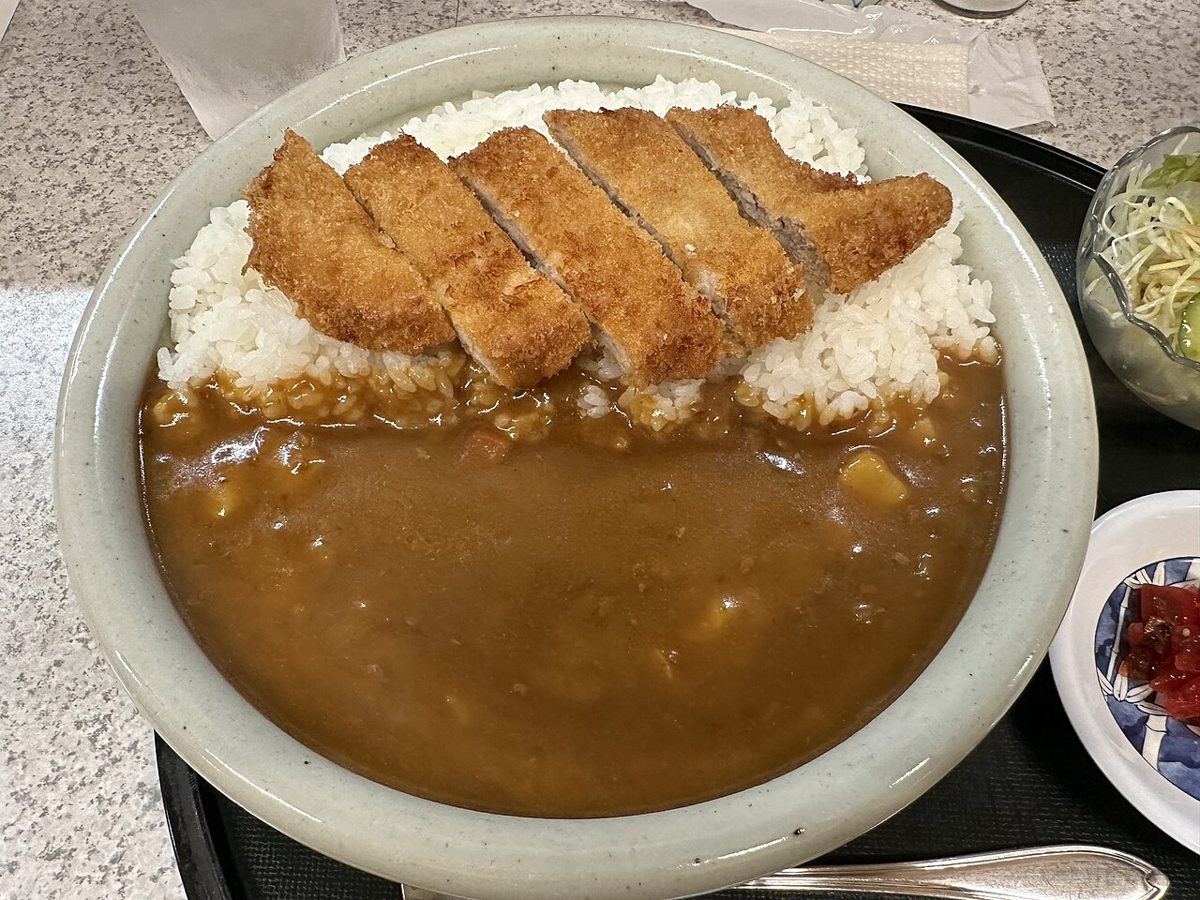
Katsu curry (カツカレー) lays a crisp cutlet over rice and douses it with mild, glossy Japanese curry, sweeter and thicker than Indian-style. The cutlet is usually pre-sliced so you can eat the whole thing with a spoon. It is heavy, glorious, and a favorite hangover cure.
Menchi-katsu and katsu sando
Menchi-katsu (メンチカツ) swaps the whole cutlet for a breaded, deep-fried patty of minced pork or a pork-beef blend, juicy inside and brilliant as a street snack; you will find it at butcher shops and in market stalls, and it overlaps with the world of Tokyo street food. The katsu sando, a fillet cutlet between soft milk bread, was reportedly invented at Isen in Ueno so geisha could eat without smudging their makeup; today it ranges from konbini shelves to luxury wagyu versions.
Tonkatsu Tokyo Comparison: Shops, Prices & Vibe
| Shop | Area / Station | Set price (approx.) | Why go |
|---|---|---|---|
| Ponta Honke | Okachimachi / Ueno | ¥2,000–3,000 | 1905 institution; lard-fried lean loin, old-school flavor |
| Tonpachitei | Ueno (lunch only) | ¥1,300–2,000 | Tiny, English menu, light rose-colored cutlet |
| Tonkatsu Yamaya | Ueno / Ameyoko | from ~¥850 | Best cheap loin set near the station |
| Maisen | Omotesando / Harajuku | ¥1,500–4,000+ | Famous all-day hall; Kurobuta & Agu options |
| Tonkatsu Nanaido | Harajuku | ¥1,800–3,000 | Bib Gourmand; rotating brand pork, refined |
| Ginza Katsukami | Ginza | lunch from ~¥3,800 | Omakase-style, served piece by piece |
| Maruya | Shinbashi / Otemachi | from ~¥700 | Salaryman lunch counter, free refills |
| Tonkatsu Wako | Citywide chain | ¥1,000–1,200 | Reliable everywhere; free rice/miso/cabbage refills |
| Tonkatsu Aogi | Kamata (Keikyu line) | ¥1,500–2,200 | Hyakumeiten-level; worth the trip, expect a queue |
Queue Strategy: How to Skip the Worst of the Wait
The famous shops have lines, but they are predictable. A few habits will save you 30–60 minutes.
- Use the 11:30 rule. Office workers flood tonkatsu shops at noon. Arrive by 11:30 and you usually walk in; after 1:00 pm works too, though some places sell out of premium cuts by then.
- Go on a weekday. Pilgrimage shops like Aogi in Kamata and Keita in Nishi-Ogikubo have brutal weekend queues; midweek you wait half as long.
- Lunch beats dinner for value. The same pork and kitchen often cost 20–30% less at lunch. A premium shop's lunch set is frequently a smarter spend than its dinner.
- Reserve where you can. A few high-end shops (the reservation-only blonde-cutlet specialists in the suburbs, for example) seat everyone at once per session, so being even five minutes late can cost your slot.
- Have a backup. If the line is absurd, a nearby Wako or Maruya is rarely a step down for a casual lunch.
Ordering Without Japanese, and Mistakes to Avoid
You do not need much Japanese. Menus usually have photos; point and hold up fingers for quantity. Many budget shops use a ticket machine (shokkenki) at the door, insert cash, press the button, hand the ticket to staff. The phrases worth knowing: rosu katsu teishoku (loin set), hire katsu teishoku (fillet set), kurobuta (premium black pork), and okawari (refill).
- Do not drown the cutlet in sauce. The crust is the dish. A light dip keeps it crisp.
- Try premium pork with salt first. Sauce can mask the very flavor you paid extra for.
- Eat the cabbage, and refill it. It is free at most shops and it makes the meal.
- Note the dietary reality. Tonkatsu is pork; the miso usually contains fish dashi, and oil is shared. It is not a vegetarian-friendly meal.
- Pair it across the trip. Tonkatsu is heavy. Balance a cutlet lunch with a lighter dinner, perhaps the best sushi in Tokyo or a clean bowl from our Tokyo ramen roundup, so you are not eating fried food twice in a day.
If you are more of a beef person, the same counter-and-grill appeal carries over to yakiniku, where you cook plates of tongue, rib and skirt yourself at the table. It runs from one-person sets at around ¥1,000 to wagyu dinners well into five figures. Our best yakiniku in Tokyo guide explains the cuts and where to go at each budget.
Frequently Asked Questions
What is the difference between tonkatsu and katsu?
“Katsu” is short for katsuretsu (cutlet) and refers to any breaded, deep-fried cutlet, chicken katsu, gyukatsu (beef), and so on. “Tonkatsu” specifically means the pork version (ton = pork). So all tonkatsu is katsu, but not all katsu is tonkatsu.
Should I order rosu or hire?
Order rosu (loin) if you want the classic, richer cutlet with a band of fat that keeps it juicy; it is the Japanese default. Order hire (fillet) if you prefer a leaner, more tender, lighter-tasting piece. Hire usually costs a little more because each pig yields far less of it.
How much does a good tonkatsu meal cost in Tokyo?
A solid chain or budget loin set runs roughly ¥850–¥1,200 with free rice and cabbage refills. Independent specialists land around ¥1,500–¥2,500, and premium Kurobuta or brand-pork shops run ¥2,500–¥4,000+. Lunch sets are typically 20–30% cheaper than the same food at dinner.
Do I need a reservation for tonkatsu in Tokyo?
Most shops are walk-in only, including the famous Ueno institutions and the chains. A handful of high-end, reservation-only specialists (such as the suburban blonde-cutlet shops) require booking and seat guests in timed sessions. For everywhere else, the move is to arrive by 11:30 am or after 1:00 pm to beat the lunch queue.
Where did tonkatsu originate?
In Tokyo. Rengatei in Ginza served thin pork cutlets from 1895 and is credited with the shredded-cabbage side; the thick-cut modern tonkatsu is tied to Ponchiken in Ueno around 1929, with Ponta Honke (1905) also part of the origin story. The Ueno–Okachimachi area is still considered the dish's birthplace.
If you try tonkatsu once in Tokyo, order the rosu, grind your own sesame, go easy on the sauce, and eat the cabbage. It is one of the city’s most underrated meals, a century of refinement hiding inside a fried-pork lunch. When you are ready to plan the rest of the day’s eating, the Tokyo food guide ties it all together.
Photo Credits
- Hero image — Photo: Andy Li / CC0 via Wikimedia Commons via Wikimedia Commons
- Loin cross-section — Photo: RightCowLeftCoast / CC BY-SA 4.0 via Wikimedia Commons via Wikimedia Commons
- Katsu curry — Photo: ノボホショコロトソ / CC BY 4.0 via Wikimedia Commons via Wikimedia Commons
- Teishoku set — Photo: 毒島みるく / CC0 via Wikimedia Commons via Wikimedia Commons
- Katsu spread — Photo: Harrison Keely / CC BY 4.0 via Wikimedia Commons via Wikimedia Commons