Tokyo Events & Festivals · Guide №132
Christmas in Tokyo: Markets, Illuminations and Why It Is a Date Night
Christmas is a working day in Japan and Christmas Eve is a date night. The markets, the KFC tradition, what to book by November, and what stays open.
目次 — Contents
- How Japan ended up with this version of Christmas
- Christmas markets
- The food: chicken, cake and a reservation problem
- Christmas Eve as a date night
- Where to actually spend the evening
- Christmas with children
- Church services in English
- What is open on 25 December
- Gifts and shopping
- A Christmas plan that works
- Is Christmas a reason to come to Tokyo?
- Frequently Asked Questions
- Photo Credits
This article contains advertising. Our booking links are routed through a partner that adds commission tracking automatically, so if you book through one we earn a commission from the provider, at no extra cost to you. It never affects what we recommend. Affiliate disclosure
Christmas in Tokyo is a working day, a romantic occasion and an enormous retail event, in that order. Nothing closes, 25 December is not a public holiday, and the emotional centre of the whole thing is Christmas Eve — which in Japan is a date night on the scale of Valentine’s Day, with restaurant bookings taken months ahead and hotel rates to match.
That makes it a strange and genuinely enjoyable city to spend Christmas in, provided you understand what you are walking into. This guide covers the markets, the food traditions, what to book and when, where to go with children, and the honest answer to whether it is worth timing a trip around.
How Japan ended up with this version of Christmas
Roughly one per cent of Japan is Christian, so Christmas arrived as a commercial import rather than a religious observance, and it was shaped almost entirely by advertising. Department stores were running Christmas displays before the war; the fried chicken tradition dates from a KFC campaign in the 1970s; and the reframing of Christmas Eve as a couples’ night is a product of the 1980s bubble years, complete with a canon of Japanese city-pop Christmas songs that still play in every shop from mid-November.
What this means practically: the family gathering is New Year, not Christmas. If you want the emotionally significant Japanese holiday, you want the first three days of January — see our Tokyo New Year guide. Christmas is the fun, lit-up, slightly silly one.
Christmas markets
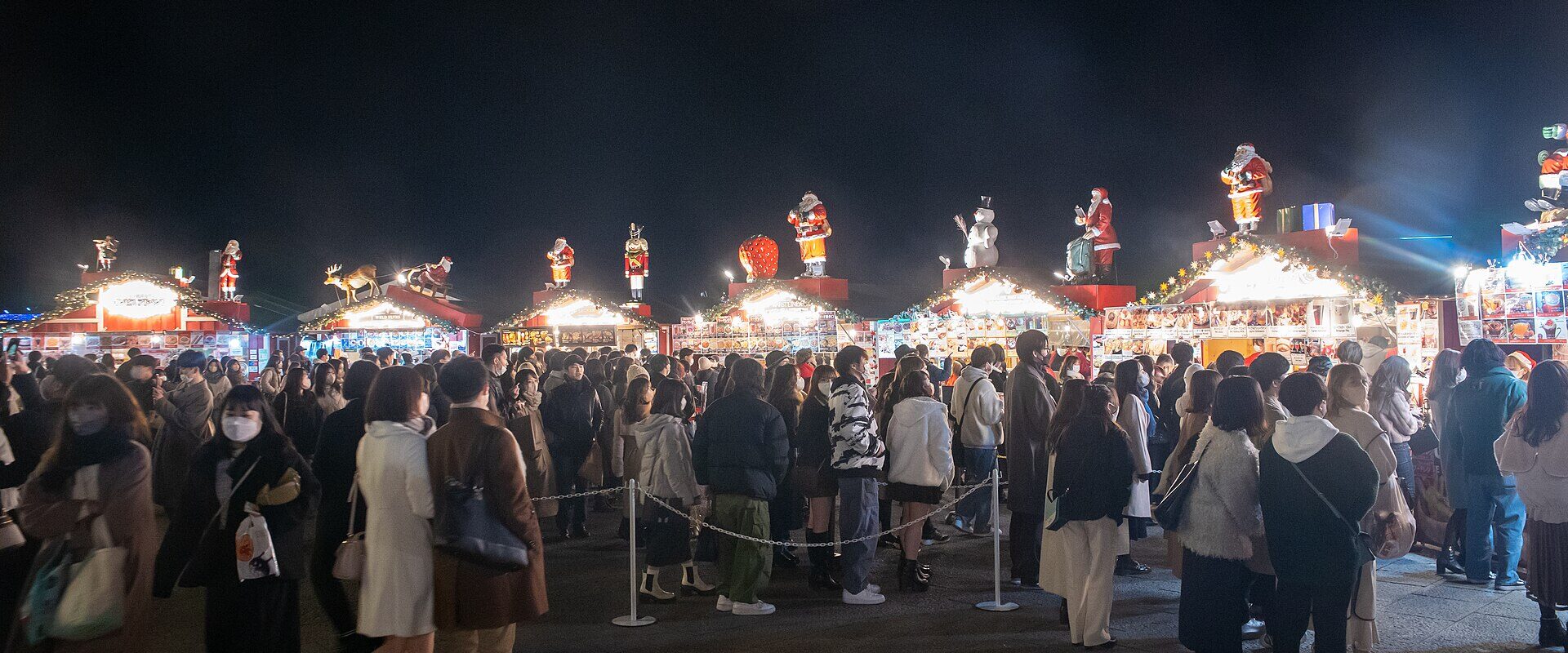
German-style Christmas markets have multiplied across Tokyo and the surrounding cities over the last fifteen years. They are smaller than European ones, considerably better organised, and — a Japanese innovation that will annoy some visitors — several now charge admission.
| Market | Where | Typical run | Notes |
|---|---|---|---|
| Roppongi Hills Christmas Market | Keyakizaka, Roppongi | Late Nov to 25 Dec | Free to enter; pairs with the illumination |
| Tokyo Christmas Market, Hibiya Park | Hibiya | Mid to late Dec | Ticketed in recent years; check before going |
| Yokohama Red Brick Warehouse | Minato Mirai, Yokohama | Late Nov to 25 Dec | The biggest and best; ticketed |
| Solamachi, Tokyo Skytree | Oshiage | Nov to 25 Dec | Free, small, good with children |
| Yebisu Garden Place | Ebisu | Nov to Dec | Free; combine with the chandelier |
The Yokohama Red Brick Warehouse market is the one worth travelling for. It sits on the waterfront at Minato Mirai, runs a proper hut layout around a tall tree, and has the scale the Tokyo ones lack. It is about 30 minutes from Shibuya on the Tokyu Toyoko line plus a walk, and our Yokohama day trip guide covers what else to do there while you are over.
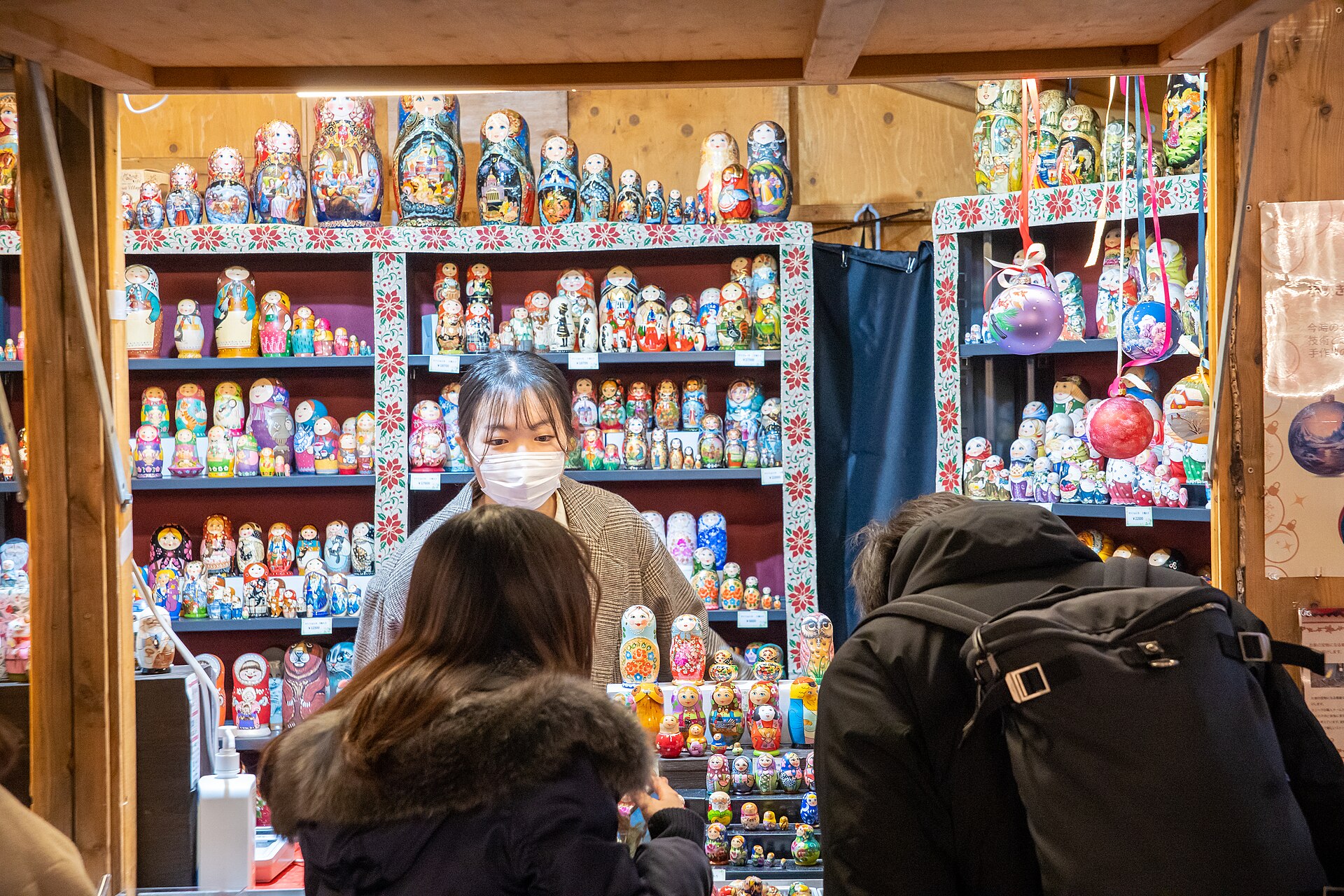
The honest caveat: mulled wine at ¥1,000 a cup and a sausage at ¥900 is not a bargain, and the ticketed markets ask for entry on top. Go for the atmosphere and the craft stalls, eat somewhere else.
The free alternative
Every major illumination site in Tokyo puts stalls out, and those are free to walk through. Roppongi Hills and Tokyo Midtown between them cover the whole Keyakizaka slope, and you get the best illumination in the city thrown in — our Tokyo illuminations guide maps the evening.

The food: chicken, cake and a reservation problem
KFC, and why it is not a joke
Fried chicken at Christmas is a genuine national tradition, observed by millions of families, and it exists because of a 1970s marketing campaign that landed at exactly the right moment. Party barrels go on pre-order from about the start of November. If you want one on 24 or 25 December you order in advance; if you do not, expect a queue of forty-five minutes or more at any branch, and quite possibly a sold-out sign by early evening.
Prices for the seasonal barrels start at around ¥5,000 and climb with the size of the set. Is it good? It is KFC. The point is not the chicken — it is that a foreign fast-food chain successfully became a national Christmas ritual, and watching it happen from the inside is more interesting than most things you could do that evening.
Christmas cake
A white sponge with whipped cream and strawberries, sold by every bakery, patisserie, supermarket and convenience store in the country. Reservations open in November; a whole cake typically runs ¥3,000 to ¥6,000, and the department store patisserie versions go considerably higher.
The move, if you are not committed to a whole cake, is a single slice from a depachika food hall — the basement levels of Isetan Shinjuku, Mitsukoshi Nihombashi or Takashimaya, where the best patissiers in Tokyo have counters. Expect ¥700 to ¥1,200 a slice for something significantly better than the supermarket version.
There is also a well-known end-of-day phenomenon: unsold whole cakes get marked down sharply on the evening of the 25th, and by the 26th the entire category has vanished from shelves as though it never existed.
Booking a restaurant on 24 December
This is the single practical thing that catches visitors out. Christmas Eve is the most heavily booked restaurant night of the Japanese year. Good places release Christmas seatings in October and November, many run a fixed course at a premium price, and walk-ins at anywhere decent are close to impossible.
- If you want a special dinner on the 24th, book by early November. Hotel restaurants and the Michelin-starred places go first.
- If you have not booked, eat on the 23rd or the 25th instead — both are dramatically easier and often cheaper.
- The good cheap option is an ordinary izakaya or a ramen counter, neither of which treats Christmas as an event. You will eat better for ¥2,000 than most people manage for ¥15,000 that night.
- Department store food halls sell restaurant-quality prepared food until about 20:00. A hotel room picnic on Christmas Eve is a legitimate and underrated plan.
Christmas Eve as a date night
Worth understanding because it drives the pricing. In Japan, 24 December is a couples’ occasion — dinner, illuminations, a gift, and frequently a hotel. Central Tokyo hotel rates on that one night sit at or near their annual peak, and the higher-end hotels sell packages built around it.
The practical implications for any visitor, romantic or otherwise:
- Book accommodation for 24 December early, or shift your dates. Our where to stay guide covers the neighbourhoods; Ikebukuro and Asakusa hold their prices better than Shibuya and Shinjuku.
- The illuminations are at maximum density on the 23rd and 24th. Go on a weekday earlier in the month.
- Everything is romantic-coded — the lighting, the music, the menus. If that is what you want, our Tokyo romantic itinerary is built for it. If it is not, aim at the 25th, which is oddly flat and calm.
Where to actually spend the evening
Beyond the markets and the booked dinner, a few places do Christmas properly enough to build an evening around.
- Marunouchi and Tokyo Station — the gold-lit boulevard, the floodlit red-brick station building, and the Kitte building’s atrium, which puts up one of the better indoor trees in the city. All free, all sheltered enough to survive a cold night, and considerably calmer than Roppongi.
- Ginza after dark — the department store windows on Chuo-dori are a genuine tradition, Mitsukoshi and Wako in particular. Twenty minutes of walking, no ticket, and the best-dressed street in Tokyo. See the Ginza guide.
- A hotel bar with a view — the high-floor bars in Shinjuku and Roppongi run Christmas cocktails at a premium, but the view is the same one people pay observation-deck money for. Expect ¥2,000 to ¥3,000 a drink plus a cover charge; our rooftop bars guide has the ones worth it.
- Odaiba — the bayside promenade, the replica Statue of Liberty and the Rainbow Bridge lit up, with far fewer people than central Tokyo on the 24th. The Odaiba guide covers getting there on the Yurikamome.
- Anywhere residential — Shimokitazawa, Koenji, Yanaka. Small bars, no Christmas pricing, and the pleasant discovery that most of Tokyo is not participating at all.
What it costs
| Version | Rough cost per person | What you get |
|---|---|---|
| Free evening | Train fare only | Illuminations, department store windows, market walk-through |
| Market plus street food | ¥2,500–4,000 | Ticketed market, mulled wine, a sausage, a souvenir mug |
| Depachika picnic | ¥2,000–3,500 | Genuinely excellent food, eaten somewhere warm |
| Booked Christmas Eve dinner | ¥12,000–30,000 | A fixed course, a view, and a table you reserved in October |
The gap between the free version and the expensive version is smaller than it looks, because the best single thing about Christmas in Tokyo — the illuminations — costs nothing at all.
Christmas with children
Better than you would expect, because the commercial version of Christmas is aimed squarely at families with young children during the day and couples at night.
- Tokyo Disney Resort runs a full Christmas season from early November to 25 December, with a dedicated parade and seasonal merchandise. It ends abruptly on Christmas Day and is replaced with New Year decoration within 48 hours. Passports run ¥9,400 to ¥10,900 by date — see our Tokyo Disney guide.
- Sanrio Puroland is indoors, warm, and much cheaper. Better for under-sixes and for a cold evening — the Puroland guide has the detail.
- Department store Santa events and grottos run through December, generally free or low cost, and are worth ten minutes if you are shopping anyway.
- The Skytree Solamachi market is small, free, and easy with a pushchair, which the Roppongi crowds are not.

For the wider family logistics — pushchair access, changing facilities, which stations to avoid at rush hour — the Tokyo with kids guide covers it.
Church services in English
If you want an actual Christmas service, Tokyo has several churches running them in English, and they are used to visitors. St. Alban’s Anglican-Episcopal Church near Kamiyacho and Tokyo Tower, the Franciscan Chapel Center in Roppongi and Tokyo Union Church on Omotesando all hold English-language Christmas services. Check each church’s own site in December for times, as midnight and Christmas morning services vary year to year and some require registration.
What is open on 25 December
Everything. This is the part visitors from Christian-majority countries find hardest to internalise: there is no shutdown, no reduced timetable, no closed museums. Offices work, schools have generally broken up for the winter but shops do not care, and the trains run a standard weekday service.
The shutdown comes four days later. From about 29 December to 3 January, Japan does close — museums, gardens, most independent restaurants — which is covered in detail in our guide to Tokyo in December. If your trip spans both, the calendar is: normal city until the 25th, transition on the 26th to 28th, shutdown and New Year from the 29th.
Gifts and shopping
Gift-giving at Christmas in Japan is mostly couple-to-couple and parent-to-young-child rather than the extended-family exchange common elsewhere. The heavier gift season is oseibo, the formal year-end present sent to bosses, clients and relatives, which is why department store food halls fill with boxed sets of ham, oil, fruit and soy sauce from the start of December.
Practically, this means there is no pre-Christmas discounting to speak of. Prices hold until the sales open on 1 or 2 January. If you are shopping for things to take home, our Tokyo souvenirs guide and the tax-free shopping rules will save you more than any seasonal sale.
A Christmas plan that works
- 22 or 23 December: the Roppongi illuminations and market on a weekday evening, before the crush. Dinner booked, or an izakaya.
- 24 December, daytime: Yokohama for the Red Brick Warehouse market and the waterfront, back to Tokyo before dark.
- 24 December, evening: either the booked dinner, or a depachika picnic and a walk down Marunouchi Naka-dori, which is quieter than Roppongi and just as good.
- 25 December: treat it as an ordinary Tokyo day, because that is what it is. Museums are open and empty. Cake is discounted by evening.
- 26 December onward: switch modes entirely and start planning around New Year.
Is Christmas a reason to come to Tokyo?
Not on its own. If you are choosing between late December and early December, early December wins on price, crowds and calm, with the same illuminations. Christmas itself adds a market or two, a KFC queue and a very expensive Tuesday night.
What it does do is make an already good month more interesting. Tokyo’s Christmas is a genuine cultural curiosity — a wholly imported festival rebuilt around romance and fried chicken — and being in the middle of it is more memorable than another temple. If your dates land there anyway, lean into it.
The thing actually worth timing a trip for is the week after: New Year in Japan is one of the great travel experiences, and it starts the moment the Christmas trees come down. For the rest of the season, see the Tokyo winter guide.
Frequently Asked Questions
Is Christmas a public holiday in Japan?
No. 25 December is a normal working day — offices open, trains run a standard weekday timetable, and shops, museums and restaurants all trade as usual. 23 December is no longer a holiday either; it moved to 23 February with the change of emperor. The national shutdown happens at New Year instead, from about 29 December to 3 January.
Why do Japanese people eat KFC at Christmas?
Because of a marketing campaign. KFC Japan launched a Christmas promotion in the 1970s that landed in a country with no existing Christmas food tradition, and it stuck. Party barrels are now pre-ordered from early November; without a reservation, expect a long queue on 24 and 25 December and possibly a sold-out branch.
Are there Christmas markets in Tokyo?
Yes, several German-style markets, though smaller than European ones and some now charging admission. Roppongi Hills, Yebisu Garden Place and Solamachi at Tokyo Skytree are free; Hibiya Park and the large Yokohama Red Brick Warehouse market have run ticketed in recent years. Yokohama’s is the biggest and the one worth travelling for.
Do I need to book a restaurant for Christmas Eve in Tokyo?
Yes, and early. Christmas Eve is the most heavily booked restaurant night of the Japanese year because it functions as a couples’ occasion. Good restaurants release Christmas seatings in October and November. If you have not booked, eat on the 23rd or 25th, or go to an ordinary izakaya or ramen counter, neither of which marks the occasion at all.
Is Tokyo expensive at Christmas?
On 24 December specifically, yes — central hotel rates peak that night and restaurants run premium fixed courses. The rest of the month is more reasonable, and the first ten days of December are among the cheapest of the winter. The illuminations, which are the main attraction, are almost all free.
Photo Credits
- The Christmas market at the Yokohama Red Brick Warehouse – Christmas Market in Yokohama Red Brick Warehouse 2022 (52646029847) by Dick Thomas Johnson from Tokyo, Japan, CC BY 2.0, via Wikimedia Commons.
- A craft stall at the Yokohama Christmas market – Christmas Market in Yokohama Red Brick Warehouse 2022 (52646021247) by Dick Thomas Johnson from Tokyo, Japan, CC BY 2.0, via Wikimedia Commons.