Tokyo Anime & Pop Culture · Guide №167
Nakano Broadway: Floor-by-Floor Through Tokyo’s Collector Maze
Four floors of Mandarake shops and the best second-hand anime stock in Japan, five minutes from Shinjuku. What each floor holds, what is worth buying, and what to skip.
目次 — Contents
- What the building actually is
- Getting there, and the five minutes you have to walk
- Floor by floor
- Mandarake without losing the afternoon
- What is actually worth buying here
- How it compares with the other otaku districts
- Eating, drinking and the rest of Nakano
- Practicalities
- How long to give it
- Frequently Asked Questions
- Photo Credits
This article contains advertising. Our booking links are routed through a partner that adds commission tracking automatically, so if you book through one we earn a commission from the provider, at no extra cost to you. It never affects what we recommend. Affiliate disclosure
Nakano Broadway is a scruffy 1966 shopping complex west of Shinjuku that has become one of Tokyo’s best-known destinations for collectors. Four floors of Mandarake branches, and a basement soft serve. Come for the 1970s robots, not for the new releases.
That distinction matters more than anything else in this guide. If you want a keychain from a series that started last month, Akihabara and Ikebukuro will serve you faster and cheaper. If you want the actual toy your Japanese counterpart owned in 1978, still in the box, priced by someone who knows exactly what it is worth — this is the building. It is a secondary market wearing the costume of a shopping mall, and the people browsing beside you are mostly Japanese men in their fifties, not tourists.

What the building actually is
It opened in 1966 as a luxury mixed-use development — shops below, apartments above. The retail podium was ordinary suburban stuff: clothes, watches, a supermarket. Then in 1980 a second-hand manga dealer called Mandarake opened here, did well, and kept expanding. Forty-odd years later the company operates a long run of specialist shops inside this one building, each a narrow glass-fronted cell devoted to a single category.
The result is a building with two personalities stacked on top of each other. The ground floor still sells shoes and handbags to local residents, while the floors above fill with collector shops. Nobody has bothered to reconcile the two, and the lack of reconciliation is the whole charm. There is no theming, no visitor centre, no attempt to make the place legible to outsiders. Signage is in Japanese. Corridors dead-end. You will get lost, and getting lost is how you find the good shops.
For the wider picture of where anime culture lives across the city — the museums, the cafés, the pilgrimage sites — start with our guide to anime in Tokyo. This page covers one building in detail.
Getting there, and the five minutes you have to walk
Nakano is on the JR Chuo Line and the Chuo-Sobu Line. From Shinjuku it is four to five minutes on a rapid service — genuinely the next stop westbound on the Chuo Rapid, which makes this one of the easiest side trips in the city. From Tokyo Station it is around twenty minutes direct. The Tokyo Metro Tozai Line also terminates at Nakano, which helps if you are staying near Otemachi or Kagurazaka. Fares are small enough that a pass makes no difference here; if you are weighing one up anyway, our subway pass comparison does the maths.
Leave by the north exit. Directly ahead is Sun Mall, a covered shopping arcade of drugstores, cheap restaurants and a Daiso. Walk its full length — about four minutes — and Nakano Broadway is the building at the far end, its entrance sitting square across the top of the arcade like a full stop. There is no ambiguity about arrival; the arcade physically runs into it.
If you exit south by mistake you will find a pleasant plaza, a cinema and no collector shops whatsoever. It is a common enough error that it is worth saying twice: north exit.
Floor by floor
Mandarake, which is to say the reason you came, opens its Nakano shops at 12:00 and closes at 20:00 daily. Independent units keep their own hours, so check a shop before you plan around it. Arrive well before midday and you may walk past rows of shutters wondering what the fuss was about. Midday onwards is the honest opening time.
B1 — food, daily goods, and the soft serve
The basement is a working local basement: a supermarket, cheap takeaway, a few counters. The reason visitors come down here is Daily Chico, a tiny stand selling an eight-flavour soft serve stacked into a single towering cone, somewhere between twenty and thirty centimetres tall. Vanilla, chocolate, matcha and ramune soda are the usual constants; the rest rotate. Read the board for the current price rather than trusting a figure you saw on Instagram.
It is a photograph more than a dessert. Eight flavours piped into one column means most of them taste of whichever one is melting fastest, and you have roughly four minutes before structural failure. Order one of the smaller sizes if you actually want to eat ice cream. Order the tokudai if you want the picture, and stand somewhere you do not mind dripping on.
1F — watches, cameras, and almost nothing you came for
Ground level is the old Nakano Broadway: luxury watch dealers, camera resellers, general reuse shops, a few clothing units. Sofmap Re Collection and Janpara both deal in used digital cameras and electronics, and if you are in the market for a second body at Japanese used prices they are worth twenty minutes. Otherwise, walk through. The escalators at the centre of the building are your friend.
2F — the main Mandarake cluster
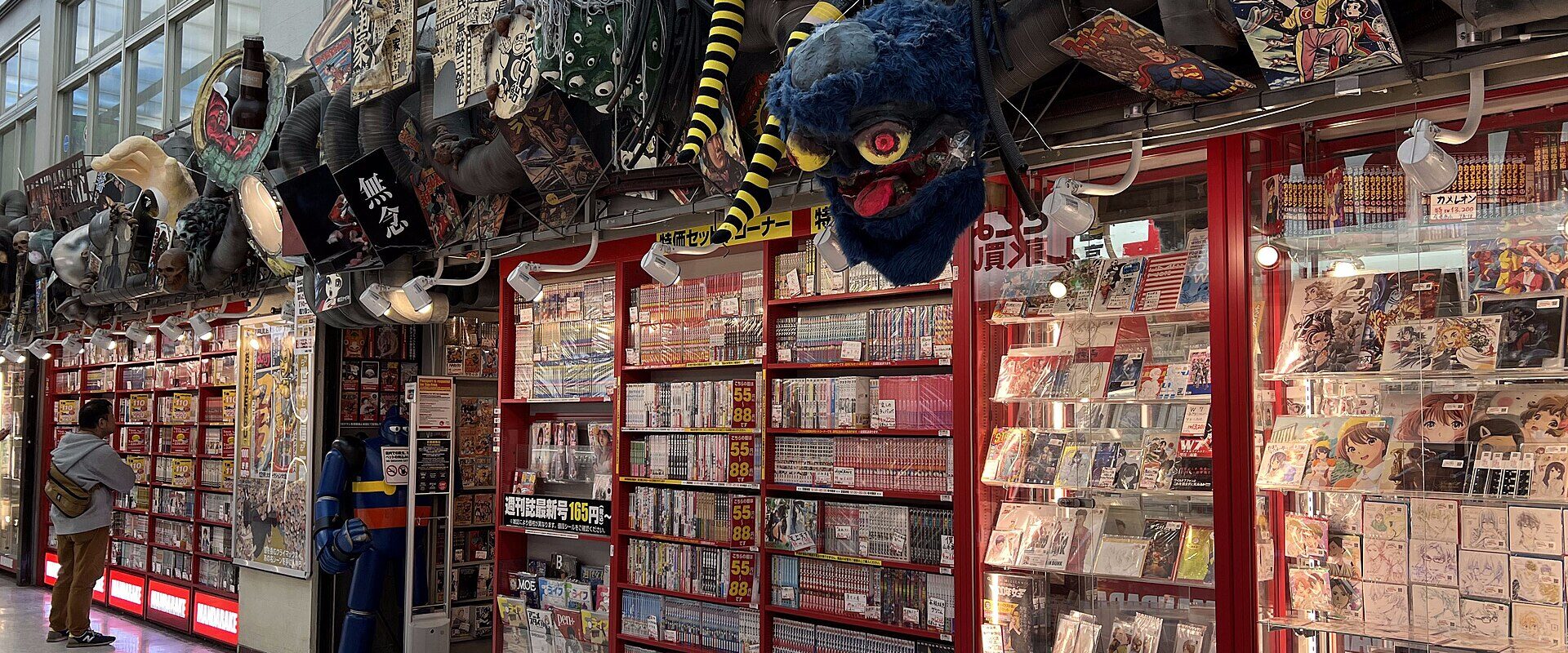
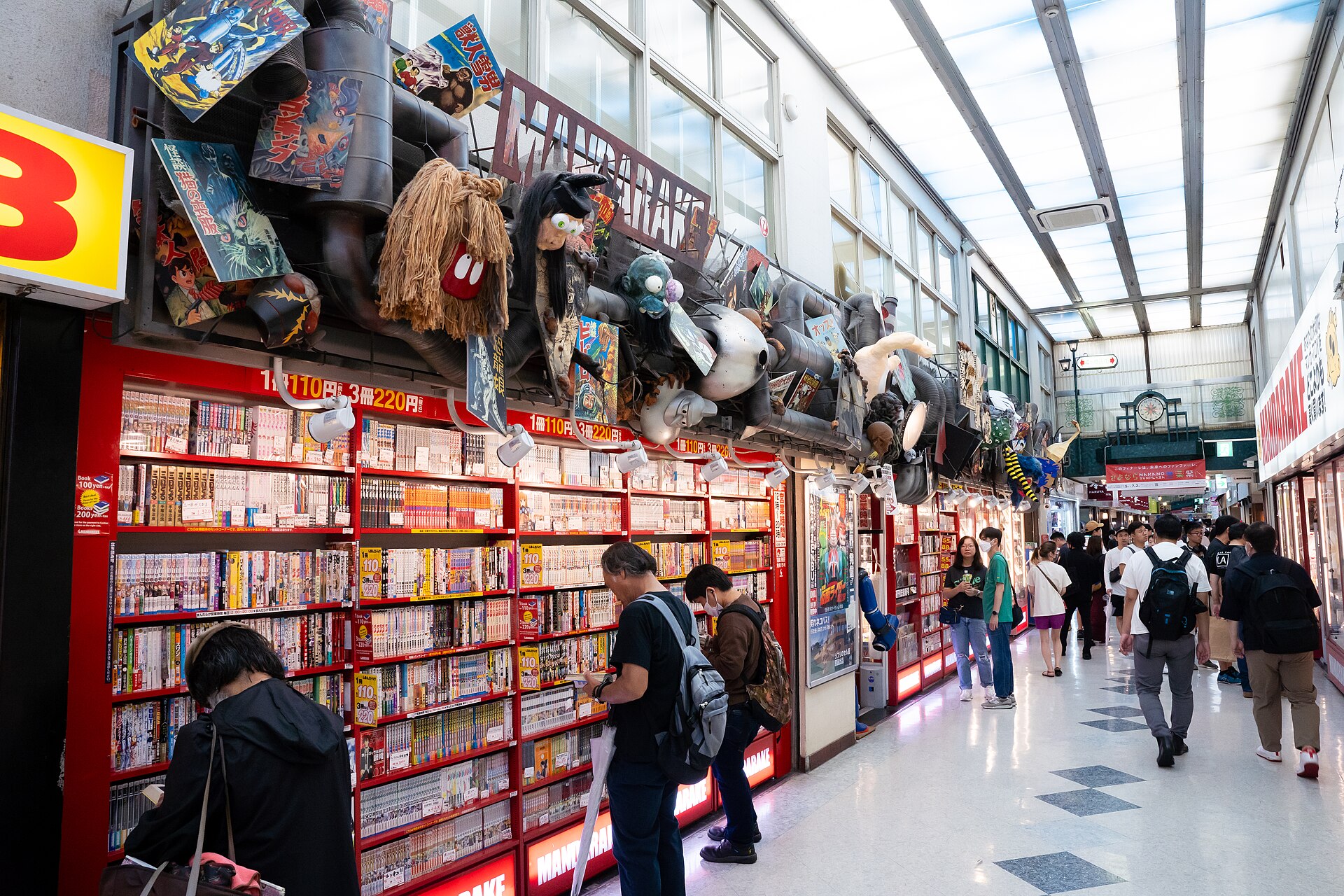
This is the floor that justifies the trip. Mandarake’s units here are split by genre rather than lumped together, so you pass from a shop selling nothing but trading cards to one selling nothing but idol photobooks to one selling nothing but Showa-era monster vinyl, in the space of thirty metres. The ceilings above the shopfronts are hung with masks, ducting, plastic limbs and vintage poster art — a permanent installation that makes the corridor feel like the inside of a toybox somebody dropped.
Mandarake Special Hall is the flagship of this floor: super alloy robots, monster vinyl, action figures, garage kits, classic plastic toys. Open 12:00 to 20:00 daily. The display cases are worth a slow walk even if you are buying nothing.
Also on this floor: Coffee Zingaro, the Kaikai Kiki café, which shows the artist Takashi Murakami’s work. Mushroom motifs, a Showa-kissaten aesthetic filtered through a contemporary art sensibility, and a queue at weekends. It is a legitimate stop rather than a novelty, and it sits comfortably alongside the older rooms in our kissaten guide.
3F — manga, books, and the watches nobody mentions
Mandarake’s main store sits here, dealing in out-of-print volumes, complete runs and the kind of thing that does not get reprinted. Alongside it, Family of Ra is the Mandarake affiliate aimed at the women’s market: shojo and BL manga, Takarazuka material, male idol goods, Korean idols, stage actors. It is a quieter, better-organised shop than most of the building and a useful alternative if you are not making it out to Ikebukuro.
The surprise on this floor is watches. Jack Road is a pre-owned watch dealer — Rolex among the stock, open 11:00 to 20:30, tax-free shopping available for eligible visitors — with a sister shop, Betty Road, for women’s watches. Two entirely separate hobbies sharing a corridor, neither acknowledging the other.
The cheap end of the manga trade is also here and on the floor below: bins of used volumes, with promotional racks among them. If you read Japanese even slightly, this is where to look for value.
4F — figures, dolls, and the deep end
Fourth floor is where it gets genuinely obscure. Vintage figures, ball-jointed dolls, doujinshi, cels, model kits, militaria, a shop dealing in nothing but idol memorabilia from a specific decade. Independent units keep their own hours, so check before you climb. It is also where you are most likely to find the thing you did not know existed.

Mandarake without losing the afternoon
Mandarake’s shops are too many to browse randomly. They are genre-sorted, so decide what you are looking for before you go in and head for that category. Rough guide to what lives where:
| If you want | Go to | Typical price | Worth the time? |
|---|---|---|---|
| Used manga volumes, Japanese | 2F/3F bin shops | ¥110–220 each | Yes — unbeatable |
| Out-of-print or complete runs | Mandarake main store, 3F | ¥2,000–30,000 a set | Yes, if you read Japanese |
| Showa robots, vinyl monsters | Special Hall, 2F | ¥5,000–500,000+ | Yes, even just to look |
| Modern anime figures, sealed | 2F and 4F figure units | ¥3,000–20,000 | Only if discontinued |
| Shojo, BL, idols, Takarazuka | Family of Ra, 3F | ¥300–5,000 | Yes |
| Trading cards | 2F card unit | ¥100–100,000+ | Graded stock is serious |
| Doujinshi and cels | 4F | ¥500–50,000 | Specialist only |
| Pre-owned luxury watches | Jack Road / Betty Road, 3F | ¥100,000–3,000,000 | A different hobby entirely |
Two mechanical things to know. Prices are fixed and haggling is not done — this is not a flea market. And condition grading is taken seriously: a boxed figure with its original inserts can be five to ten times the price of the same figure loose, and the tags will tell you which you are holding if you can read the kanji for “box” and “unopened”. If you cannot, ask; staff are used to it, and the counter staff at the bigger units generally manage enough English to handle a transaction.
What is actually worth buying here
Honest verdict time. This is not a cheap place to buy current-release merchandise, and several categories of shopper should skip it entirely.
- Worth it: anything discontinued. Figures from series that finished five years ago, out-of-print art books, Showa-era tin and vinyl toys, obscure doujinshi, cels from productions that predate digital animation. Mandarake’s buying network means stock here that you will not see anywhere else in the country.
- Worth it: used manga. Even as a souvenir for someone who cannot read it, a stack of volumes is an inexpensive, properly Japanese thing to carry home.
- Not worth it: new figures of current shows. Retail price or close to it, and often less selection than a single Animate floor. That is general character-goods shopping, and it is better done elsewhere.
- Not worth it: generic “Japan” souvenirs. There is a Daiso in the arcade outside and it will do the job for a tenth of the price. Our souvenir guide covers this properly.
- Depends: trading cards. Sealed modern product is priced to market and you are not going to beat a card shop in your own city by much. Vintage graded singles are a different matter.
It helps to understand where the stock comes from. Mandarake buys from the public across counters all over Japan, grades what it takes in, and prices to the collector market rather than to a catalogue. That means two things for you: the price on the tag is researched rather than arbitrary, and identical items in two different units of the same building can carry different prices because they were graded by different people on different days. Comparing before you commit is normal behaviour here, not rudeness.
The trap to avoid is buying something mid-range because you feel you should buy something. A ¥6,000 figure you half-wanted takes up the same suitcase space as the ¥600 of manga you actually enjoyed choosing.
How it compares with the other otaku districts
People treat these as interchangeable. They are not, and picking the wrong one for what you want wastes a half-day.
| Nakano Broadway | Akihabara | Ikebukuro | |
|---|---|---|---|
| Strength | Second-hand, vintage, collector | New release, electronics, arcades | Female fandom, doujinshi, idols |
| Scale | One building, four floors | A whole district | A few streets plus Sunshine City |
| Time needed | 2–4 hours | Half a day minimum | 3–5 hours |
| Crowds | Moderate, mostly Japanese | Heavy, heavily touristed | Moderate |
| English support | Patchy | Good | Patchy |
| Suits | Collectors, bargain hunters | First-timers, gamers | Shojo, BL and idol fans |
The practical answer for most visitors: do Akihabara first because it is the more complete district experience, and come out here on a second trip or a spare afternoon when you know what you are hunting. If your interest is specifically old toys, invert that — Akihabara will disappoint you and this building will not. The arcade floors are also thinner here than in Akihabara, so if you want game centres, our arcade guide points you east.

Eating, drinking and the rest of Nakano
Do not eat inside the building unless you want the soft serve. Sun Mall and the lanes off it do much better — this is a student and commuter neighbourhood with the eating options to match, at prices that make central Tokyo look silly.
Aoba, a few steps from the building, is the local ramen institution: a Nakano original serving a double-soup chuka soba that blends pork bone and fish stock, and the shop widely credited with popularising that style. Expect a short queue at lunch. Beyond that, the lanes north and east of the arcade hold one of the better concentrations of tiny izakaya in west Tokyo, several with four seats and a proprietor who has been there thirty years — the kind of room our izakaya guide exists for.
The neighbourhood also runs a strong second-hand clothing scene, which pairs naturally with the building. If that appeals, our vintage shopping guide maps where Nakano sits relative to Shimokitazawa and Koenji, both a few minutes away on the same lines.
Practicalities
Money
Mandarake takes cards. Many of the small independent units do not, or set a minimum. Carry ¥10,000–20,000 in cash if you intend to shop seriously, and more if you are looking at anything vintage. Keep a stash of ¥100 coins for the capsule machines in the corridors, though some cost more per turn.
Tax-free
Until 31 October 2026 Mandarake operates tax-free at the till for qualifying purchases with a passport, as does Jack Road; from 1 November 2026 the system becomes a refund one, where you pay the tax-inclusive price and show the goods at customs on departure. Independent units generally do not. Bring your actual passport, not a photograph of it — a phone image will be refused. The mechanics, and how the rules changed, are in our tax-free shopping guide.
Getting purchases home
Mandarake ships internationally from the counter, which is the sane option for anything fragile or bulky. For a boxed vintage figure this is not really optional — airline baggage handling and 1970s cardboard are not compatible, and box condition is most of what you paid for.
Photography
Assume no. Most units prohibit photographing stock, sometimes firmly, because pricing is proprietary and resellers photograph inventory. Corridors are fine. Inside a shop, ask or do not.
How long to give it
A focused visit — you know what you want, you go to two or three units — is ninety minutes including the walk from the station. Allow three to four hours if you want to browse every floor properly, and expect the visual density to wear you out. Nobody does the whole building attentively in one go; regulars work one floor per visit.
A good half-day shape: arrive at Nakano around 12:30, walk the arcade, do 2F and 3F until roughly 15:00, Zingaro for coffee, 4F until you flag, then Aoba or an izakaya in the back lanes at 18:00. If you would rather bolt it onto something bigger, it slots neatly into a west Tokyo afternoon with Shimokitazawa, and it works as a rainy-day fallback — the whole thing is indoors, which our rainy day guide takes full advantage of.
Frequently Asked Questions
Is Nakano Broadway better than Akihabara?
Better for different things. Nakano Broadway is the stronger second-hand and vintage market — Showa-era toys, out-of-print manga, discontinued figures, collector-grade stock. Akihabara is the stronger district for new releases, electronics, arcades and general atmosphere, and it is far more set up for non-Japanese visitors. If you are in Tokyo once and have one afternoon, take Akihabara. If you are hunting something specific and old, come here.
What time does it open?
Mandarake’s Nakano shops open at 12:00 and close at 20:00 daily. Independent units keep their own hours, so check a shop before you go. Plan to arrive after midday; earlier than that and some of the shutters may still be down.
How do I get to Nakano Broadway from Shinjuku?
Take the JR Chuo Rapid Line westbound from Shinjuku to Nakano — four to five minutes, the first stop out of the station. Leave by the north exit, walk straight through the covered Sun Mall arcade for about four minutes, and the building sits at the end of it. The Tokyo Metro Tozai Line also terminates at Nakano.
Is it expensive?
It depends entirely on what you look at. Used manga is cheap and browsing costs nothing. Collector-grade vintage toys run into six figures in yen, and the pre-owned watch dealers on the third floor trade in millions. Current-release merchandise sits at roughly retail, which is the one category where you are better off shopping elsewhere.
Do the shops speak English?
Patchily. The larger Mandarake counters usually have someone who can complete a transaction in English, and tax-free paperwork is routine there. The small independent units on the third and fourth floors often have no English at all, and signage throughout the building is Japanese. A translation app and a willingness to point will get you through everything that matters.
Photo Credits
- Mandarake main store, Nakano Broadway – Mandarake Nakano main store 2024-04-11 by Asanagi, CC0, via Wikimedia Commons.
- Mandarake corridor and manga shelves – Nakano Broadway (53146685677) by Dick Thomas Johnson from Tokyo, Japan, CC BY 2.0, via Wikimedia Commons.