Meiji Jingu is Tokyo’s grandest Shinto shrine, hidden inside a 170-acre man-made forest a two-minute walk from the chaos of Harajuku. This Meiji Shrine Tokyo guide covers everything you need for a visit: the towering wooden torii gates, the wall of sake barrels, how to pray properly, the iris-filled Inner Garden, and exactly which station exit to use. Entry to the shrine itself is free, and you should set aside about 90 minutes.
What makes Meiji Jingu special is the contrast. You step off a Harajuku street packed with crepe stalls and teenagers, pass under a giant cypress gate, and within thirty seconds the city noise drops away. Gravel crunches underfoot, the canopy closes overhead, and you walk for ten quiet minutes through woodland before the shrine buildings even appear. It is one of the few places in central Tokyo where you can genuinely hear birdsong.
A shrine built to remember an emperor
Meiji Jingu enshrines the spirits of Emperor Meiji (1852–1912) and his wife, Empress Shoken. Emperor Meiji matters enormously to modern Japan: he reigned during the Meiji Restoration, the period when the country ended centuries of feudal isolation and transformed itself into a modern industrial nation in barely a generation. When he died in 1912, ordinary people wanted a permanent place to honor him, and the shrine was completed and dedicated in 1920.
The original buildings burned down in the air raids of 1945. What you see today is a faithful 1958 reconstruction, rebuilt with public donations after the war. So while the site feels ancient, the structures are younger than they look — a detail worth knowing when you stand in the courtyard. The architecture follows the clean, unpainted nagare-zukuri style: Japanese cypress, copper roofs that have weathered to soft green, and almost no decorative color. The restraint is the point.
Empress Shoken deserves more than a footnote. She was a champion of women’s education and modern welfare in Japan, and she co-founded the organisation that became the Japanese Red Cross Society. The fortune slips you can draw at Meiji Jingu — those gentle poems rather than ranked-luck predictions — are drawn from the thousands of waka poems the emperor and empress wrote, so her voice is literally part of the visitor experience. Enshrining the couple together, rather than the emperor alone, was a deliberate choice that reflected their partnership.
The forest that was planted by hand
The woodland you walk through is not natural. Before 1920 this was barren, boggy ground. To create a forest worthy of the shrine, the planners ran a nationwide campaign and roughly 100,000 trees of around 365 species were donated from every corner of Japan and planted by some 110,000 volunteers. The foresters deliberately designed it to become self-sustaining — a woodland that would regenerate on its own and eventually look like a primeval forest. A century on, it has done exactly that.
You don’t need to be a botanist to feel the effect. The temperature drops noticeably under the canopy in summer, and the sense of seclusion is total even though Shibuya is fifteen minutes’ walk south. Stay on the wide gravel paths; the deeper woodland is protected and off-limits, which is part of why the wildlife has thrived.
The giant torii gates
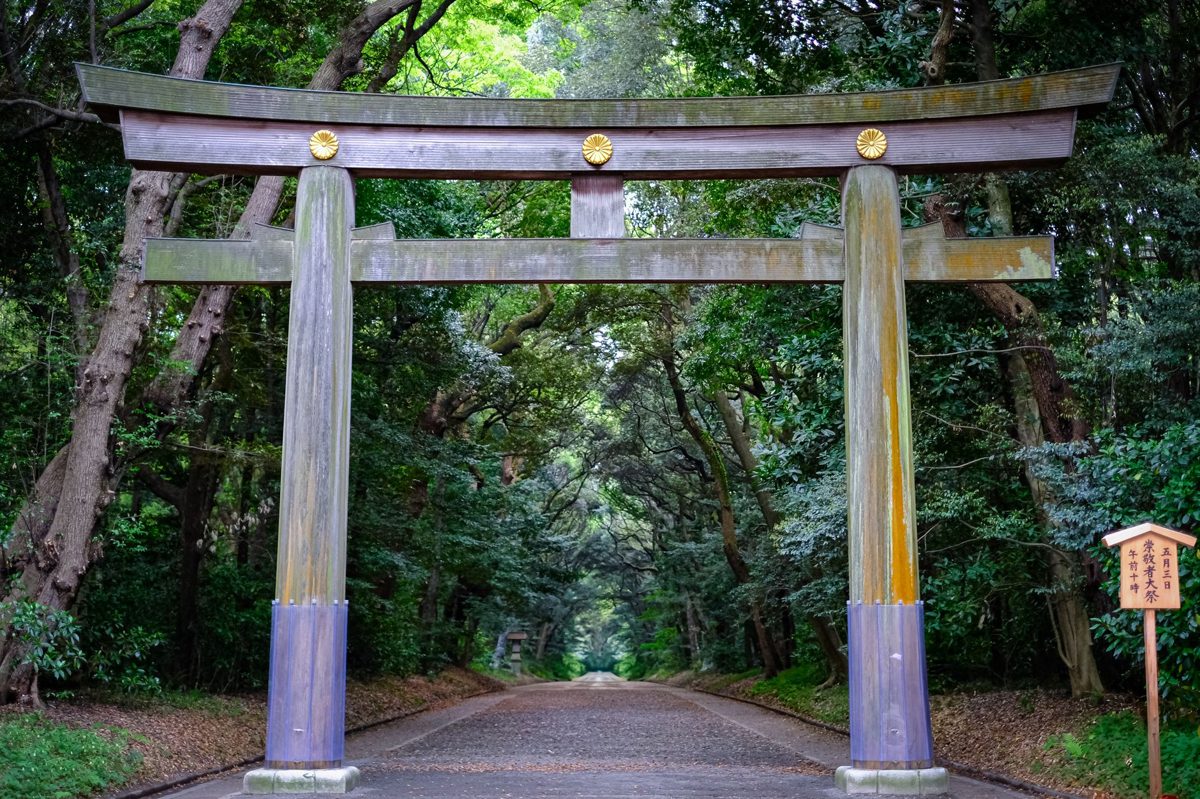
Two enormous wooden torii gates frame the approach, and they are among the largest of their kind in Japan. The grand torii near the southern entrance stands about 12 metres tall with pillars over a metre thick, built from 1,500-year-old Japanese cypress sourced from Taiwan. Pause under it. By tradition you bow once before passing through, and you walk slightly to the left or right rather than straight down the centre — the middle of the path is reserved for the kami (the deity).
Each torii marks a threshold between the everyday world and sacred ground. There are several along the route, so by the time you reach the shrine buildings you have passed through three of them, each one taking you a little further from the city.
The wall of sake and wine barrels
Halfway along the main path you reach two of the most photographed spots at Meiji Jingu. On one side sits a wall of brightly wrapped sake barrels — around 200 decorative casks (kazaridaru) donated each year by sake brewers from across Japan as an offering to the enshrined spirits. They are empty display barrels, but the colour and the calligraphy make a striking photo.
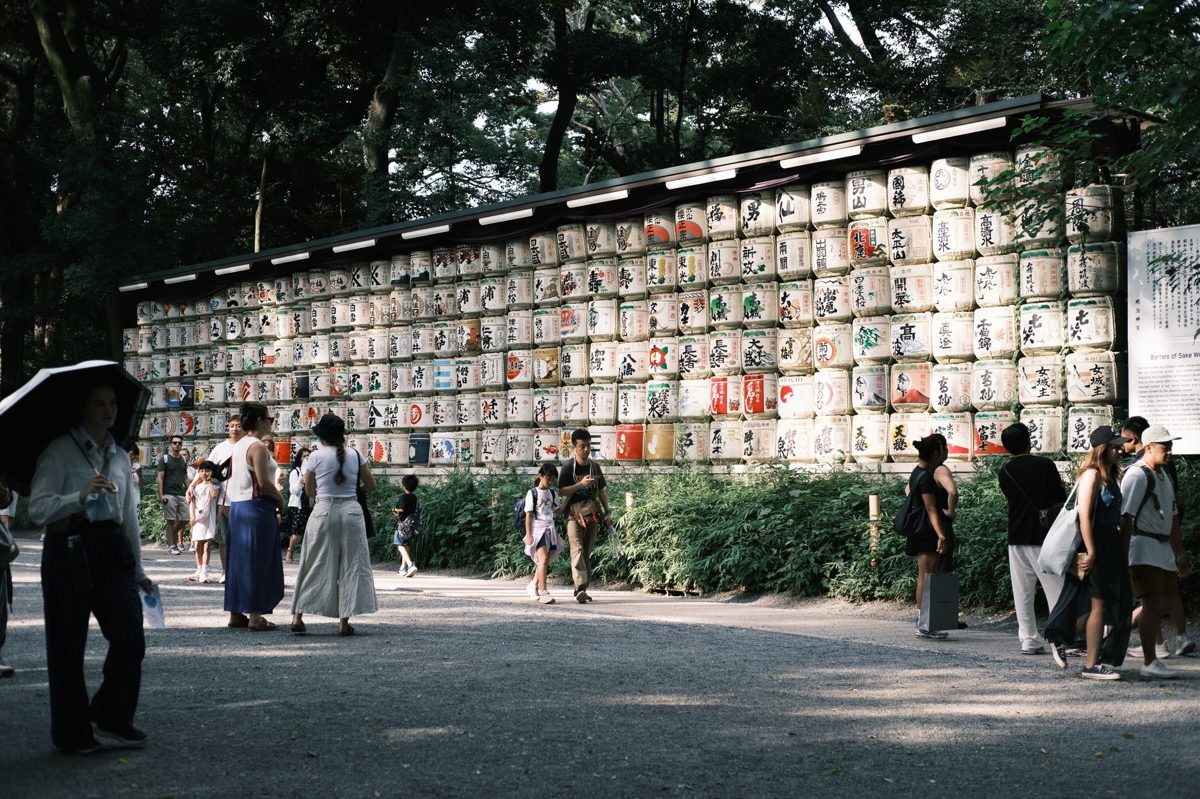
Directly opposite, and far less expected, is a wall of French wine barrels from the Burgundy region. This one surprises people, but it ties back to the emperor himself: Emperor Meiji embraced aspects of Western culture during his reign and was known to enjoy wine, so Burgundy winemakers donate barrels in his honour. The two walls facing each other — Japanese sake and French wine — sum up the whole Meiji era in a single glance.
The main shrine and how to pray properly
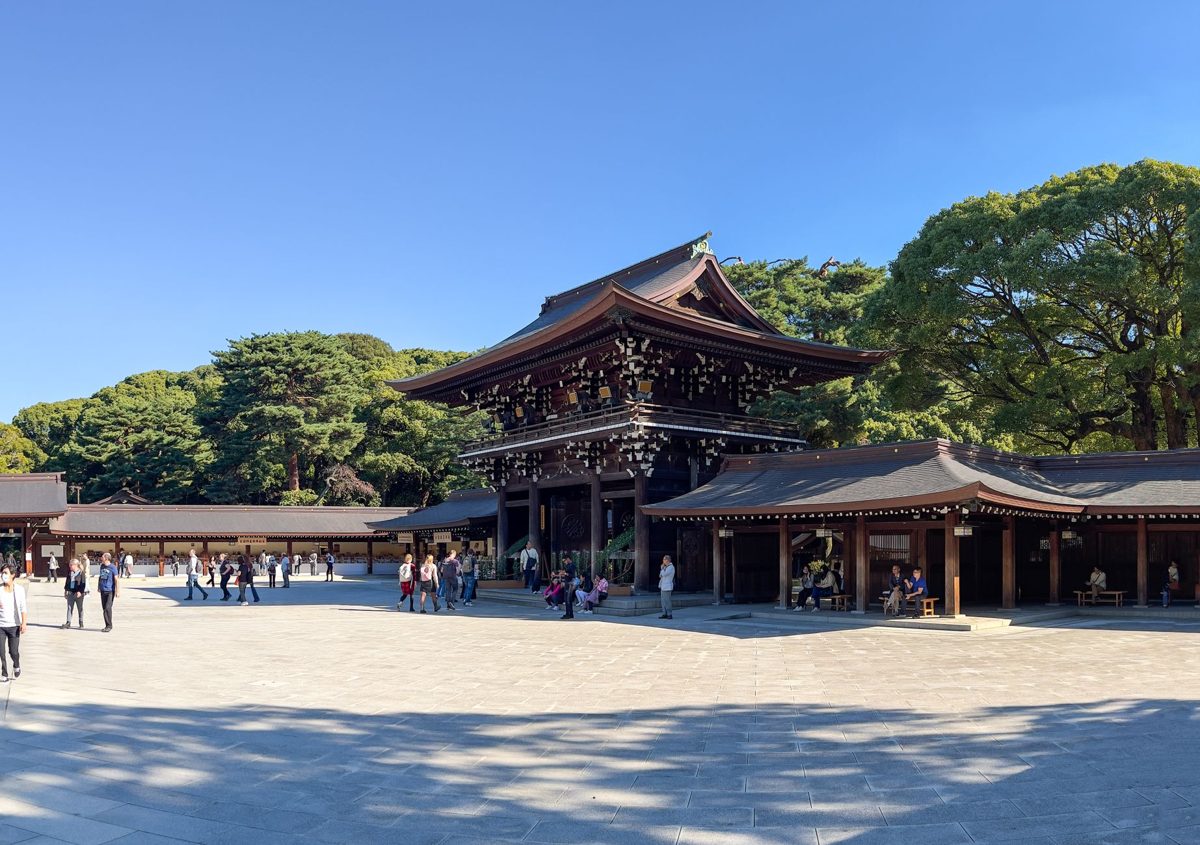
Pass through the final gate and you emerge into a wide, gravelled courtyard surrounded by the main shrine buildings. This is where you make your offering and pray. The ritual is simple, and following it shows respect even if you aren’t religious.
The five-step bow-bow-clap-clap-bow
- Toss a coin into the offering box. A 5-yen coin (go-en) is traditional because the word is a homophone for “good fortune,” but any coin is fine.
- Bow deeply twice, from the waist.
- Clap your hands twice at chest height.
- Keep your hands together and hold a quiet moment of prayer or gratitude.
- Bow deeply once more to finish.
That sequence — bow, bow, clap, clap, bow — is the standard Shinto form. Before you even reach the courtyard, you’ll pass a temizuya water pavilion: scoop water with the ladle, rinse your left hand, then your right, then pour a little into a cupped hand to rinse your mouth, and finally let water run down the handle. It purifies you before you approach the deity. If shrine ritual is new to you, our wider shrine etiquette guide walks through every step in detail.
Ema, omamori and fortune slips
Near the worship hall you’ll find a counter selling charms and a tree hung with hundreds of small wooden plaques. These are part of the everyday life of the shrine, and you’re welcome to take part.
Ema — wishing plaques
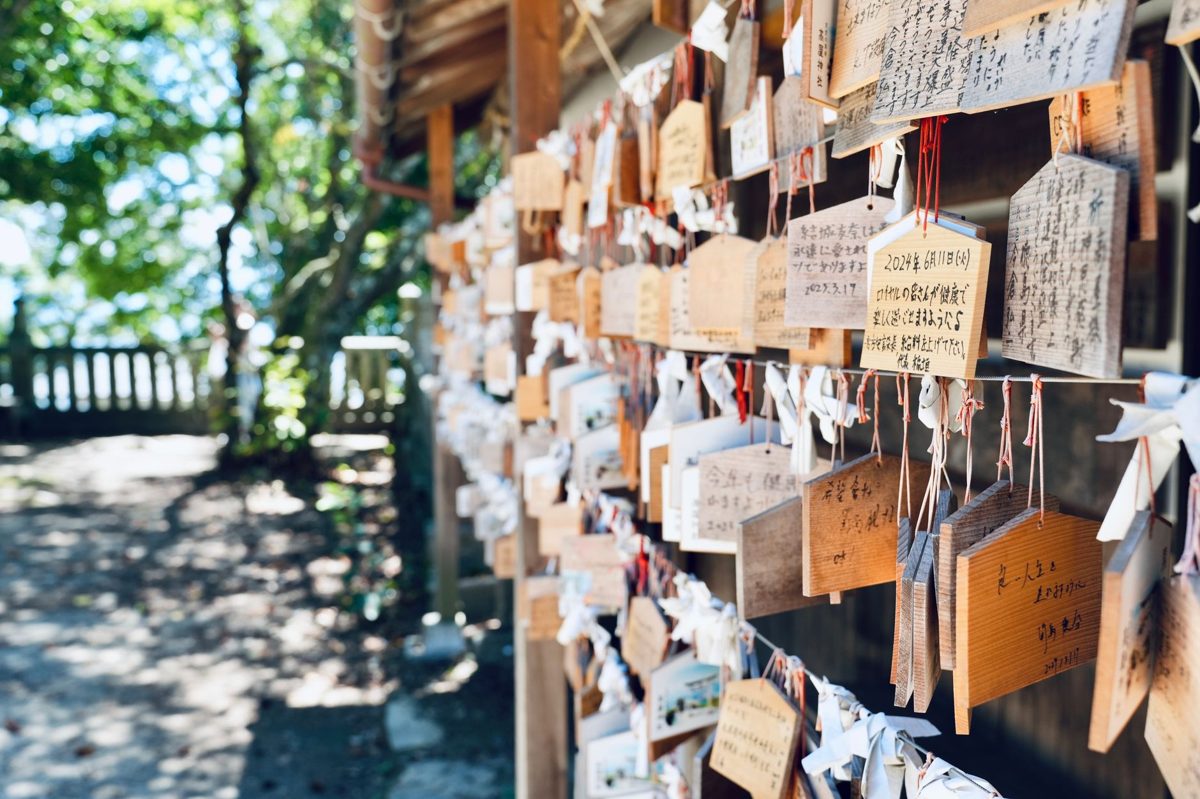
An ema is a small wooden plaque (a few hundred yen) on which you write a wish or prayer — health, success in exams, a safe pregnancy, world peace — then hang it on the rack near the sacred camphor trees so the kami can receive it. At Meiji Jingu the racks fill with messages in dozens of languages, which tells you how international the shrine has become.
Omamori — protective amulets
Omamori are small embroidered fabric charms, usually 800–1,000 yen, each one aimed at a specific need: traffic safety, good health, success in study, luck in love, safe childbirth, business prosperity. They make a meaningful souvenir, and the custom is to carry one for a year and then return it to a shrine to be respectfully retired. You can also draw an omikuji fortune slip; at Meiji Jingu these take the gentle form of poems written by the emperor and empress rather than the usual ranked-luck format.
Traditional Shinto weddings

Meiji Jingu is one of the most popular places in Tokyo for a traditional Shinto wedding, and if you visit on a weekend morning there’s a good chance you’ll see one. A procession crosses the main courtyard led by a Shinto priest and shrine maidens (miko) in red-and-white robes, with the bride in a pure-white kimono and an elaborate tsunokakushi headdress, the groom in formal black, the couple often shaded by a large red parasol. It is dignified and unhurried.
You can watch and photograph the procession from a respectful distance — just don’t crowd the party or use flash. Weekends, especially auspicious dates in spring and autumn, are when you’re most likely to catch one.
The Inner Garden — irises in June
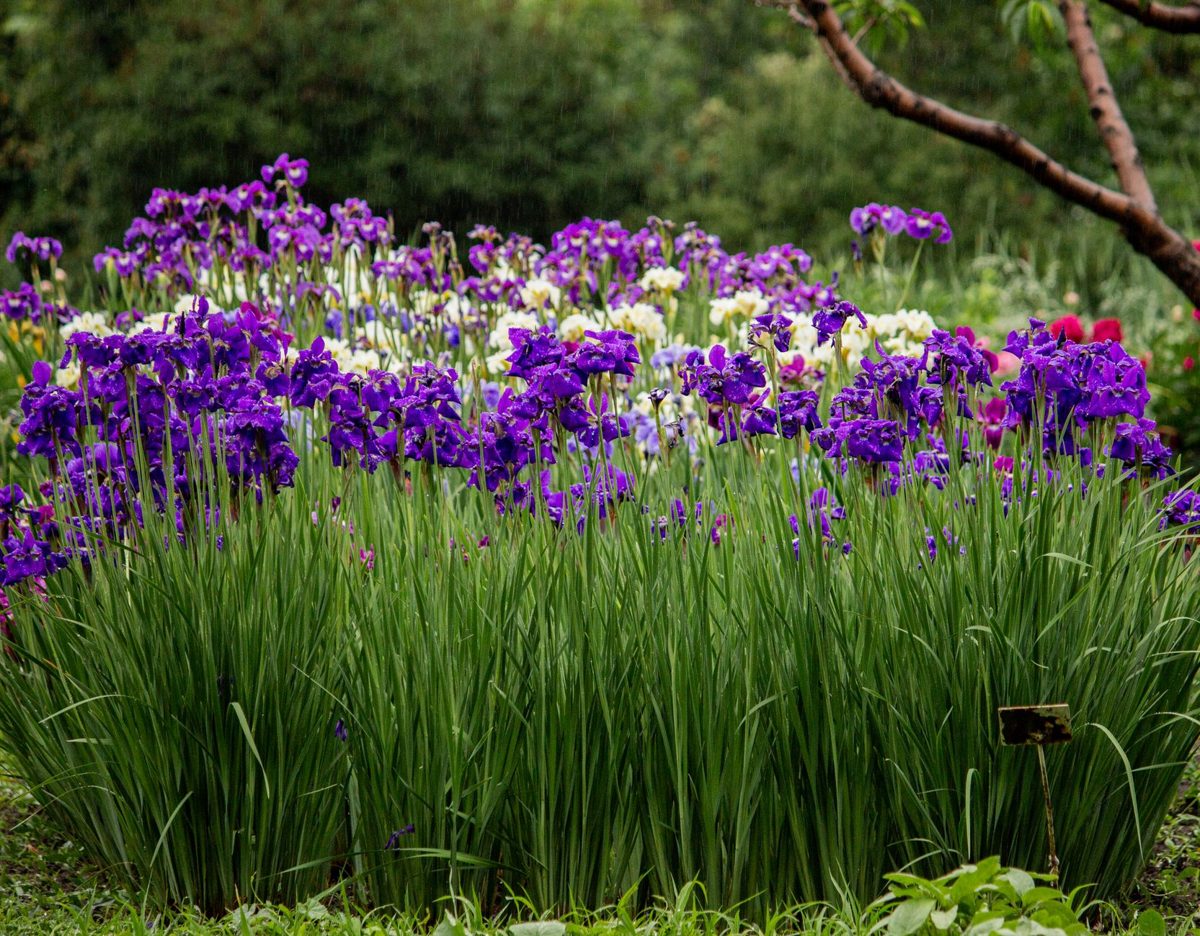
Tucked inside the forest is the Meiji Jingu Gyoen, or Inner Garden, the one part of the precinct with an entry fee: ¥500, open roughly 9:00–16:30 (last entry 16:00, with extended hours in peak iris season). It’s a strolling garden the emperor designed for the empress, and it’s worth the price if you have the time.
The highlight is the iris field. In mid-June around 1,500 irises of roughly 150 varieties bloom in waves of purple, white and blue along a marshy stream — one of the best iris displays in the city, and the single best reason to pay the entry fee. The garden also holds Kiyomasa’s Well, a clear spring that has become a quiet power spot, and azaleas earlier in spring and wisteria in late spring. Outside iris season the garden is peaceful but less spectacular, so save the ¥500 for June if depth of bloom is what you’re after.
Also on site is the Meiji Jingu Museum (around ¥1,000), a Kengo Kuma–designed building displaying personal items of the imperial couple, including the carriage the emperor rode to proclaim the constitution. It’s optional but architecturally lovely.
Getting there — which station and exit
Meiji Jingu has entrances on three sides, so the right station depends on which part you want to see first.
| Entrance | Nearest station | Best exit / notes |
|---|---|---|
| South (main) — grand torii | Harajuku (JR Yamanote) / Meiji-jingumae (Metro) | Omotesando exit at Harajuku; the entrance is right across the road. This is the classic approach. |
| North — quieter, near the wine barrels | Yoyogi (JR / Oedo) or Sangubashi (Odakyu) | Good if you want a calmer, less crowded walk in. |
| West — near the Inner Garden | Sangubashi (Odakyu Line) | Closest to the Gyoen iris garden. |
Most visitors arrive at Harajuku on the JR Yamanote Line (4 minutes from Shinjuku, 2 minutes from Shibuya) and use the Omotesando exit, or come up at Meiji-jingumae “Harajuku” on the Chiyoda and Fukutoshin subway lines. Both put you metres from the southern grand torii. The main paths are wide gravel and largely step-free, making the shrine fairly accessible for wheelchairs and strollers, though the gravel is slow going.
A suggested route through the grounds
Meiji Jingu rewards a slow, in-order walk rather than a dash to the main hall. Here’s the sequence most visitors find works best from the southern Harajuku entrance.
- The grand torii — pause, bow, and step under the 12-metre cypress gate that marks the boundary of sacred ground.
- The forest path — about a ten-minute walk on wide gravel through the planted woodland; the city noise fades almost immediately.
- The barrel walls — the sake casks on one side, the Burgundy wine barrels on the other, facing each other across the path.
- The temizuya — purify your hands and mouth here before going further.
- The main courtyard and worship hall — make your offering and pray; look for the two huge camphor trees joined by a sacred rope, a popular spot to pray for happy relationships.
- Ema rack and charm counter — write a wish or pick up an omamori.
- The Inner Garden (optional, ¥500) — detour here for the irises if it’s June, or for the calm of Kiyomasa’s Well any time.
Done unhurried, that loop takes around 90 minutes and brings you back out near where you started, ready to walk straight into Harajuku.
Hours, how long to spend, and the best time of day
The shrine grounds open at sunrise and close at sunset, so the gates move with the seasons — roughly 5:00 in midsummer to about 6:40 in midwinter for opening, and 16:00–18:30 for closing. Because hours change month to month, check the official site for your exact date. Entry to the shrine itself is always free.
Budget about 90 minutes for a relaxed visit: ten minutes’ walk in, time at the sake and wine barrels, the courtyard and prayer, the charm counter, and the walk back out. Add another 45 minutes if you go into the Inner Garden. The best time of day is early morning, soon after the gates open — the light filters beautifully through the canopy, the air is cool, and you may have long stretches of path almost to yourself before the tour groups arrive.
Combining Meiji Jingu with Harajuku and Yoyogi Park
The shrine sits perfectly between two very different neighbours, which makes for an easy half-day on foot. Step out of the southern entrance and you’re straight into Harajuku — Takeshita Street’s youth fashion and crepe stands one way, the tree-lined luxury boulevard of Omotesando the other. The contrast between a silent cypress forest and Tokyo’s loudest fashion district, separated by a single road, is one of the city’s great moments of whiplash.
On the western side, Meiji Jingu shares its woodland edge with Yoyogi Park, one of Tokyo’s largest green spaces and a brilliant spot to picnic, people-watch and, on Sundays, catch street performers and rockabilly dancers. A natural route is shrine first thing in the morning, then Yoyogi Park, then Harajuku and Omotesando for lunch and shopping — a full, walkable day with almost no train rides in between.
New Year hatsumode — the busiest days of the year
If you’re in Tokyo over New Year, know that Meiji Jingu hosts the country’s biggest hatsumode — the year’s first shrine visit. Around three million people pour through the grounds in the first three days of January to pray for the year ahead, making it the single most-visited shrine in Japan for the holiday.
It’s an extraordinary atmosphere, with food stalls, bonfires and a real sense of occasion — but be realistic about the crowds. On January 1 the queue to reach the offering hall can take an hour or more, and the grounds are managed in slow-moving columns. If you want the experience without the worst of the crush, go in the evening rather than at midnight, or wait until after January 3 when numbers drop sharply.
Meiji Jingu through the seasons
The shrine is open year-round and the free grounds look good in any weather, but a few moments stand out if you can time your visit.
| Season | What to look for |
|---|---|
| Early January | Hatsumode — three million visitors, food stalls and a festive buzz, but long queues. |
| Late April – May | Azaleas and wisteria in the Inner Garden; fresh green in the forest. |
| Mid-June | Peak irises in the Inner Garden — about 1,500 plants of roughly 150 varieties. The best reason to pay the ¥500. |
| November 3 | The autumn grand festival and the Meiji Jingu Aki no Taisai, with traditional performances; the autumn colour around the grounds peaks late November. |
Cherry blossom is not really a Meiji Jingu specialty — for that, neighbouring Yoyogi Park is the better bet — but the autumn ginkgo avenue just outside the precinct, on Icho Namiki near Aoyama, turns brilliant gold in late November and is an easy add-on.
Insider tips and what to skip
- Come at opening. The single biggest upgrade to a visit is arriving in the first hour, when the light is soft and the paths are nearly empty.
- Skip the Inner Garden outside June unless you specifically want the well or the quiet — the ¥500 buys far more in iris season than out of it.
- Use the north or west entrance if you want a calmer walk in; almost everyone uses the south gate from Harajuku.
- Draw an omikuji for the experience — at Meiji Jingu it’s a poem with a gentle message, a nice keepsake rather than a luck ranking.
- Bring a few ¥5 coins for offerings; you don’t need much, but it saves fumbling for change at the box.
- Don’t expect food or shops inside. Beyond charm counters and a small rest area there’s little; eat in Harajuku before or after.
Practical things worth knowing
There are coin lockers and clean restrooms near each entrance, and a small rest area with vending machines partway along the main path, but no proper café inside — plan to eat in Harajuku or Yoyogi. Photography is welcome across the grounds; the only no-go is the inner sanctuary itself. If it rains, the forest canopy keeps the worst off you and the gravel drains well, so a wet-weather visit is still pleasant and noticeably quieter. Tattoos, which can bar entry to some pools and gyms in Japan, are no issue at all here — shrines welcome everyone.
English signage is good throughout, the charm counter staff are used to international visitors, and you can pick up an English leaflet at the entrance with a map and the day’s opening times. If you only do one thing beyond praying at the main hall, draw an omikuji poem and read the gentle English translation on the back — it’s a small, lovely souvenir of the visit and costs barely a coin.
A few etiquette notes
- Bow once before passing under each torii, and avoid walking down the dead centre of the path.
- Purify your hands and mouth at the temizuya before approaching the worship hall.
- Photography is fine on the grounds, but not inside the inner sanctuary, and never of a wedding party at close range or with flash.
- Keep your voice down once you’re past the first gate — this is an active place of worship, not a museum.
- Dress is casual but tidy; there’s no strict code, but it’s a sacred site, so save the beachwear.
Meiji Jingu is one of the easiest places in Tokyo to experience living Shinto culture, and it pairs naturally with the city’s great Buddhist site. If you’re building a culture-focused itinerary, see how the two traditions compare in our overview of Tokyo’s temples and shrines, read the deep dive on the Senso-ji temple guide in Asakusa, and slot the shrine into a wider plan with our roundup of the best things to do in Tokyo.
Frequently Asked Questions
Is Meiji Shrine free to enter?
Yes. Entry to the main shrine grounds and the forest is completely free and open from sunrise to sunset. The only paid areas are the Inner Garden (¥500), famous for its June irises, and the Meiji Jingu Museum (around ¥1,000).
How long do you need at Meiji Jingu?
Plan for about 90 minutes for the forest walk, the torii gates, the sake and wine barrels, and prayer at the main shrine. Add roughly 45 minutes if you also visit the Inner Garden.
Which station is closest to Meiji Shrine?
Harajuku Station on the JR Yamanote Line (use the Omotesando exit) and Meiji-jingumae “Harajuku” on the Chiyoda and Fukutoshin subway lines both sit right by the southern grand torii. For the Inner Garden, Sangubashi on the Odakyu Line is closest.
How do you pray at Meiji Shrine?
Offer a coin, bow deeply twice, clap your hands twice, hold a quiet moment of prayer, then bow once more — the standard bow-bow-clap-clap-bow ritual. Purify your hands and mouth at the temizuya water pavilion first.
When is the best time to visit Meiji Shrine?
Early morning, just after the gates open, is best for cool air, soft light and the smallest crowds. Visit in mid-June if you want to catch the irises in the Inner Garden, and expect huge crowds during New Year hatsumode in early January.